Temples of India · Rameswaram
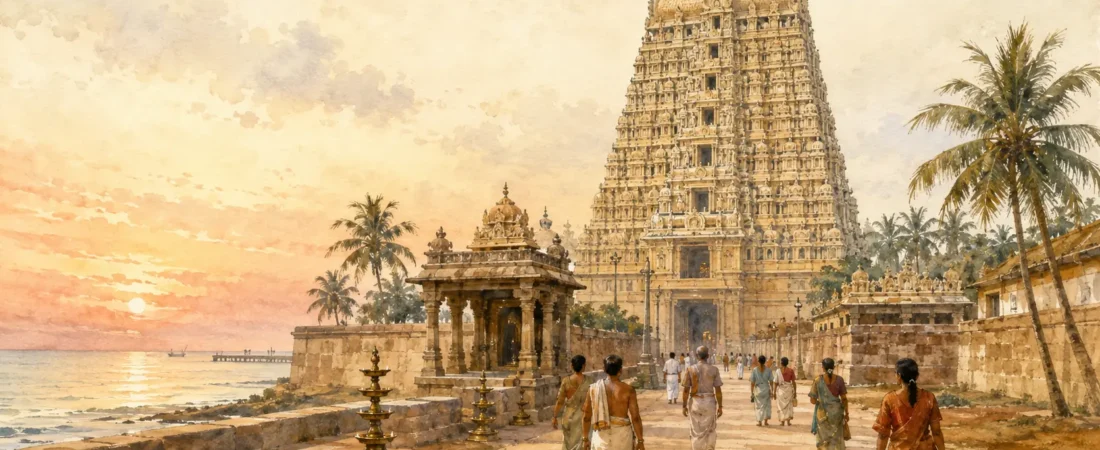
Before the shops lift their shutters, the sea is already awake at Rameswaram. Pilgrims gather near Agni Theertham, brass vessels catch the first light, and the eastern rajagopuram rises a short walk away. Some have travelled across India to complete a Char Dham journey. Others have come to bow before one of Shiva’s twelve sacred Jyotirlingas. Many carry both intentions in their hearts.
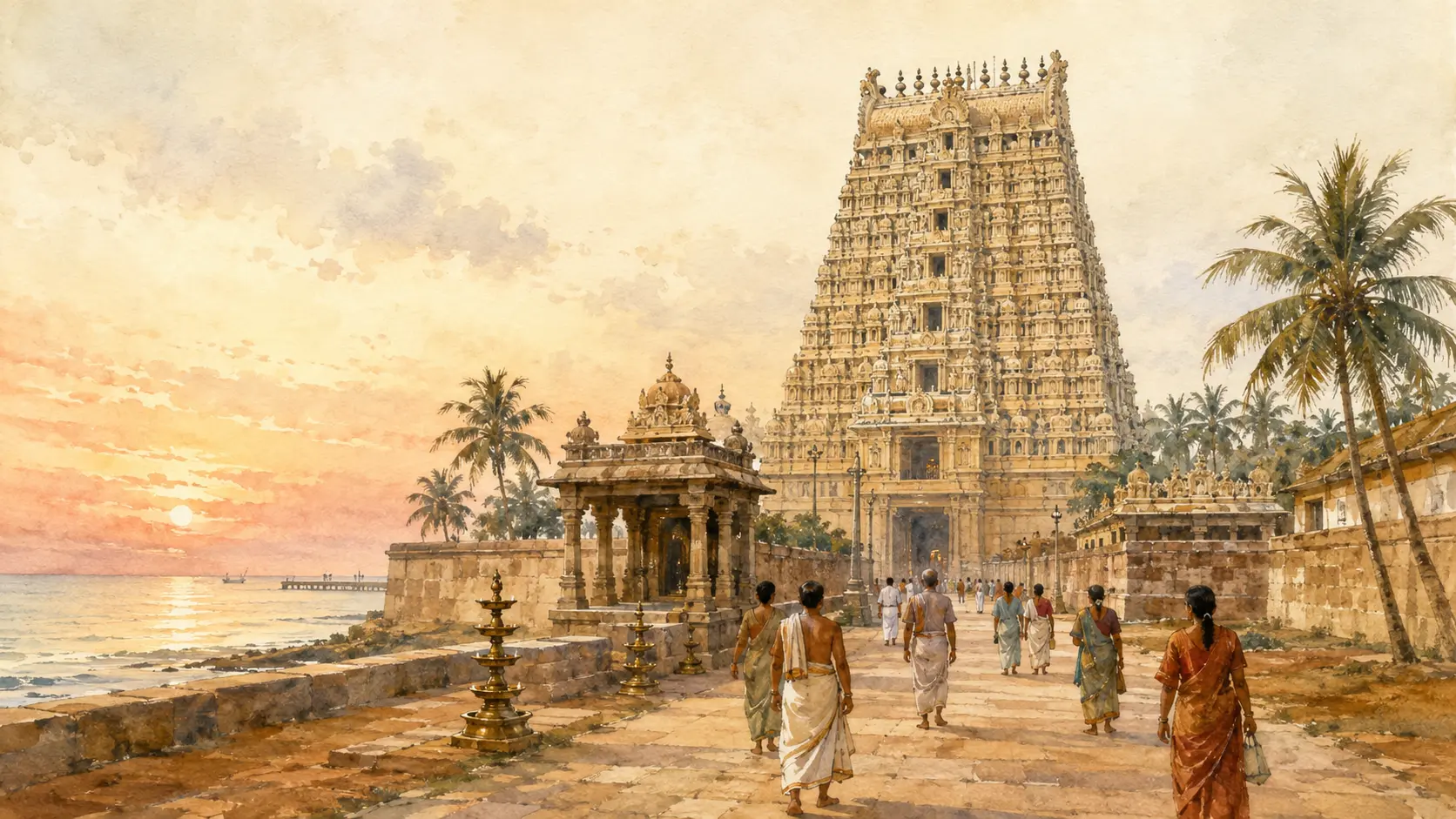
Sri Ramanathaswamy Temple is exceptional even within India’s vast sacred geography. Here, Rama, revered as an avatara of Vishnu, worships Shiva. A victorious king pauses for atonement and reflection. Water from the north is traditionally offered at a shrine beside the southern sea. Monumental corridors lead towards a small, dark sanctum.
This meeting of devotion, humility and sacred geography is the heart of Rameswaram.
The official spelling is Rameswaram. Rameshwaram is also widely used in English, and both refer to the same island town and temple. The presiding deity is worshipped as Ramanathaswamy or Ramanatha, “the Lord worshipped by Rama.”
On this page
- Rameswaram Ramanathaswamy Jyotirlinga in brief
- Why Rameswaram is both a Jyotirlinga and a Char Dham
- The Sthala Purana: Rama, Sita, Hanuman and the two lingas
- The spiritual significance of Ramanathaswamy Jyotirlinga
- A temple shaped across centuries
- Agni Theertham and the 22 sacred theerthams
- Ramanathaswamy Temple timings and worship
- Satvik and vegetarian food in Rameswaram
- Sacred and meaningful places near Ramanathaswamy Temple
- How to reach Rameswaram
- A practical two-day Rameswaram pilgrimage
- Frequently asked questions about Rameswaram Jyotirlinga
Rameswaram Ramanathaswamy Jyotirlinga in brief
| Pilgrimage detail | What to know |
|---|---|
| Main deity | Shiva as Sri Ramanathaswamy; Goddess Parvathavardhini is worshipped as his consort |
| Location | Rameswaram on Pamban Island, Ramanathapuram district, Tamil Nadu |
| Sacred importance | One of the twelve Jyotirlingas, the southern Char Dham, and a Tamil Paadal Petra Sthalam |
| Sacred lingas | Ramalinga, traditionally made by Sita from sand, and Vishwalinga, brought by Hanuman |
| Distinctive pilgrimage | Agni Theertham, 22 sacred temple theerthams, followed by darshan according to custom and ability |
| Architectural landmark | The celebrated long pillared corridors of the third prakara |
| Best duration | One full day for the temple; two days for a calmer island pilgrimage |
| Best weather | Generally November to February; festival periods are spiritually vibrant but crowded |
Why Rameswaram is both a Jyotirlinga and a Char Dham
The Jyotirlinga tradition remembers Shiva as jyoti, limitless divine radiance, worshipped through the linga. Across India, the twelve Jyotirlinga shrines create a sacred map of Shiva’s luminous presence. Rameswaram is the southernmost of these revered temples.
The pan-Indian Char Dham tradition joins Badrinath in the north, Dwarka in the west, Jagannath Puri in the east and Rameswaram in the south. Among these four, Rameswaram is centred on Shiva. Yet its founding tradition begins with Rama. That is why it cannot be reduced to a narrow Shaiva-versus-Vaishnava identity.
The Tamil Nadu Hindu Religious and Charitable Endowments Department describes Rameswaram as sacred to both Shaivas and Vaishnavas. The temple is also deeply rooted in Tamil Shaiva bhakti. Appar and Tirugnanasambandar praised the shrine, making it one of the Paadal Petra Sthalams. Later devotional figures, including Arunagirinathar, Tayumanavar and Muthuswami Dikshitar, also celebrated its sanctity.
Rameswaram therefore belongs simultaneously to pan-Indian pilgrimage, Tamil spiritual history, Ramayana memory and living coastal worship.
Read the wider Dwadasha Jyotirlingas introduction to place Ramanathaswamy within the complete sacred sequence. The preceding shrine in our series is Bhimashankar Jyotirlinga.
Continue through the four sacred directions with the Indian Ethos guides to Badrinath Dham, Dwarka and Jagannath Puri.
The Sthala Purana: Rama, Sita, Hanuman and the two lingas
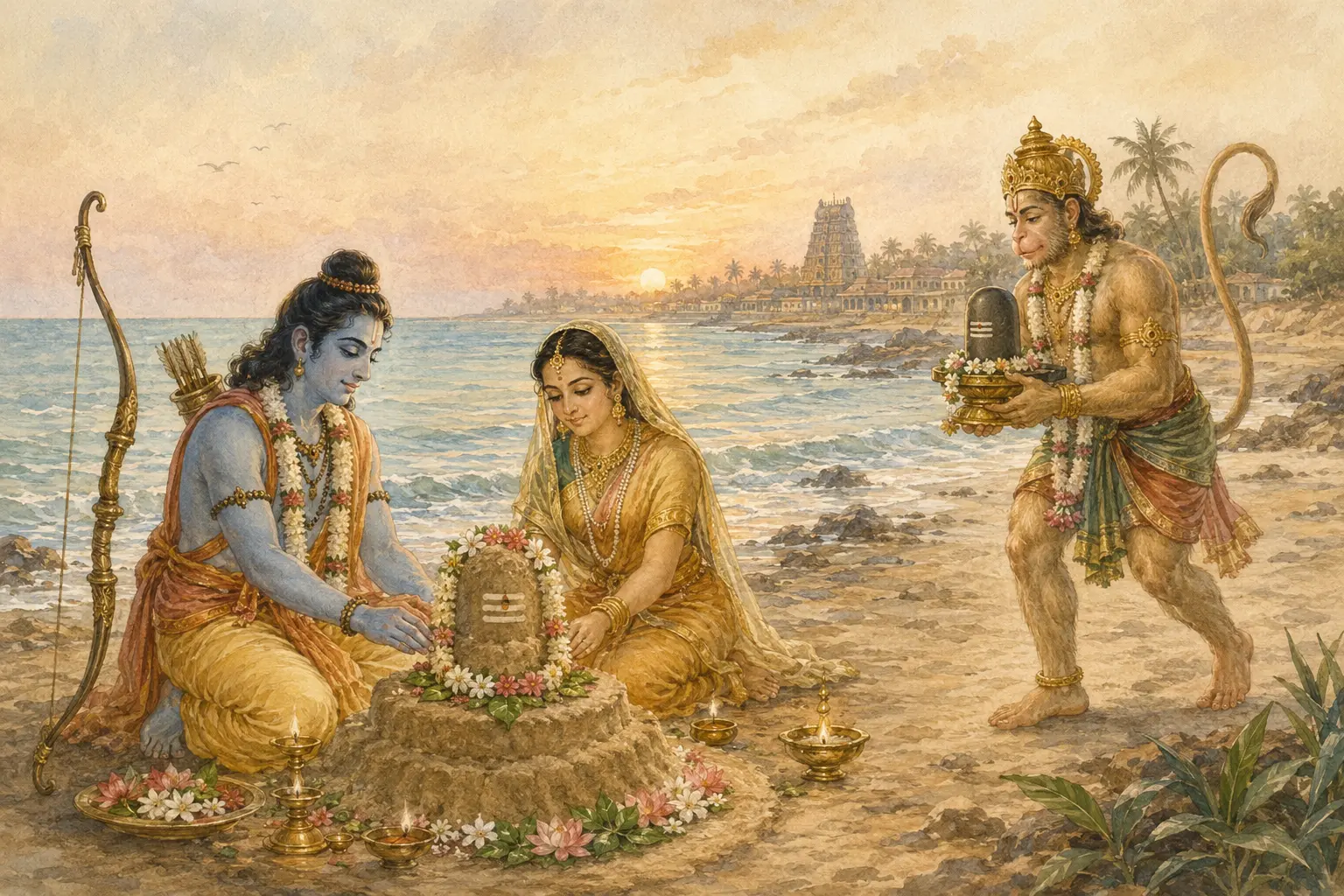
The temple’s best-known sacred account is associated with Rama’s return after the defeat of Ravana.
According to the official temple history, Rama wished to worship Shiva as an act of expiation after the war, for Ravana was remembered not only as a king but also as a Brahmin and a great scholar. On the advice of Sage Agastya, Rama sent Hanuman to Kailasa to bring a Shiva linga for installation at an auspicious time.
Hanuman did not return before the appointed hour. Sita therefore formed a linga from sand, and Rama installed and worshipped it. This became the Ramalinga, identified with the principal Ramanathaswamy linga.
When Hanuman returned carrying a linga from Kailasa, he was distressed that the worship had already taken place. Rama did not allow Hanuman’s devotion and effort to go unhonoured. The linga brought by Hanuman was installed beside the Ramalinga as Vishwalinga, also called Viswanatha. Rama directed that worship should first be offered to Vishwalinga. The temple states that this order of honour continues today.
This is Sthala Purana, the sacred tradition of the place. It should not be treated as a building record or as proof that the present stone complex existed in the epic age. Different sacred retellings place Rama’s Shiva worship before the crossing to Lanka, after the victory, or within both ritual contexts. Rather than forcing these traditions into one rigid chronology, we can receive them as complementary expressions of the shrine’s meaning.
The Valmiki Ramayana remains central to the memory of Rama’s southern campaign and the bridge to Lanka. The detailed sand-linga and first-worship sequence belongs particularly to later Puranic and temple traditions. Stating this distinction honours both scripture and living devotion.
What the sacred story teaches
Rameswaram is one of India’s clearest images of harmony between Shaiva and Vaishnava devotion. Rama bows before Shiva; Shiva’s shrine carries Rama’s name. Neither deity is diminished. Devotion becomes an act of mutual reverence.
The story also asks what should follow victory. Rama has completed a righteous but terrible war. He does not respond with self-congratulation. He pauses, reflects and worships. The spiritual lesson is not that dharma makes reflection unnecessary. It is that the greater the responsibility, the deeper the humility required.
Hanuman’s linga adds another lesson. A sincere effort does not lose its value merely because circumstances change. Rama gives Hanuman’s offering permanent precedence in worship. Gratitude is not left as a private emotion; it is placed in the daily order of ritual.
These are Indian Ethos reflections rather than universal doctrinal claims:
- Power must remain answerable to conscience.
- Victory should deepen humility, not ego.
- Another person’s sincere effort deserves honour.
- The sacred cannot be confined to sectarian rivalry.
- Pilgrimage becomes meaningful when outer ritual transforms inner conduct.
The spiritual significance of Ramanathaswamy Jyotirlinga
A Jyotirlinga represents Shiva not merely as a physical form but as immeasurable divine consciousness. At Rameswaram, that luminous symbolism is placed within a story of surrender.
The light here is not the glare of conquest. It is the clarity that makes a person examine even a justified action. It is the awareness that allows a great leader to bow. It is the compassion that honours a devotee’s delayed offering. It is the wisdom that sees Shaiva and Vaishnava paths as mutually enriching rather than mutually threatening.
For pilgrims, Ramanathaswamy is also associated with purification, the completion of vows and the traditional Kashi–Rameswaram yatra. Some families bring Ganga water from Kashi for abhishekam at Rameswaram. Practices differ by family, sampradaya and teacher, so anyone undertaking a formal vow should follow the guidance of a trusted family priest or spiritual guide.
A temple shaped across centuries
The sacred identity of Rameswaram is ancient, but the temple visible today was not built in a single reign.
The official HR&CE history records patronage and construction over many centuries. It associates the sanctum with the twelfth-century reign of Parakramabahu of Sri Lanka, later walls and gateways with regional patrons, the Nandi pavilion with a sixteenth-century Sethupathi ruler, and further work with successive Sethupathis and mercantile communities. The nine-tiered eastern rajagopuram was completed in the late nineteenth and early twentieth centuries.
Scholarly architectural research identifies early stone remains and inscriptions while tracing substantial later expansion under Pandya, Jaffna, Nayaka, Setupati and merchant patronage. The celebrated third-prakara corridors took their monumental form largely in the eighteenth century.
The historically careful conclusion is simple: the sacred centre is old, while the surviving complex is a layered achievement repeatedly enlarged, repaired and cared for by generations of rulers, donors, priests, artisans and devotees.
The great pillared corridors
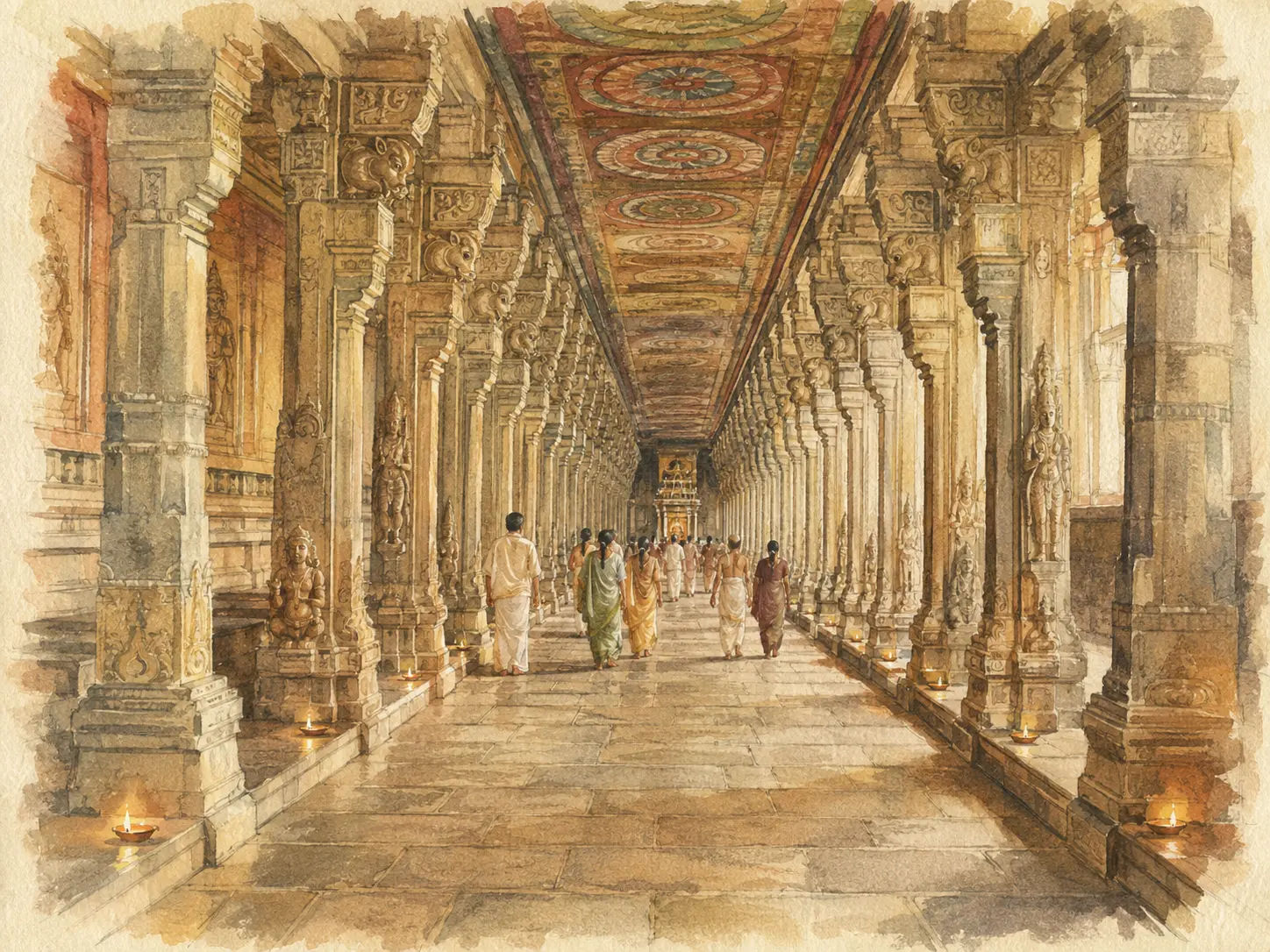
Ramanathaswamy Temple has three concentric prakaras, or enclosures. Its outer corridors are among India’s most memorable temple spaces. Rows of carved pillars extend through changing bands of light and shade, turning circumambulation into a measured architectural rhythm.
Government records describe corridor runs of about 197 metres east to west and 133 metres north to south. The experience is more important than any superlative. Walk slowly and one begins to notice variations in the pillars, sculpted figures, painted ceilings and the human scale of devotees moving through the long perspective.
The corridor becomes a metaphor for sadhana. Spiritual life rarely advances through one dramatic leap. It develops through repeated steps, chosen direction and patient return.
Nandi and the sacred centre
The official temple history describes the large Nandi pavilion, with Nandi measuring approximately 17 feet in height, 22 feet in length and 12 feet in width. Nandi represents steadfastness, patience and single-pointed attention. His uninterrupted orientation towards Shiva is itself a teaching: keep the mind turned towards what is sacred.
Within the inner enclosure are the Ramanathaswamy shrine, the Vishwalinga associated with Hanuman, the shrine of Goddess Parvathavardhini and other deities. This is a living ritual space. Pilgrims should follow current queues, respect photography restrictions and allow temple staff to determine where visitors may pause.
Agni Theertham and the 22 sacred theerthams
Water gives the Rameswaram pilgrimage its distinctive movement. Agni Theertham is the seashore east of the temple. Pilgrims traditionally bathe or sprinkle themselves here before entering the temple. Families also perform ancestral rites along the shore.
The temple has 22 sacred water sources known as theerthams. Authorised attendants draw and pour the water as pilgrims move through the prescribed route. A widely followed sequence is:
- Begin at Agni Theertham according to personal custom and physical ability.
- Proceed to the 22 temple theerthams during the permitted hours.
- Change into dry clothing as directed.
- Join the darshan queue for Ramanathaswamy.
This sequence is customary, not a condition for every visitor. Elderly pilgrims, young children and anyone with illness or limited mobility should never feel spiritually inadequate for adapting or omitting the water ritual. Darshan does not become less sincere because a body has limits.
The waters are sacred within pilgrimage tradition. Claims that every well has laboratory-proven medicinal properties should not be made without reliable scientific evidence. Faith does not require an unsupported scientific explanation.
The transition from sea to temple also carries a beautiful symbolic meaning. Outer cleansing invites inner cleansing. Water becomes a reminder to release resentment, distraction and pride before approaching the sanctum.
Pilgrim etiquette at the sacred waters
- Dress modestly and carry a dry change of clothes in a waterproof bag.
- Use only authorised temple arrangements for the 22-theertham ritual.
- Do not photograph private rites or grieving families without permission.
- The sea can change quickly. Avoid entering rough water and follow local warnings.
- Keep footwear, phones and valuables only in designated safe places.
- Choose a quieter weekday morning if travelling with seniors or small children.
Ramanathaswamy Temple timings and worship
As verified on the official temple portal in August 2026, the temple lists these general opening hours:
- Morning: 4:00 a.m. to 1:00 p.m.
- Evening: 3:00 p.m. to 8:00 p.m.
- Spatika Linga Puja: approximately 5:00 a.m. to 6:00 a.m.
- Main sanctum darshan: from approximately 6:10 a.m. in the morning and 3:15 p.m. in the afternoon
- 22-theertham bathing: approximately 5:30 a.m. to 12:30 p.m. and 3:00 p.m. to 7:00 p.m.
Temple timings, ritual access, tickets and queue arrangements can change on festival days or for administration and maintenance. Check the official Ramanathaswamy Temple portal shortly before travelling.
The early Spatika Linga Puja is especially valued by many devotees. Spatika means crystal and is traditionally associated with purity, clarity and light. Separate abhishekam and archanai arrangements may be available through official counters or the temple booking system. Avoid unofficial agents and verify every paid service with temple authorities.
Festivals and meaningful times to visit
Maha Shivaratri is among the most important occasions for Shiva worship at Ramanathaswamy Temple. The night is traditionally associated with wakefulness, prayer and inner awareness. The temple also observes major Tamil Shaiva festivals, processions and sacred-calendar occasions. New-moon days can bring large numbers of pilgrims for ancestral rites at Agni Theertham.
Festival dates follow lunar and Tamil calendars and should be checked for the year of travel. Those seeking a quieter visit may prefer a non-festival weekday. Those who wish to experience a major celebration should plan for heavy crowds, longer queues and limited accommodation.
For comfortable travel, November to February is usually the gentlest season. March to June can be hot and humid. Coastal rain, strong wind and cyclonic weather are possible in parts of the year, so travellers should check the India Meteorological Department and local administration before visiting Dhanushkodi or entering the sea.
Satvik and vegetarian food in Rameswaram
Rameswaram’s pilgrimage cuisine is at its best when it is simple, warm and unmistakably Tamil. Many eateries around the temple serve vegetarian tiffin and rice meals. Always confirm that food matches your personal dietary practice, particularly if strict satvik preparation, no onion or no garlic is required.
Breakfast to look for
- Soft idli with sambar and coconut chutney
- Plain dosa or ghee roast dosa
- Ven pongal with pepper, cumin and ghee
- Upma or kichadi
- Traditional appam with vegetable stew, after confirming the preparation is egg-free
- South Indian filter coffee
Lunch and dinner
- Steamed rice with sambar and rasam
- Lemon rice
- Tamarind rice or puliyodarai
- Curd rice, especially welcome in the coastal heat
- Vegetable kootu and poriyal
- Appalam and simple pickle
- A Tamil vegetarian meal served on a banana leaf where available
The official temple also describes an annadanam programme serving vegetarian meals to pilgrims. Availability and access should be confirmed locally. Carry drinking water, but avoid taking food into restricted temple areas. Before theertham bathing and darshan, a light breakfast is often more comfortable than a heavy meal.
Sacred and meaningful places near Ramanathaswamy Temple
Agni Theertham
The sacred shore lies very close to the eastern gopuram. Sunrise can be deeply moving, but this is first a ritual space, not a photographic set. Respect ancestral ceremonies and the privacy of other pilgrims.
Gandhamadhana Parvatham and Rama Padam
This elevated sacred site is traditionally associated with Rama’s footprints and offers broad views across the island. It is usually quieter than the main temple and helps visitors understand Rameswaram as a whole sacred landscape.
Villoondi Theertham
Local tradition remembers Rama bringing forth fresh water when Sita was thirsty. The story’s spiritual suggestion is gentle and enduring: grace may appear where it seems least expected, even beside a salt sea.
Lakshmana Theertham and Jada Theertham
These smaller sites are linked in local Ramayana tradition with Lakshmana and Rama. Visit them as places of remembrance rather than as attractions to be hurried through.
Kothandaramaswamy Temple
Near Dhanushkodi, this temple is associated with Vibhishana seeking refuge with Rama. The tradition expresses sharanagati, sincere surrender. Rama receives Vibhishana despite suspicion from others, teaching that dharma considers a person’s sincerity, not only the family or side from which that person comes.
Dhanushkodi and Arichal Munai
Dhanushkodi lies about 18 kilometres from Rameswaram. The old settlement was devastated by the 1964 cyclone, while Kothandaramaswamy Temple remained. Today, sand, sea, ruins and Ramayana memory make the region emotionally powerful.
The coastal edge is associated in sacred tradition with Rama Setu. Present this connection as revered tradition. Archaeological, geological and theological questions should not be collapsed into unsupported certainty.
Visit only during permitted hours. Use authorised transport, avoid entering rough water and return before poor light or weather makes the road unsafe. Access to the farthest point can be limited by official direction.
The new Pamban railway bridge
The journey to Rameswaram across the sea has long marked the psychological transition from mainland to sacred island. India’s new vertical-lift Pamban railway sea bridge was inaugurated in April 2025, and Southern Railway restored rail connectivity to Rameswaram. Train schedules can still change, so verify your service directly with Indian Railways before departure.
Dr A.P.J. Abdul Kalam National Memorial
Rameswaram was the birthplace of Dr A.P.J. Abdul Kalam, India’s eleventh President, scientist and beloved teacher. His memorial at Pei Karumbu adds a meaningful modern chapter to the island: ancient pilgrimage and scientific aspiration belonging to the same cultural landscape.
Thiruppullani, Devipattinam and Uthirakosamangai
Travellers with an additional day may visit Thiruppullani, linked with Rama’s prayer to the ocean; Devipattinam, associated with Navagraha worship and ancestral rites; and Uthirakosamangai, an important Shiva temple near Ramanathapuram. These form a wider sacred circuit beyond the island.
How to reach Rameswaram
By train
Rameswaram railway station is about 1.3 kilometres from Ramanathaswamy Temple according to the district administration. Rail services again cross the new Pamban Bridge, but confirm the exact train and operational schedule before travelling.
By air
Madurai is the most commonly used airport and is approximately 175 kilometres from Rameswaram. Thoothukudi is another option at approximately 195 kilometres. Road time depends on traffic, weather and breaks.
By road
State buses, private buses, taxis and hired vehicles connect Rameswaram with Ramanathapuram, Madurai and other Tamil Nadu cities. The bus stand is roughly two kilometres from the temple. If driving to Dhanushkodi, check local access and weather on the day.
A practical two-day Rameswaram pilgrimage
Day 1: keep Ramanathaswamy at the centre
Begin before sunrise at Agni Theertham if health, weather and personal custom permit. Proceed to the 22 theerthams during official hours, change into dry clothing and join the Ramanathaswamy darshan queue. Allow time to walk through the great corridors without rushing.
After a simple vegetarian meal and rest, visit Lakshmana Theertham and Gandhamadhana Parvatham. Return to the temple area for evening darshan if energy and crowd conditions permit.
Day 2: understand the Ramayana landscape
Leave early for Villoondi Theertham, Kothandaramaswamy Temple and Dhanushkodi. Continue to Arichal Munai only when access and weather are safe. On the return, visit the Dr A.P.J. Abdul Kalam Memorial and pause at an authorised Pamban viewpoint.
Families with seniors should reduce the number of stops. A pilgrimage is not a checklist. One unhurried darshan can be more meaningful than ten exhausted visits.
Practical guidance for families and senior pilgrims
- Keep one waterproof bag for dry clothes, medicines and identity documents.
- Use footwear that is easy to remove and carry.
- Expect wet floors near the theertham route and walk carefully.
- Choose official counters for tickets and rituals.
- Carry prescribed medicine, oral rehydration salts and a refillable water bottle.
- Plan a midday rest; the coastal heat and humidity can be tiring.
- Do not promise a strict schedule on festival or new-moon days.
- Ask the temple about current accessibility support before travel.
- For Dhanushkodi, prioritise weather and safety over completing the itinerary.
- Respect local Tamil customs and use gentle, modest behaviour throughout the pilgrimage.
Frequently asked questions about Rameswaram Jyotirlinga
Is Rameswaram one of the twelve Jyotirlingas?
Yes. Sri Ramanathaswamy at Rameswaram is revered as one of Shiva’s twelve Jyotirlingas. Rameswaram is also the southern Char Dham, giving it a rare place in two major pilgrimage traditions.
Is Ramanathaswamy Temple a Shiva temple or a Rama temple?
The presiding deity is Shiva as Ramanathaswamy. Rama is central to the Sthala Purana because he is traditionally believed to have installed and worshipped the Ramalinga. The temple therefore embodies harmony between Shaiva and Vaishnava devotion.
What is the difference between Ramalinga and Vishwalinga?
Ramalinga is the principal linga traditionally formed by Sita from sand and worshipped by Rama. Vishwalinga was brought from Kailasa by Hanuman. Temple tradition gives Vishwalinga the honour of receiving worship first.
Did Rama worship Shiva before or after the Lanka war?
Sacred retellings differ. The official temple tradition emphasises worship after the defeat of Ravana as an act of expiation, while some other traditions associate worship with the journey before the crossing. The differences should be acknowledged respectfully.
Are all 22 theertham baths compulsory for darshan?
No. They form an important customary pilgrimage, but darshan should not be denied spiritual meaning because of health, age, disability, crowd conditions or family practice. Follow temple rules and personal religious guidance.
What are the current Ramanathaswamy Temple timings?
As verified in August 2026, the official portal lists 4:00 a.m. to 1:00 p.m. and 3:00 p.m. to 8:00 p.m. General darshan and theertham access have more specific hours. Recheck before travel because schedules can change.
What is special about the temple corridors?
The long pillared corridors of the outer enclosure are celebrated for their repeated carved columns, changing light and monumental perspective. Their present form is associated largely with eighteenth-century Setupati patronage.
How many days are sufficient for Rameswaram?
One full day can cover the main temple and nearby sacred sites. Two days allow a calmer visit that includes Dhanushkodi, Kothandaramaswamy Temple, Gandhamadhana Parvatham and the Kalam Memorial.
What is the best time to visit Rameswaram?
November to February is generally most comfortable. Maha Shivaratri and other sacred-calendar days are spiritually significant but crowded. Always check coastal weather, especially before visiting Dhanushkodi.
What vegetarian food should pilgrims try?
Idli, dosa, ven pongal, lemon rice, puliyodarai, curd rice, sambar, rasam, kootu, poriyal and a traditional Tamil vegetarian meal are good choices. Confirm individual ingredients and preparation when you follow strict dietary rules.
Can senior citizens complete the Rameswaram pilgrimage comfortably?
Yes, with a slower plan. Avoid rushing the wet theertham route, schedule rest during the hottest hours, carry medication and ask the temple about current queue or accessibility support.
Is Dhanushkodi safe to visit?
It can be visited safely when official access is open and weather is calm. The coast is exposed, so use authorised transport, remain within permitted areas, avoid rough water and follow district or police directions.
Carry this with you
Rameswaram is not simply a destination where Rama once worshipped Shiva. It is a continuing invitation to let dharma bow before the divine.
The sea teaches vastness. The theerthams teach renewal. The long corridors teach perseverance. Rama’s worship teaches humility. Hanuman’s Vishwalinga teaches gratitude. The shrine’s Char Dham and Jyotirlinga identities teach that India’s sacred unity has never required spiritual sameness.
One may arrive for a ritual bath, a family vow, a Jyotirlinga yatra or a Char Dham pilgrimage. The deeper journey begins when the pilgrim asks a quieter question: after approaching Shiva, what within me is ready to become clearer, gentler and more accountable?
That is the enduring light of Ramanathaswamy.
Editorial source note
Sacred tradition, temple history and current timings were checked against the Tamil Nadu HR&CE Ramanathaswamy Temple portal. Travel distances and nearby places were checked with the Ramanathapuram district administration, and restored rail connectivity was checked with Southern Railway. Historical evidence, sacred belief and Indian Ethos reflection are presented as distinct forms of knowledge.