TEMPLES OF INDIA · BADRINATH
High beside the Alaknanda, Badrinath brings together Lord Vishnu’s meditative presence, a living Himalayan temple and two great pilgrimage traditions. This careful guide explains its sacred stories, spiritual meaning and the practical choices that help a visit remain attentive.
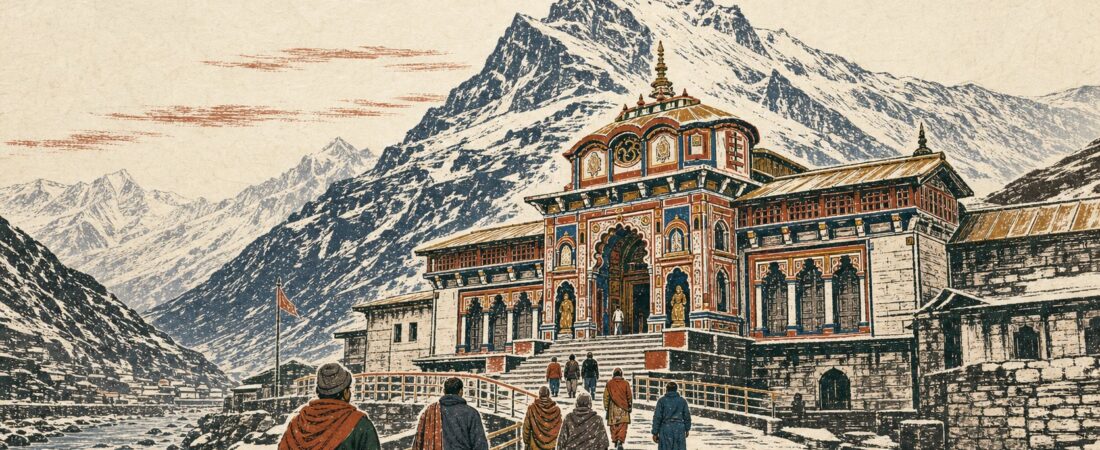
At Badrinath, the brightly painted temple stands against rock, snow and a sky that can change within minutes. The Alaknanda moves below, pilgrims draw their shawls closer, and the mountain seems to set its own pace.
This is one reason Badrinath feels different from a shrine reached in the middle of a busy town. The road may bring us to the temple gate, but the landscape asks us to slow down before we enter.
Lord Vishnu is worshipped here as Badri Narayana, seated in meditation rather than shown in a royal or reclining form. The image at the centre of the shrine gives Badrinath its enduring spiritual character: devotion is not only an act of asking. It can also be a practice of becoming still enough to see clearly.
The heart of Badrinath
Badrinath is a sacred town in Chamoli district, Uttarakhand, at an elevation of roughly 3,100 metres in the Garhwal Himalayas. Its principal shrine, Badrinath Temple or Badrinarayan Temple, stands near the Alaknanda River and is dedicated to Vishnu.
The word Char Dham can refer to two related pilgrimage traditions, and Badrinath belongs to both:
- In the pan-Indian Char Dham, Badrinath is the northern sacred destination; Dwarka, Puri and Rameswaram mark the west, east and south. The Puri district administration names these four Dhams together.
- In Uttarakhand’s Himalayan circuit—often called the Chota Char Dham—pilgrims visit Yamunotri, Gangotri, Kedarnath and Badrinath. Uttarakhand Tourism describes the customary route as ending at Badrinath.
This double place in sacred geography helps explain why the shrine carries such importance. For many Vaishnava devotees, it is also revered among the 108 Divya Desams, sacred places praised in the Sri Vaishnava tradition. The Shri Badarinath Kedarnath Temple Committee records this living association.
Badrinath in brief
- Who is worshipped here? Vishnu as Badri Narayana or Badri Vishal.
- Where is the temple? In Chamoli district, beside the Alaknanda, between the Nar and Narayana mountain ranges.
- Why is it important? It belongs to both the pan-Indian Char Dham and Uttarakhand’s four-shrine pilgrimage.
- What form does the deity take? A black-stone image of Vishnu seated in a meditative posture.
- When is the shrine open? Usually from April or May until October or November; exact dates are announced each year.
- Is registration required? Pilgrims should follow the current requirements on Uttarakhand’s official Char Dham registration portal.
Why Vishnu is called Badri Narayana here
Temple tradition connects the name Badri with a wild berry tree. In the best-known sacred account, Vishnu chose this Himalayan valley for penance. Lakshmi saw him exposed to the severe weather and took the form of a badri tree, sheltering him from sun, snow and wind. The place therefore came to be known as Badrinath—the Lord of Badri.
This is a devotional narrative, not a botanical or historical explanation that can be dated like an inscription. Its meaning lies in the relationship it preserves. Vishnu’s austerity is held within Lakshmi’s care. Discipline and tenderness are not shown as opposites.
Another tradition associates Badrikashram with Nara and Narayana, the paired sages understood as forms of Vishnu. They are said to have performed tapas here for the welfare of the world. The temple committee connects this account with the Vamana Purana and other sacred literature.
Taken together, these traditions make Badrinath more than a place of solitary withdrawal. Meditation here is remembered as service: an inward practice undertaken for a larger good.
Adi Shankaracharya and a temple renewed over time
Many short accounts say that Adi Shankaracharya “built Badrinath Temple in the eighth century.” The history is better described with a little more care.
According to temple tradition, Shankaracharya recovered the black-stone image of Badri Narayana from Narad Kund and re-established its worship. The temple committee further records that a Garhwal ruler moved the murti to the present temple in the sixteenth century. The shrine has since been repaired and renewed in response to the demanding Himalayan climate.
The standing temple should therefore not be imagined as one untouched building surviving from Shankaracharya’s lifetime. Badrinath’s continuity lies in a sacred place, a form of worship and a community of care carried through successive structures and restorations.
That distinction does not diminish the shrine. It makes its endurance more human. Each generation receives something precious, repairs what the mountain has tested, and passes it forward.
Inside Badrinath Temple
The colourful entrance is known as the Singhdwar. Beyond it, the temple is organised into three main parts: the garbhagriha, or sanctum; the Darshan Mandap, where rituals are performed; and the Sabha Mandap, where pilgrims gather.
At the centre is the black-stone murti of Badri Narayana, seated in a meditative posture. The sanctum also includes figures associated with the shrine’s Vaishnava world, including Nar and Narayana, Narada, Uddhava, Kubera and Garuda. Descriptions of the temple’s layout and deities are available from the official temple committee.
Near the shrine is Tapt Kund, a natural hot spring. Many pilgrims traditionally bathe here before darshan. The practice is understood as ritual preparation; visitors should follow current local instructions rather than assume that access or bathing arrangements will always remain the same.
The contrast is striking: cold air from the valley, warm water rising from the earth, and a deity whose stillness anchors the movement around him. Badrinath’s sacred landscape often teaches through such pairings.
What the meditating form of Vishnu can teach us
Vishnu is often remembered as the sustainer—the presence that protects order and restores balance. At Badrinath, that sustaining power appears in meditation.
This is an Indian Ethos interpretation, not a claim made on behalf of every devotee: the shrine suggests that right action needs an inner ground. Without pauses for reflection, even sincere effort can become hurried, reactive or proud. Stillness does not remove us from responsibility. It can help us return to responsibility with better judgement.
The mountain setting makes this lesson tangible. A pilgrim cannot command the weather, the road, the queue or the body’s response to altitude. The journey asks for planning, patience and humility at once.
Perhaps that is why Badrinath has long been associated with tapas—disciplined effort. The discipline is not only in reaching a high shrine. It is also in meeting inconvenience without losing consideration for the people beside us.
The sacred landscape around Badrinath
The places around Badrinath are best approached as a connected sacred geography, not a checklist to be completed in haste.
Mana, Vyas Gufa and Ganesh Gufa
Mana lies a few kilometres beyond Badrinath, near the upper reaches of the Saraswati. Local and pilgrimage traditions connect Vyas Gufa with Vyasa and Ganesh Gufa with Ganesha’s role as the scribe of the Mahabharata. These are sacred associations rather than claims that archaeology can presently verify.
Mana is also a living Himalayan settlement, not merely a backdrop for a “last village” photograph. Visit with respect for residents, local work, private spaces and changing border-area rules.
Bhim Pul and the Saraswati
At Mana, a natural rock bridge crosses the forceful Saraswati stream. Tradition associates the bridge with Bhima, who is said to have placed a great stone across the water during the Pandavas’ final journey. The story gives the landscape an epic memory; the rushing river gives it an immediate presence.
Brahma Kapal and Tapt Kund
Brahma Kapal, on the Alaknanda near the temple, is a place where families perform ancestral rites. It should be approached as an active ritual space, with privacy and restraint.
Tapt Kund belongs to the same close sacred landscape. Whether one bathes or simply pauses nearby, local rules, safety directions and the dignity of other pilgrims come first.
Charan Paduka and Vasudhara Falls
Charan Paduka is associated in tradition with Vishnu’s footprints and requires an uphill walk. Vasudhara Falls lies farther beyond Mana and involves a mountain route whose difficulty can vary with weather and local conditions. Uttarakhand Tourism’s Badrinath guide provides an official overview of these nearby places.
Neither walk should be treated casually. Check access, weather, daylight and your own capacity before setting out.
How to plan a Badrinath pilgrimage with care
Check the temple season, not just the month
Badrinath Temple is generally open for about six months, from spring until the onset of winter. The exact opening and closing dates are announced annually. Confirm them through the temple committee before booking travel.
May and June, and the post-monsoon period from September into October, are commonly chosen by pilgrims. July and August can bring heavy rain, landslides and road interruptions. Conditions can also change outside the monsoon, so a “best month” is never a substitute for a current forecast.
Complete the official registration
Uttarakhand’s government portal states that pilgrims and vehicles must be registered for the Char Dham Yatra and that verification takes place at the destinations. Complete the process only through the official registration website or the channels it lists. Keep the registration letter and a valid photo ID available.
Plan the road journey realistically
Badrinath is reached by road through the Garhwal Himalayas. Rishikesh and Haridwar are common gateways; the route continues through places such as Devprayag, Rudraprayag, Karnaprayag, Chamoli and Joshimath. Jolly Grant Airport near Dehradun is the nearest major airport, while Rishikesh is the closest railhead listed by the district administration.
Distances on a map do not capture mountain travel time. Leave room for traffic controls, road work, weather holds and rest.
Treat weather and altitude seriously
The journey reaches a high-altitude environment with cold, rapidly changing weather. Carry warm layers and prescribed medicines, and do not compress the itinerary merely to collect more temple visits. Travellers with a health condition should seek individual medical advice before undertaking a high-altitude pilgrimage.
Before departure and during the journey, check the IMD Char Dham sector forecast and official district or yatra updates. Follow local instructions if travel is paused.
Let reverence shape ordinary behaviour
Dress simply, observe photography restrictions, keep the queue moving gently and make room for older pilgrims and families. Carry waste back to the appropriate collection point. Do not turn a ritual, a resident or another pilgrim’s prayer into content without consent.
The most practical form of devotion is often consideration.
Frequently asked questions about Badrinath Dham
Why is Badrinath Dham sacred?
Badrinath is dedicated to Vishnu as Badri Narayana. It belongs to both the pan-Indian Char Dham and Uttarakhand’s four-shrine pilgrimage, is revered in Vaishnava tradition, and is associated with sacred accounts of Vishnu, Lakshmi, Nara-Narayana and Adi Shankaracharya.
Is Badrinath part of the Char Dham or the Chota Char Dham?
Both. In the pan-Indian Char Dham, Badrinath is joined by Dwarka, Puri and Rameswaram. In Uttarakhand’s Himalayan circuit, it is joined by Yamunotri, Gangotri and Kedarnath.
Who built Badrinath Temple?
There is no single simple answer. Temple tradition credits Adi Shankaracharya with recovering the murti and re-establishing worship. The temple committee says a Garhwal ruler moved the image to the present temple in the sixteenth century, and the structure has been repaired and renewed over time.
When does Badrinath Temple open?
The shrine usually opens in April or May and closes in October or November. The exact dates change each year and should be confirmed through the official temple committee.
How do pilgrims reach Badrinath?
The final approach is by road. Rishikesh and Haridwar are common gateways, Jolly Grant is the nearest major airport, and Rishikesh is the nearest railhead listed by the Chamoli district administration. Registration and current route checks should be completed before travel.
What can be visited near Badrinath Temple?
Nearby sacred places include Tapt Kund, Brahma Kapal and Charan Paduka. Mana, Vyas Gufa, Ganesh Gufa, Bhim Pul and the route towards Vasudhara Falls lie farther beyond. Access and weather conditions should be checked locally.
Carry this with you
Badrinath does not separate devotion from difficulty. The cold, the distance and the uncertainty of a mountain road are not proofs of faith, yet they can reveal the quality of attention we bring to a pilgrimage.
At the centre of the movement sits Badri Narayana in meditation. That image offers a quiet correction to our hurried habits: not every meaningful journey is measured by how much we manage to cover.
We may leave Badrinath without carrying home the mountain’s silence. But we can carry one small part of its discipline—the willingness to pause before we speak, choose or act, and to remember who else our choices must shelter.
Jai Badri Vishal! Om Namo Narayanaya!
Read next: Temples of India – The Soul of a Timeless Civilization · Dwarka: The Sacred Abode of Lord Krishna · Jagannath Temple in Puri: Where the Lord Lives Among His People
Editorial source note
This article is based on source material supplied to Indian Ethos by email on 30 July 2026 and independently checked against the Shri Badarinath Kedarnath Temple Committee, Uttarakhand Tourism, Chamoli district administration, the Government of Uttarakhand’s Char Dham registration portal, the India Meteorological Department and the Ministry of Tourism. Sacred narratives are labelled as tradition; the standing temple is not presented as one untouched eighth-century structure. The accompanying image is an original AI-generated editorial illustration, not documentary photography.