TEMPLES OF INDIA · JAGANNATH PURI
At Puri, Lord Jagannath is not worshipped as a distant divinity. He is bathed, dressed, offered food, brought among his devotees and lovingly welcomed home—a sacred relationship that has shaped Odisha for centuries.
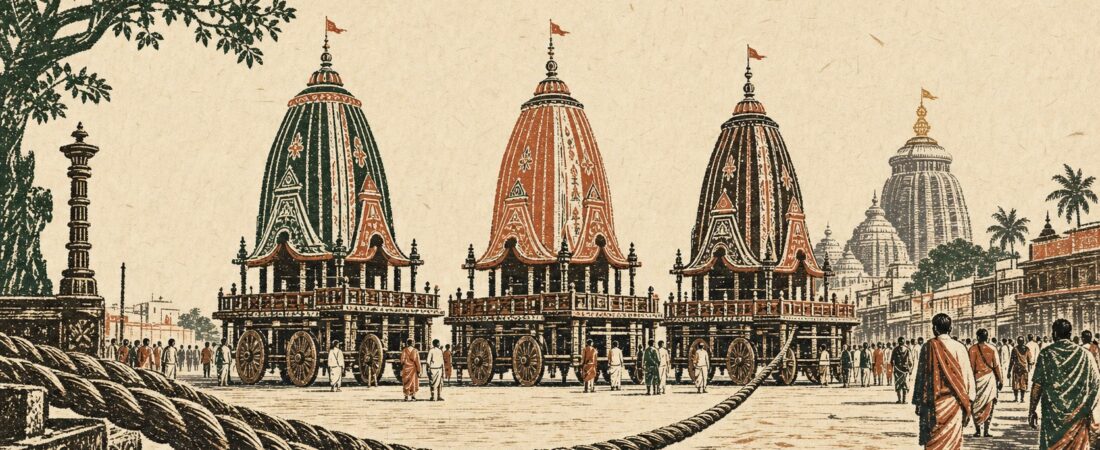
On Puri’s Bada Danda, the Grand Road, three immense chariots carry Lord Jagannath, his elder brother Balabhadra and his sister Subhadra towards Gundicha Temple as thousands wait for darshan. Wood creaks, ropes tighten and voices rise in devotion. Yet at the heart of this vast gathering is a tender idea: the Lord of the Universe leaves the sanctum and allows himself to be seen among his people.
That nearness is the key to understanding the Jagannath tradition. The 12th-century temple rises in monumental Kalinga architecture, but Jagannath is never held at a distance by stone alone. He is awakened, bathed, offered food, dressed for the season, carried in procession and lovingly welcomed home. Even his wooden form is periodically renewed. At Puri, sacred continuity is not lifeless permanence; it is a relationship kept alive through care.
The heart of it
Jagannath means “Lord of the Universe,” but in Odisha the relationship is often strikingly intimate. The deities are awakened, bathed, dressed, fed and put to rest. After the great bathing festival, they withdraw from public view as if recovering from illness. During Ratha Yatra, they travel. During Nabakalebara, they receive new wooden bodies.
This is why Jagannath culture feels at once grand and close to home. The temple is one of India’s major pilgrimage centres, but its ritual imagination makes room for illness, appetite, travel, renewal and return—the ordinary rhythms through which human beings also understand care.
Jagannath Temple in brief
- The present temple dates to the 12th century and is associated with the Eastern Ganga ruler Anantavarman Chodaganga Deva.
- Jagannath is worshipped on the Ratna Simhasana with Balabhadra, Subhadra and Sudarshana.
- The principal deities are made of wood rather than stone or metal.
- Ratha Yatra carries the deities from the main temple to Gundicha Temple on three great chariots.
- During Nabakalebara, held in years with an additional month of Ashadha, the wooden images are ritually renewed.
- Mahaprasad is prepared in earthen pots over firewood, offered in the temple and shared through Ananda Bazar.
These points are documented by the Puri district administration, Odisha Tourism and temple-focused records of the rituals.
A 12th-century temple with older, layered roots
The present Jagannath Temple was built under the Eastern Ganga dynasty in the 12th century. Its curving tower, raised platform and monumental enclosure belong to the Kalinga architectural tradition. Later additions continued to shape the complex over several centuries. The Puri district’s official account associates its construction with Anantavarman Chodaganga Deva; scholarship has examined how later Ganga rulers further consolidated the temple and its state cult.
The beginnings of Jagannath worship are harder to place neatly—and that is important. Historians have proposed several interacting strands, including regional, tribal, Vaishnava, Shaiva, Shakta, Buddhist and Jain influences. A major scholarly study, The Jagannatha Temple at Puri: Its Architecture, Art and Cult, treats the tradition as a layered historical development rather than a story with one simple point of origin.
Temple tradition tells the story differently, through devotion. In the best-known account, Nila Madhava was secretly worshipped by the Savara chief Visvavasu. King Indradyumna searched for the deity and later received sacred wood from which the forms of Jagannath, Balabhadra, Subhadra and Sudarshana were made. A divine craftsman began carving behind closed doors; when the door was opened before the work was complete, the forms were left with their unmistakable large eyes and unfinished limbs.
This is sacred narrative, not a dated construction record. Its truth belongs to the tradition’s understanding of the deity: a form that does not need to conform to classical ideas of bodily perfection in order to be whole.
Why the deities are made of wood
Most visitors first notice Jagannath’s vast circular eyes. Equally significant is the material beneath the paint and cloth. The principal images are fashioned from neem wood, often described in the tradition as daru.
Because wooden forms are impermanent, Jagannath worship gives renewal a sacred meaning through Nabakalebara—literally, a “new body.” The observance takes place when the Hindu calendar contains an additional month of Ashadha. Specially designated servitors search for suitable neem trees, the new images are carved within the temple, and the old images are buried in Koili Vaikuntha. Temple records of Nabakalebara describe a secret transfer of a mysterious inner substance, called Brahma Padartha, from the old forms to the new.
Popular retellings sometimes identify this inner substance as the surviving heart of Krishna. That identification belongs to belief and later narration; it is not something the rite makes available for public verification. The more careful—and perhaps more meaningful—description is the one the ritual itself offers: the body changes, while sacred continuity is carried forward.
Ratha Yatra: when Jagannath gives darshan beyond the temple
Ratha Yatra is the temple’s most visible act of movement. Construction of the three chariots begins on Akshaya Tritiya, well before the day of the procession. Jagannath travels in Nandighosha, Balabhadra in Taladhwaja and Subhadra in Darpadalana. The chariots move along Bada Danda towards Gundicha Temple before returning in the Bahuda Yatra. Odisha Tourism’s account of Ratha Yatra traces this longer festival cycle rather than treating it as a single day.
When the chariots move, the sacred centre of Puri seems to widen. Darshan is no longer confined to the temple’s inner spaces; Jagannath appears beneath the open sky before pilgrims who have travelled from near and far. This public character has made Ratha Yatra an enduring emblem of shared devotion, even though the social history around any great institution is more complex than one festival can resolve.
One ritual distils the festival’s moral imagination. In Chhera Pahanra, the Gajapati Maharaja of Puri sweeps the platforms of the chariots with a golden broom. The king approaches not as sovereign but as a servitor. Rank remains visible—the broom itself is gold—yet the action places service above status.
A calendar in which the divine is treated as family
The annual cycle at Puri is not simply a schedule of festivals. It is a language of relationship.
During Chandan Yatra, representative images take a boat ride on Narendra tank in the heat of summer. On Snana Yatra, Jagannath, Balabhadra, Subhadra and Sudarshana are brought to the bathing platform and bathed with 108 pitchers of ritually prepared water. They then remain out of public view during Anavasara, a period traditionally understood as rest and recovery after the bath. Before Ratha Yatra, they reappear in renewed colour and youthful dress. After the return journey, Suna Besha adorns them with gold ornaments while they remain on their chariots. These observances are described in the temple festival record and the record of the deities’ ceremonial dress.
The tenderness of these rituals matters. Divinity is not made remote by perfection. The deities feel the heat, bathe, rest, dress for occasions and return home. Worship becomes a form of attentive care.
Mahaprasad: devotion prepared in earthen pots
The temple kitchen, or Rosaghara, gives another meaning to care. Food is cooked in earthen pots over firewood, offered first within the temple and then made available as Mahaprasad. Cooked rice, dal, vegetable preparations, cakes and sweets form part of a culinary system sustained by hereditary knowledge and daily ritual.
Mahaprasad is sold and shared in Ananda Bazar inside the temple complex. The temple’s account of Bhoga and Ananda Bazar notes that the offering is associated with eating together across social distinctions. An Odisha Review study of the temple kitchen documents the kitchen’s hearths, ingredients and organised work.
Many popular descriptions focus on the claim that the uppermost stacked pot cooks first. It is often repeated, including in tourism material, but reliable independent testing is difficult to find. The documented achievement needs no embellishment: a large ritual kitchen preserves a complex earthen-pot tradition while feeding pilgrims day after day.
What the legends are trying to tell us
Jagannath tradition is carried not only by architecture and ritual manuals, but also by stories of devotees. One beloved Odia account remembers Dasia Bauri, a devotee excluded from the temple because of caste. He sent a coconut for Jagannath and, according to the legend, the Lord accepted it directly. The story appears in Odisha’s devotional literature and is discussed as legend in Odisha Review.
Read responsibly, the story is not proof of a supernatural event. Nor is it a detail to dismiss. It is a moral argument made through devotion: social gates may be guarded by human beings, but grace cannot be owned by rank.
The same care is needed with widely shared claims that the temple casts no shadow or that its flag always flies against the wind. Such statements circulate in official tourism copy as well as social media, yet clear independent evidence is scarce. Wonder does not become smaller when we call a legend a legend. In Puri, the well-documented reality—a sacred community sustaining architecture, food, craft, music, service and ritual over centuries—is already extraordinary.
What Jagannath leaves in the heart
In Puri, majesty and tenderness are not opposites. Jagannath is the Lord of the Universe, yet devotees serve him with the care offered to a beloved member of the family. He is fed, dressed, allowed to rest, taken on a journey and welcomed home.
Perhaps this is why Jagannath feels so close to his devotees. The tradition does not ask us to approach the Divine only through grandeur. It shows us that love can live in repeated acts of service—in preparing food, pulling a rope, sweeping a platform, waiting for darshan and making space for another person beside us.
Long after the chariots have returned, that invitation remains: let humility soften status, let service deepen devotion, and let every sincere return to what is true bring us a little closer to home.
Jai Jagannath.
Read next: Temples of India – The Soul of a Timeless Civilization
Editorial source note
This article draws on source material supplied by the Indian Ethos publisher by email on 17 July 2026 and checks its material claims against government, temple-focused and scholarly sources. Traditional narratives are labelled as legend or belief; unverifiable “mystery” claims are not presented as scientific fact.