Temples of India · Dwadasha Jyotirlingas
Across Bharat, these twelve sacred abodes are revered in Shaiva tradition as radiant expressions of the eternal presence of Shiva, the Adiyogi.
Prologue
Before the first light of dawn, a temple bell sounds. A small flame rises before the sanctum, the fragrance of incense settles into the stone corridors, and a familiar chant begins:
Om Namah Shivaya.
This moment is repeated in countless Shiva temples. Yet twelve shrines hold a distinctive place in Shaiva tradition. Known collectively as the Dwadasha Jyotirlingas, they are revered as sacred manifestations of Shiva as jyoti—boundless divine light.
Readers may also encounter the spelling Jyothirlingas, particularly in English usage shaped by southern Indian languages. This series uses Jyotirlingas, the more widely established English transliteration, while respecting both forms.
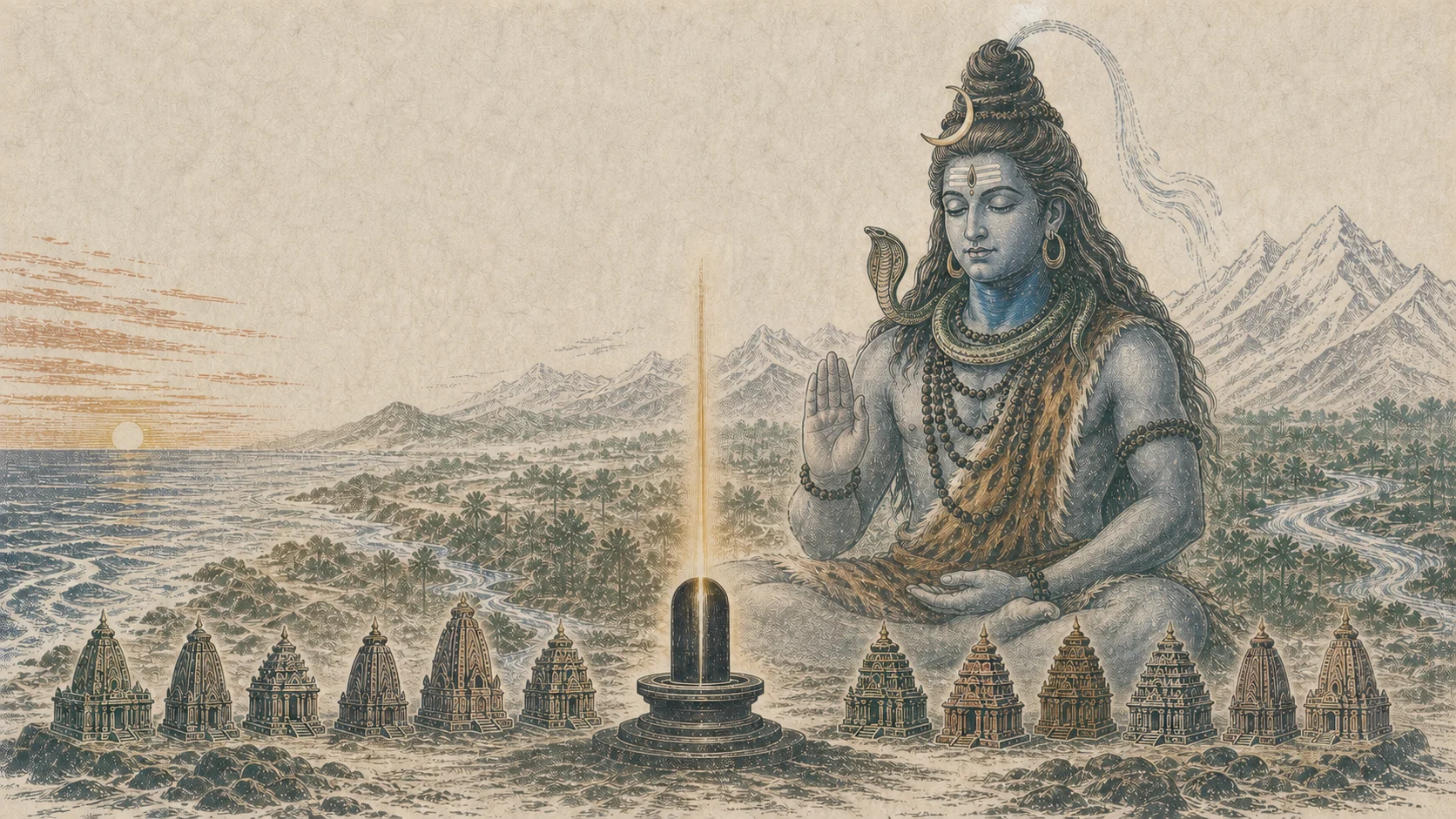
A well-known Shaiva account tells of Shiva appearing before Brahma and Vishnu as an immeasurable pillar of radiance, with neither beginning nor end. Their search for its limits becomes a quiet reminder: the divine may be approached through a form, but can never be contained within one.
Following the sequence of the traditional Dwadasha Jyotirlinga Shloka, the twelve sacred manifestations are:
- Somnath
- Mallikarjuna
- Mahakaleshwar
- Omkareshwar–Amaleshwar
- Vaidyanath
- Bhimashankar
- Rameshwar
- Nageshwar
- Vishweshwar, better known as Kashi Vishwanath
- Trimbakeshwar
- Kedarnath
- Ghushmeshwar, widely known as Grishneshwar
This is the order followed by the shloka reproduced below. Names, spellings and the identification of some locations vary across textual and regional traditions; the upcoming articles will acknowledge those differences rather than flatten them into a single claim.
Each shrine belongs deeply to its landscape. The sequence moves from Saurashtra and Srisailam to Ujjain and the Narmada region; through sacred places remembered as Parali, Dakini, Setubandha and Darukavana; and onward to Varanasi, the banks of the Gautami, the Himalayas and Ghushmeshwar.
Their legends differ. Their architecture, rituals and regional customs differ too. Some temples have endured destruction and rebuilding; others have been shaped by kings, pilgrims, priests and local communities over generations. Together, however, they are much more than twelve points on a pilgrimage map.
In devotional understanding, the Jyotirlingas are sacred centres where the cosmic presence of Adiyogi is encountered in different forms. “Energy centre” is used here as spiritual language—not as a measurable scientific or medical claim. Each shrine offers its own way of approaching the same mystery: through courage, healing, humility, devotion, silence and surrender.
In the upcoming series, we will visit each Jyotirlinga in the order in which it is invoked in the traditional shloka. We will explore its sacred story, historical setting, distinctive traditions and the meaning it continues to hold for devotees.
This will be more than a passage from one temple to another. It will be an attempt to understand why, for centuries, people have crossed rivers, climbed mountains and walked through crowded lanes for one quiet moment before Shiva.
Perhaps that is the enduring call of the Dwadasha Jyotirlingas: not only to search for divine light in distant sanctums, but to recognise the presence of Adiyogi in the stillness waiting patiently within.
The Dwadasha Jyotirlinga Shloka
सौराष्ट्रे सोमनाथं च श्रीशैले मल्लिकार्जुनम् ।
उज्जयिन्यां महाकालमोङ्कारममलेश्वरम् ॥परल्यां वैद्यनाथं च डाकिन्यां भीमशङ्करम् ।
सेतुबन्धे तु रामेशं नागेशं दारुकावने ॥वाराणस्यां तु विश्वेशं त्र्यम्बकं गौतमीतटे ।
हिमालये तु केदारं घुश्मेशं च शिवालये ॥एतानि ज्योतिर्लिङ्गानि सायं प्रातः पठेन्नरः ।
सप्तजन्मकृतं पापं स्मरणेन विनश्यति ॥
The final couplet is a traditional devotional statement about the fruit of recitation. It is presented here as part of the received shloka, not as an independently verifiable promise.
Read next: Temples of India: The Soul of a Timeless Civilization · Rameswaram Dham: Where Rama Worships Shiva by the Sea
Sources and editorial notes
- Traditional Dwadasha Jyotirlinga text, Sanskrit Documents.
- Mahakaleshwar Temple and the pillar-of-light tradition, Incredible India, Ministry of Tourism.
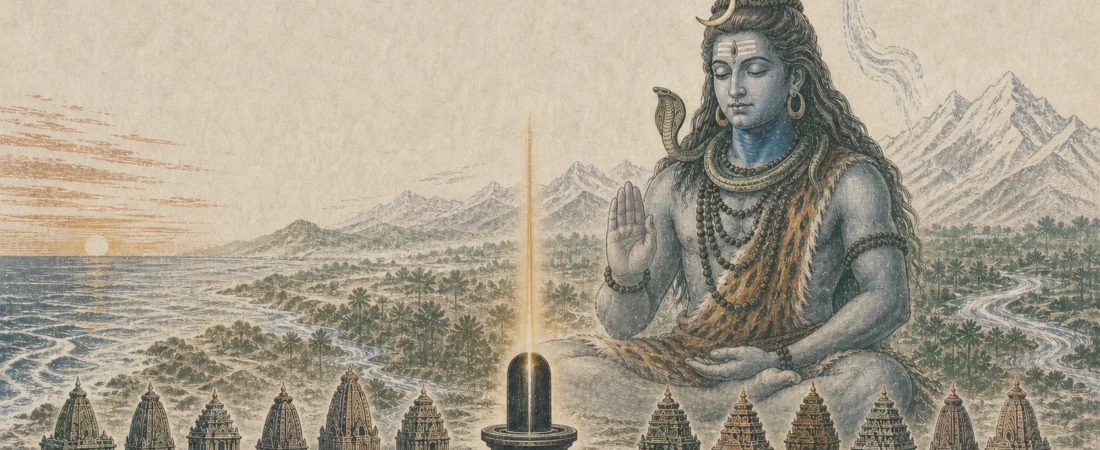
- The hero is generated conceptual artwork, not documentary photography or an exact reconstruction of the twelve temples.