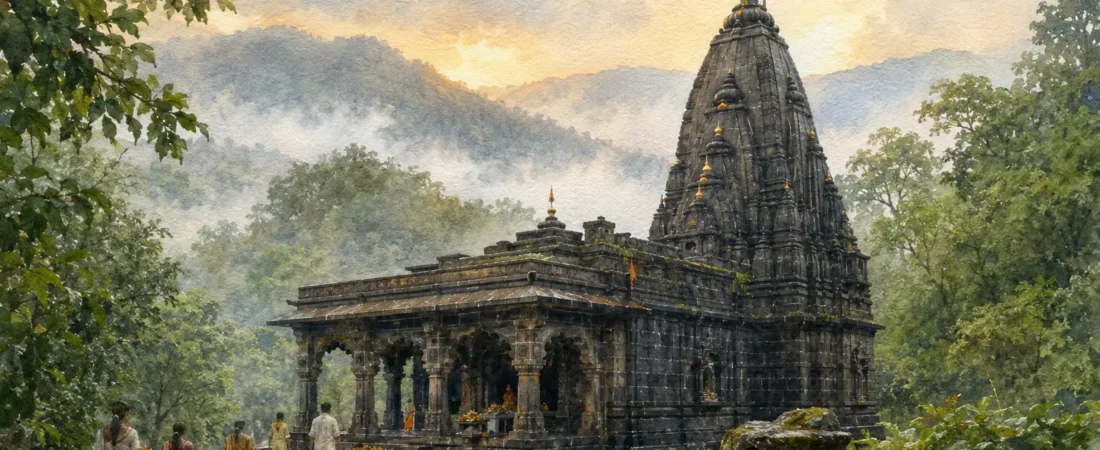
There are temples that rise above a city, temples that stand beside a river, and temples that draw the pilgrim deep into the shelter of a mountain. Bhimashankar Jyotirlinga in Maharashtra belongs to the third kind. The road climbs into the Sahyadris, the air becomes cooler, and the forest gradually closes around the traveller. In the monsoon, moss brightens the black stone and mist moves between the trees. In winter, the hills grow clear and quiet. At the centre of this living landscape stands an ancient shrine of Shiva.
Bhimashankar is revered as one of the twelve Jyotirlingas of India. Yet its spiritual character is different from the grandeur of Somnath beside the Arabian Sea or the intense ritual atmosphere of Mahakaleshwar in Ujjain. Here, Shiva is encountered through stone, cloud, water and forest silence.
The traditions of Bhimashankar speak of pride brought under dharma, of divine power used to protect rather than dominate, and of a sacred river born after a great cosmic struggle. The temple also invites a modern reflection: when a holy place lies inside a wildlife sanctuary, reverence must extend beyond the sanctum to every stream, animal and tree around it.
This guide brings together Bhimashankar’s Sthala Purana, mythological and spiritual significance, architecture, rituals, travel details, nearby attractions and strictly vegetarian cuisine – so that a visit can be prepared with both devotion and care.
In this guide
- Bhimashankar Jyotirlinga at a glance
- Where is Bhimashankar Jyotirlinga?
- The Puranic Bhimasura tradition
- The Maharashtra temple’s Tripurasura tradition
- The spiritual significance of Bhimashankar
- History and architecture: devotion built over centuries
- Darshan timings and daily worship
- Festivals at Bhimashankar
- What to eat near Bhimashankar: a vegetarian guide
- Places to visit near Bhimashankar Temple
- How to reach Bhimashankar Jyotirlinga
- Best time to visit Bhimashankar
- Frequently asked questions about Bhimashankar Jyotirlinga
Bhimashankar Jyotirlinga at a glance
| Detail | Information |
|---|---|
| Presiding deity | Lord Shiva as Bhimashankar Jyotirlinga |
| Location | Bhorgiri region, Sahyadri hills, Pune district, Maharashtra |
| Sacred geography | Traditionally associated with the source of the Bhima River |
| Temple style | Layered old-and-new stone complex with Nagara and Hemadpanti influences |
| Major festivals | Maha Shivaratri, Shravan Mondays and Kartik Purnima |
| Nearest major airport | Pune Airport, approximately 125 km by the temple’s published route information |
| Nearest convenient major railhead | Pune Junction, approximately 125 km by road |
| Road distance from Pune | Approximately 125 km; allow about 3.5–4.5 hours depending on weather and traffic |
| Best season for comfortable travel | September/October to February |
| Monsoon experience | Very green and atmospheric, but roads and trails can be slippery |
| Physical access | The temple website mentions around 150 steps; conditions may change during works |
| Ideal duration | One full day from Pune, or one night and two days for a slower pilgrimage |
Important travel note, checked 17 August 2026: The temple’s published routine schedule lists darshan from early morning until 9:30 PM. Its homepage also carries a renovation notice with a tentative closing date that has already passed, while recent visitor material refers to ongoing work. Because access may change at short notice, pilgrims should confirm the latest opening hours, staircase access and abhisheka arrangements directly with the temple before beginning the journey.
Where is Bhimashankar Jyotirlinga?
Bhimashankar lies high in the Western Ghats, or Sahyadri range, in Maharashtra’s Pune district. The official temple information places it about 125 kilometres from Pune, reached through a winding ghat route. Unlike a city temple that can be visited between other appointments, Bhimashankar asks the pilgrim to surrender to the journey. The forest, gradients, weather and final descent by steps are all part of the experience.
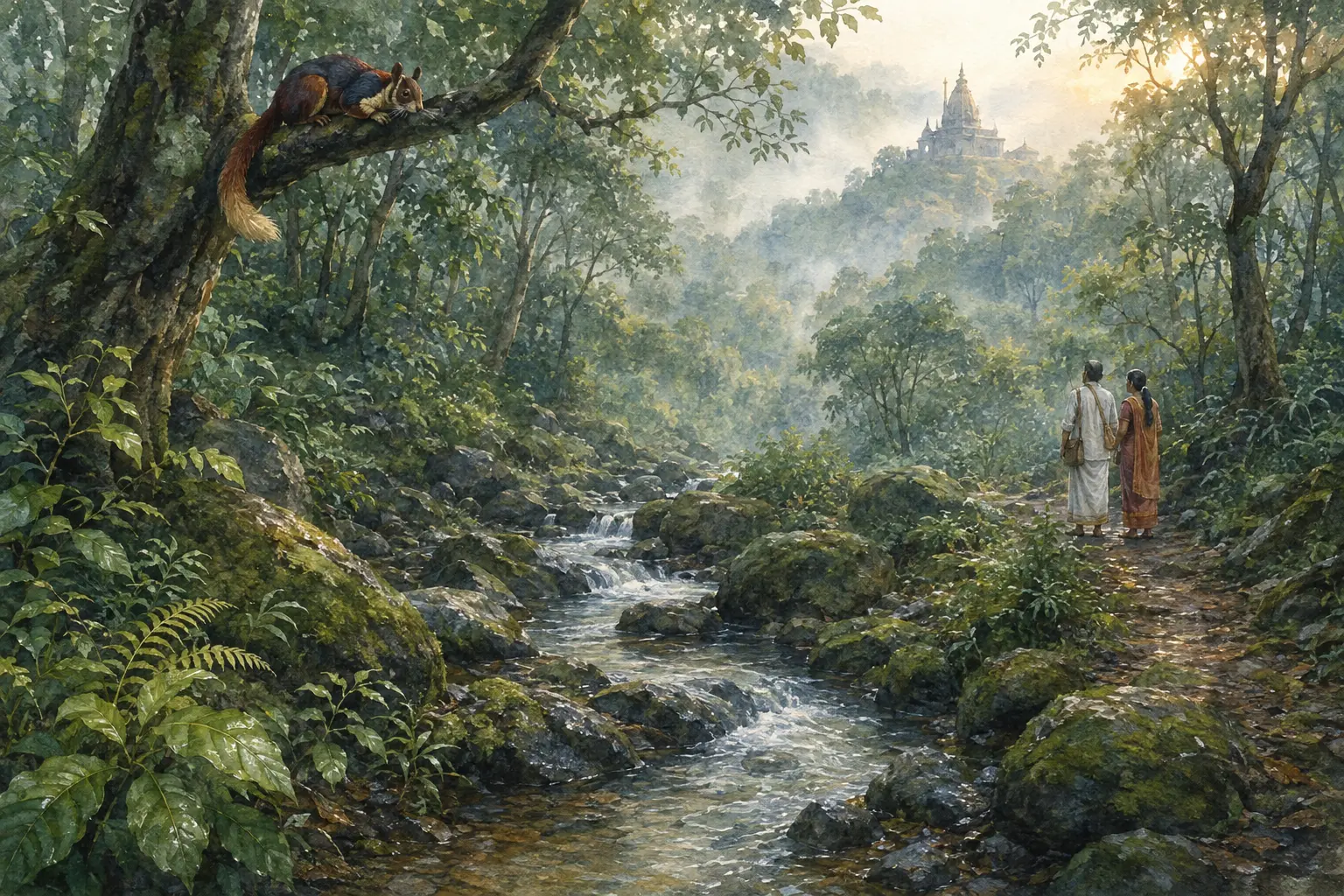
The shrine is surrounded by the Bhimashankar Wildlife Sanctuary, known for its dense forest and the Indian giant squirrel, locally called the Shekru. A visitor may be fortunate enough to see one, but a sighting should never be expected or pursued by leaving a permitted trail. The sanctuary is not a backdrop arranged for tourists; it is a protected habitat.
Bhimashankar is also held to be the place from which the Bhima River emerges. Farther downstream, the same river is known as Chandrabhaga at Pandharpur. This association creates a beautiful sacred bridge between Shaiva and Varkari landscapes: one river links the mountain presence of Shiva with the devotional world of Vitthala.
What does the name Bhimashankar mean?
“Shankara” is one of Shiva’s beloved names – the auspicious one, the beneficent one, the giver of peace. “Bhima” can suggest tremendous or formidable power. At Bhimashankar, these meanings meet: Shiva’s immense power is revealed not as uncontrolled force but as strength placed in the service of dharma.
Sacred traditions also connect the name to the Bhima River and to the accounts of Bhimasura and Tripurasura. As with many ancient tirthas, Bhimashankar is remembered through more than one sacred narrative. This article presents the Puranic account and the Maharashtra temple’s local tradition as distinct but complementary strands, without forcing them into a single chronology.
The Puranic Bhimasura tradition
The Shiva Purana’s Koti Rudra Samhita narrates the account of Bhima, the son of Kumbhakarna and Karkati. When Bhima learnt that his father had been slain by Shri Rama during the events of the Ramayana, anger took root in him. He performed severe tapas to Brahma and received extraordinary strength. But power without inner maturity became arrogance. Bhima began troubling the devas and obstructing righteous worship. He eventually defeated and imprisoned King Sudakshina of Kamarupa, a steadfast devotee of Shiva.
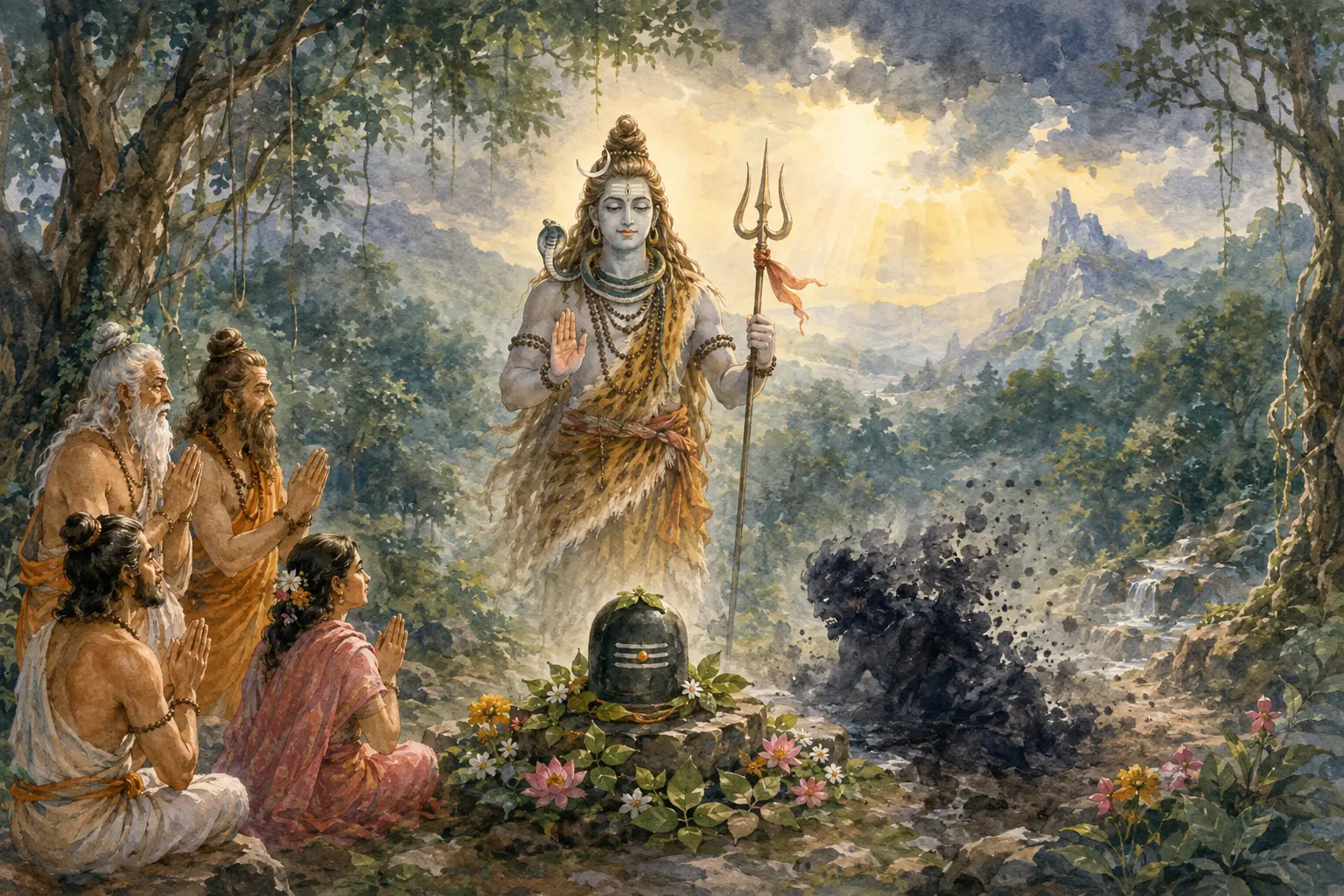
Even in captivity, King Sudakshina continued worshipping a Parthiva Linga, a linga reverentially formed from earth, and remained absorbed in Shiva mantra japa. When Bhima attempted to attack the king and his worship, Shiva manifested as Bhimeshwara, protected his devotee and destroyed Bhima. At the prayer of the devas and sages, the Lord abided there as the Jyotirlinga. This Puranic narrative is widely recounted in connection with Bhimashankar.
The purpose of this Puranic account is not simply to describe a victory. It brings an ethical truth close to the heart. Bhima’s penance gives him strength, but discipline without humility does not become wisdom. The king may be physically restrained, yet his devotion remains free. Shiva’s manifestation declares that spiritual power cannot be owned by the ego.
For the pilgrim, Bhimasura is also an inward symbol. Anger, injury and ambition can accumulate until they begin to rule the mind. Worship at Bhimashankar becomes a prayer that these forces be seen clearly and transformed before they harm others.
The Maharashtra temple’s Tripurasura tradition
The Maharashtra temple’s own traditional account gives special importance to Tripurasura. The asura performs penance and receives a boon, but later forgets the responsibility attached to it. When his actions create suffering, the deities turn to Shiva. In the temple tradition, Shiva invokes Goddess Parvati as Kamalaja Mata, and the divine unity of Shiva and Shakti restores balance. The victory is remembered on Kartik Purnima, also called Tripurari Purnima.
This local account brings forward a central Shaiva–Shakta insight: Shiva is inseparable from Shakti. Kamalaja Mata embodies the divine energy through which protection and the restoration of dharma unfold. Her nearby shrine reminds pilgrims to honour the sacred unity of Lord Shiva and Goddess Parvati.
The Tripurasura story carries the same warning as the Bhimasura narrative: tapas, talent or authority becomes dangerous when separated from responsibility. A boon is never merely a private possession; every gift brings a duty toward the larger world.
The sacred origin of the Bhima River
According to a cherished local tradition, drops of perspiration flowed from Shiva after the contest with Tripurasura and became the Bhima River. This image is spiritually rich. The river is born not from conquest but from the divine exertion associated with restoring order. It carries the memory that dharma must be lived, protected and renewed.
Water also changes the emotional tone of the legend. Fierce energy cools and becomes a river that nourishes villages, farms and places of pilgrimage. What begins as heat becomes grace. In personal practice, this can be understood as the transformation of difficult experience: pain, effort and struggle need not remain destructive; with awareness, they may become compassion and service.
The river’s forest source strengthens the duty of ecological care. Plastic, food waste, chemical offerings and careless trekking do not remain local inconveniences. They enter a watershed. To honour the Bhima as sacred is to keep her beginnings clean.
The spiritual significance of Bhimashankar
Each Jyotirlinga is revered as a manifestation of Shiva’s boundless jyoti, or divine light, while every tirtha gives that truth a distinct devotional language. Bhimashankar speaks especially through five ideas.
1. Power must be governed by dharma
Both sacred accounts show that spiritual discipline alone does not guarantee wisdom. Strength becomes sacred only when guided by compassion, restraint and responsibility.
2. Devotion preserves inner freedom
The imprisoned devotee in the Bhimasura tradition cannot control his circumstances, but he can guard the direction of his mind. His worship becomes an image of freedom that no external power can fully remove.
3. Shiva and Shakti are inseparable
The Kamalaja Mata tradition invites contemplation of the unity of Shiva and Shakti. Consciousness and divine energy are not opposing principles; together they sustain creation, protection and transformation.
4. Struggle can become a river of grace
The sacred account of the Bhima River’s origin transforms the heat of conflict into life-giving water. Bhimashankar therefore offers hope to those carrying fatigue, grief or conflict: sincere effort can be purified into something that sustains others.
5. Nature is part of the pilgrimage
At Bhimashankar, the forest is not outside the holy place. The mist, river source, birds and animals are part of the tirtha. Silence on the trail, responsible waste disposal and respect for wildlife become forms of seva.
History and architecture: devotion built over centuries
Bhimashankar Temple is not the work of a single moment. It is a composite structure, with an older stone core and later additions. Government tourism and district sources describe its Nagara-style character and place important portions of the complex in the medieval period. The sabhamandap and shikhara are traditionally associated with Nana Phadnavis in the eighteenth century.
The temple’s dark stone gives it a grounded presence. Its scale is dignified rather than overpowering. Carved details, pillars and the rising shikhara reward slow observation, but the atmosphere remains that of a mountain shrine. The architecture appears to grow from the same basalt landscape as the hills around it.
Tradition also remembers Maratha patronage, including endowments associated with Chhatrapati Shivaji Maharaj. A large bell in the complex is connected with Chimaji Appa and the Maratha victory at Vasai. Where documentary certainty varies, it is best to present these as remembered traditions rather than compress history and legend into one claim.
Inside the sanctum is the revered Jyotirlinga, worshipped as swayambhu, or self-manifested, in temple tradition. The sanctum can feel intimate, especially during quieter hours. During Shravan, Mondays and major festivals, the experience may be very different: queues grow long, ritual arrangements change, and movement is guided by temple staff.
Darshan timings and daily worship
The temple’s published routine schedule currently lists:
| Time | Ritual or access |
|---|---|
| 4:30 AM | Kakada Aarti |
| 5:00 AM | Nijarup Darshan |
| 5:30 AM | Regular puja and abhisheka begin |
| 12:00 PM | Naivedya Puja; no abhisheka inside |
| 12:30 PM | Regular puja and abhisheka resume |
| 3:00 PM | Madhyan Aarti; darshan pauses for approximately 45 minutes |
| 4:00–9:30 PM | Shringar Darshan; no abhisheka inside |
| 7:30 PM | Evening Aarti |
| 9:30 PM | Temple closes |
The published notes state that abhisheka arrangements differ on Mondays, Pradosh, during Shravan and at Maha Shivaratri. Renovation or crowd-control measures may override the routine. Treat the table as planning guidance, not a promise of access.
For a peaceful visit, arrive early, carry minimal belongings and follow the instructions given at the temple. Wear modest clothing suitable for worship and for descending stone steps. Photography may be restricted inside; always ask before using a camera. Do not assume that online videos reflect current rules.
Simple offerings traditionally associated with Shiva include clean water, bilva leaves, flowers and heartfelt mantra japa. The inward offering matters most: a few quiet repetitions of Om Namah Shivaya can prepare the mind before darshan.
Festivals at Bhimashankar
Maha Shivaratri
Maha Shivaratri is the most important festival of the shrine. Devotees gather for worship, mantra, fasting and night vigil. The spiritual atmosphere is powerful, but queues and traffic can be intense. Elderly pilgrims, families with small children and anyone with limited mobility should plan conservatively.
Shravan and Shravan Mondays
The month of Shravan brings large numbers of Shiva devotees. The forest is also at its greenest, creating a deeply beautiful pilgrimage. Heavy rain, slippery surfaces and long waits are possible. Carry rain protection that leaves the hands free, use footwear with reliable grip and keep a dry change of clothing.
Kartik Purnima
Kartik Purnima has special meaning because of the local Tripurasura tradition. For those drawn to the temple’s Sthala Purana, this observance brings the story of Shiva as Tripurari into the living ritual calendar.
Bhimashankar Wildlife Sanctuary: the forest as a sacred responsibility
The forest gives Bhimashankar its unmistakable character. The sanctuary protects Western Ghats habitat and is especially associated with the Indian giant squirrel or Shekru, Maharashtra’s state animal. Birdlife, streams, mosses and seasonal waterfalls make the landscape exceptionally rich.
Pilgrims can help preserve it through simple discipline:
- Carry back every item brought into the forest, including food wrappers and wet wipes.
- Do not feed, chase or call wildlife for photographs.
- Keep music and conversation low on forest paths.
- Use only permitted trails and respect closures during difficult weather.
- Avoid plucking plants or collecting stones, flowers and forest material.
- Carry a reusable water bottle where permitted.
- Never enter streams with soap, oil, food or ritual residue.
The Shekru is elusive. Seeing one is a blessing, not an entitlement. A pilgrimage remains complete even when the forest chooses silence.
What to eat near Bhimashankar: a vegetarian guide
Food near a mountain pilgrimage centre is usually simple, warming and practical. Availability changes with season, crowd and time of day, so it is wise to eat at a clean, busy establishment and keep a small reserve of fruit or dry snacks.
Breakfast favourites
Kanda poha: Soft flattened rice cooked with onion, mustard seeds, turmeric and peanuts. If fasting or avoiding onion, ask whether a plain version is available.
Upma: A gentle semolina breakfast that travels well after an early start.
Sabudana khichdi: Tapioca pearls with peanut, cumin and potato; popular on fasting days, though preparation practices vary.
Thalipeeth: A savoury multigrain flatbread, excellent with curd or a little homemade butter when available.
Comforting Maharashtrian meals
Pithla-bhakri: Gram-flour curry served with millet flatbread – earthy, filling and well suited to cool weather.
Varan-bhat: Mild dal with rice and a touch of ghee, ideal after darshan or for travellers who prefer gentle food.
Zunka-bhakri: A drier gram-flour preparation with bhakri; ask about spice level.
Usal or matki bhaji: Sprouted-bean preparations that add nourishing local flavour.
Maharashtrian vegetarian thali: Usually includes dal, rice, roti or bhakri, seasonal vegetables, pickle and curd; contents differ by restaurant.
Sweets and warm refreshments
Depending on the establishment, visitors may find puran poli, shrikhand, sheera or jaggery-based sweets. Hot tea is widely available, but in the monsoon choose stalls carefully and prefer freshly prepared food served hot.
Travellers with allergies or strict dietary observances should ask directly about peanuts, dairy, onion, garlic and shared cooking vessels. Packaged “fasting” food is not always prepared to the same standard in every kitchen.
Places to visit near Bhimashankar Temple
Gupt Bhimashankar
Gupt Bhimashankar is associated with a natural formation and flowing water in the forest. The path can become wet, uneven and difficult to identify during rain. Visit only when local conditions are safe, preferably with reliable local guidance, and do not attempt it merely because a social-media itinerary calls it “easy.”
Kamalaja Mata Temple
This shrine completes the Shiva–Shakti understanding of the local Sthala Purana. It is especially meaningful for pilgrims who wish to contemplate Parvati’s presence in the Tripurasura tradition.
Nagphani Point
Also called the Cobra’s Hood because of its shape, Nagphani offers wide Sahyadri views. Weather can change rapidly, and cloud, wind or rain may make the trail unsafe. Avoid exposed viewpoints during storms.
Hanuman Lake
Hanuman Lake offers a quieter encounter with the landscape and may interest birdwatchers. Maintain silence, avoid picnicking waste and treat the shore as habitat rather than a recreational dumping ground.
Bhorgiri Fort
The remains of Bhorgiri Fort add a historical and trekking dimension to the region. It is best considered an optional excursion for fit travellers with suitable footwear, local advice and enough daylight.
A longer Pune-district pilgrimage circuit
With additional days, travellers can connect Bhimashankar with the Ashtavinayak shrines at Ozar and Lenyadri, or explore Shivneri Fort near Junnar. Do not crowd all three into the same day as Bhimashankar unless the aim is only to touch each place briefly.
A gentle two-day Bhimashankar itinerary
Day 1: Pune to Bhimashankar
- Leave Pune early, ideally before city traffic builds.
- Stop for a fresh vegetarian breakfast on the route.
- Reach the Bhimashankar area with enough daylight to settle in.
- If access and crowd conditions permit, attend evening darshan or aarti.
- Eat a simple early dinner and rest. Forest roads are best avoided unnecessarily after dark.
Day 2: Darshan, sacred landscape and return
- Begin with early darshan, subject to the confirmed schedule.
- Visit Kamalaja Mata Temple and observe the architecture without hurry.
- Have a warm vegetarian breakfast.
- Choose only one nearby nature stop – such as a permitted forest walk, Hanuman Lake or Gupt Bhimashankar – based on weather, mobility and official/local advice.
- Eat lunch before beginning the return to Pune.
- Descend the ghat road well before late-night fatigue sets in.
This pace leaves room for prayer. A tirtha is not made more meaningful by collecting the maximum number of stops.
How to reach Bhimashankar Jyotirlinga
From Pune by road
The temple publishes a principal route through Rajgurunagar, Manchar and Taleghar, covering about 125 km. Under ordinary conditions it may take around three and a half hours, but city traffic, pilgrimage crowds, rain, fog and road works can add significant time. A private vehicle or taxi offers flexibility; state transport services may be economical, but exact timings should be rechecked before departure.
By bus
The temple website lists services from Pune’s Shivajinagar bus stand, as well as limited connections from the Mumbai side. Bus timetables are highly changeable. Confirm with Maharashtra State Road Transport Corporation or at the relevant bus station rather than depending on an old screenshot.
By train
Pune Junction is the most practical major railhead for many pilgrims because onward road transport is easier to arrange. Some travel guides mention Karjat for trekking approaches from Khandas, but it should not automatically be treated as the simplest temple railhead. Choose the rail route according to whether the goal is direct darshan or a serious trek.
By air
Pune Airport is the nearest major airport in the temple’s published travel guidance, approximately 125 km away by road. Leave a generous buffer between a return flight and the drive from Bhimashankar.
Trekking from Khandas
The Khandas approach is for prepared trekkers, not a shortcut for visitors seeking direct temple access. Ganesh Ghat is generally considered the more gradual option; Shidi Ghat is steeper and more technical. Monsoon water, loose rock, low visibility and slippery ladders or ledges can turn a familiar route into a dangerous one. Use a competent local guide, start early, check weather and forest permissions, and never pressure children or older family members into a trek they did not choose.
Best time to visit Bhimashankar
October to February: The most comfortable period for temple visits and light exploration. Mornings and evenings can be cool.
June to September: The forest is lush and the atmosphere unforgettable, but heavy rain, fog, slippery steps and trail closures are possible.
March to May: Warmer, though the high forest setting may still be more pleasant than the plains. Carry water and avoid demanding midday activity.
Shravan and Maha Shivaratri: Best for festival devotion, not for solitude or predictable queues.
If travelling with seniors, children or anyone with joint, heart or respiratory concerns, prefer stable weather and an overnight stay. Check current step access and renovation arrangements before booking.
Practical pilgrimage checklist
- Confirm temple opening, renovation status and ritual access on the day before travel.
- Keep government identification, essential medicines and a small first-aid kit.
- Carry a light shawl or rain layer according to season.
- Wear modest clothing and shoes with good grip.
- Keep cash in small denominations; digital connectivity may not always be dependable.
- Use a waterproof pouch for phones and documents during monsoon.
- Pack only vegetarian food and avoid carrying excessive disposable packaging.
- Keep time for the return journey; ghat driving after dark demands extra care.
- Do not promise elderly companions a “short walk” without checking current access.
- Allow the place to be sacred: reduce noise, hurry and photography.
Frequently asked questions about Bhimashankar Jyotirlinga
Where is Bhimashankar Jyotirlinga located?
Bhimashankar is in the Sahyadri hills of Pune district, Maharashtra, near the Bhorgiri region and within the landscape of Bhimashankar Wildlife Sanctuary.
How far is Bhimashankar from Pune?
The temple’s published route information gives an approximate road distance of 125 km. Travel time varies with traffic, weather and pilgrimage crowds.
What are the Bhimashankar temple timings?
The routine published schedule begins with Kakada Aarti at 4:30 AM, lists darshan from 5:00 AM and closes at 9:30 PM. Renovation and festival arrangements may change access, so confirm immediately before travel.
Why is Bhimashankar one of the twelve Jyotirlingas?
It is revered in the Dwadasha Jyotirlinga tradition as a manifestation of Shiva’s boundless divine light. The Puranic Bhima narrative and the Maharashtra temple’s local Tripurasura tradition both connect Bhimashankar with Shiva’s protection of devotees and restoration of dharma.
What is the Sthala Purana of Bhimashankar?
The Shiva Purana narrates Lord Shiva’s protection of King Sudakshina and the destruction of Bhima. The Maharashtra temple’s local tradition honours the victory over Tripurasura through the inseparable divine unity of Shiva and Parvati, worshipped here as Kamalaja Mata. Both accounts teach that power must remain aligned with dharma.
Is the Bhima River born at Bhimashankar?
The Bhimashankar landscape is traditionally regarded as the source region of the Bhima River. Sacred legend connects the river with Shiva after his struggle to restore order.
Which is the best month to visit Bhimashankar?
September or October through February usually offers the most comfortable weather. Monsoon is exceptionally beautiful but demands greater caution on roads, steps and trails.
Can senior citizens visit Bhimashankar Temple?
Many seniors do visit, but the approach includes steps and may be affected by construction or crowd controls. Check current access, plan an unhurried stay and seek medical guidance when needed.
Is Bhimashankar suitable for a one-day trip from Pune?
Yes, with an early start and limited stops. A one-night stay is better for relaxed darshan, seniors, festival periods or nature exploration.
Is the Bhimashankar trek compulsory?
No. The temple is accessible by road. Trekking from Khandas is a separate adventure activity and should be attempted only with preparation, safe weather and local guidance.
What vegetarian food is available near Bhimashankar?
Common choices may include poha, upma, sabudana khichdi, pithla-bhakri, varan-bhat, usal and simple vegetarian thalis. Availability changes, so carry modest backup snacks.
Can visitors see the Shekru at Bhimashankar?
The sanctuary is an important habitat of the Indian giant squirrel, locally called Shekru, but sightings are never guaranteed. Stay on permitted paths and never chase or feed wildlife.
A pilgrimage from force to grace
At Mallikarjuna in Srisailam, mountain, river and Shiva–Shakti devotion meet in one sacred geography. At Omkareshwar, the Narmada gathers the pilgrimage around an island shaped by sacred imagination. Bhimashankar offers another form of the same Indian insight: land and spirit are not separate.
The legends begin with enormous force – with tapas, boons, anger and cosmic struggle. Yet the lasting gifts of the place are quiet: a stone shrine, a forest, a stream becoming a river, and a mantra repeated under the breath.
Bhimashankar asks a tender but demanding question: What do we do with the strength we have been given? If it serves only the ego, it becomes Bhima’s burden. If it protects, purifies and nourishes, it becomes Shiva’s grace.
May the pilgrimage awaken courage without harshness, humility without weakness, and reverence that extends from the Jyotirlinga to the living forest around it.
Om Namah Shivaya.
To continue this sacred journey, read the previous article in our series: Baidyanath Jyotirlinga – Deoghar temple and travel guide.
Sources and further reading
- Kanchi Kamakoti Peetham: Shiva Purana summary
- Bhimashankar Temple: daily schedule
- Bhimashankar Temple: sacred tradition and temple information
- Bhimashankar Temple: route guidance
- Pune District Administration: Bhimashankar
- Maharashtra Tourism: Bhimashankar Temple
- Maharashtra Tourism: Bhimashankar nature guide