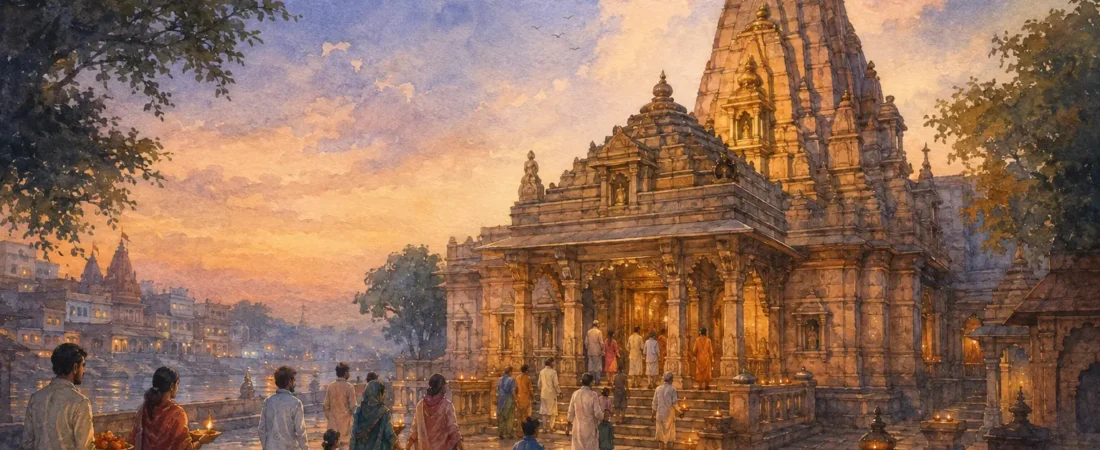
In the ancient city of Ujjain, where the sacred Shipra River carries memories of pilgrims, poets, astronomers and kings, Lord Shiva is worshipped as Mahakaleshwar, the great Lord of Time. This is one of the twelve Jyotirlingas of Shiva and one of the most distinctive sacred centres in India. The linga is traditionally revered as swayambhu, self-manifested, and as dakshinamukhi, facing south.
The name Mahakala brings the pilgrim face to face with a truth that ordinary life often avoids: everything within time changes. Youth, success, possessions, sorrow and even fear pass through the same current. Shiva as Mahakala is not worshipped to make life dark or frightening. He is approached as the consciousness that is greater than change, the compassionate presence before which fear loses its control.
The sacred name can be contemplated through three ideas: maha, the great or supreme; kala, time, change and mortality; and Ishwara, the Lord. Mahakaleshwar is therefore the Supreme Lord who governs and transcends time itself. This interpretation, emphasised in the source article supplied for Indian Ethos, is the philosophical key to the pilgrimage.
Mahakaleshwar is inseparable from Ujjain itself. Known in earlier traditions as Ujjayini and Avanti, the city has been a centre of pilgrimage, learning, poetry, astronomy and sacred geography. The Mahakal temple, the Shipra ghats, Harsiddhi Devi, Kal Bhairav, Sandipani Ashram, Mangalnath and Ved Shala together create a pilgrimage in which devotion, history and the Indian understanding of cosmic time meet.
ॐ महाकालेश्वराय नमः।
Om Mahakaleshwaraya Namah: Salutations to Lord Mahakaleshwar.
Contents
- Mahakaleshwar Jyotirlinga at a glance
- Why Mahakaleshwar is spiritually unique
- Sthala Purana and sacred legends
- The meaning of the south-facing Jyotirlinga
- Bhasma Aarti: ritual, meaning and booking
- Ujjain, the city of sacred time
- Temple history and architecture
- Darshan, worship and festivals
- Mahakal Lok and places to visit
- Vegetarian food and Malwa cuisine
- How to reach Ujjain
- Where to stay and practical guidance
- Suggested two-day pilgrimage itinerary
- Indian Ethos reflections
- Frequently asked questions
Mahakaleshwar Jyotirlinga at a Glance
| Detail | Information |
|---|---|
| Sacred name | Shri Mahakaleshwar Jyotirlinga |
| Location | Ujjain, Madhya Pradesh |
| Presiding deity | Lord Shiva as Mahakaleshwar or Mahakal |
| Sacred status | One of the twelve Jyotirlingas; Ujjain is traditionally counted among the Sapta Puri |
| Distinctive feature | Swayambhu and south-facing Jyotirlinga in temple tradition |
| Sacred river | Shipra, also written Kshipra |
| Famous ritual | Early-morning Bhasma Aarti |
| Principal festivals | Maha Shivaratri, Shravan Mondays, Mahakal Sawari and Nag Panchami |
| Nearest airport | Devi Ahilyabai Holkar Airport, Indore, about 53 to 56 km away according to official tourism sources |
| Nearest railway station | Ujjain Junction, station code UJN |
| Best general season | October to March for more comfortable weather |
| Ideal visit length | Two days for the main temple and principal sacred places |
| Official information and booking | Shri Mahakaleshwar Temple |
Why Is Mahakaleshwar Jyotirlinga Spiritually Unique?
Every Jyotirlinga points towards Shiva as limitless light, but Mahakaleshwar carries a particular relationship with kala, time. The Ujjain district administration describes Mahakala as the presiding deity of the city and remembers Ujjain as an important point in the traditional calculation of Indian time. The name therefore joins theology with the intellectual heritage of the city.
Time gives order to life, yet it also reminds us that nothing material can be permanently held. Mahakala represents that which is not diminished by passing years. To stand before Mahakaleshwar is to remember that human life is precious precisely because it is finite. Awareness of time need not create anxiety; it can create clarity.
The temple is also distinguished by the traditional understanding that the Jyotirlinga is swayambhu. Rather than being remembered only as an image ritually established at a later moment, it is revered as a presence that arose by its own power. This conveys a simple spiritual idea: the Divine is not manufactured by the human mind. Worship refines our perception so that we can recognise what is already present.
Mahakaleshwar is further known as dakshinamukhi, facing south. In many Hindu traditions, the southern direction is associated with Yama and mortality. Shiva facing south is therefore understood as sovereignty over death and fear. Devotees approach Mahakal for courage, protection and the strength to live without being ruled by the fear of the inevitable.
What Does Jyotirlinga Mean at Mahakaleshwar?
Jyoti means light, while linga points towards Shiva beyond limited form. A Jyotirlinga is therefore contemplated as infinite divine radiance. At Ujjain, this becomes a particularly beautiful relationship: Jyoti is eternal consciousness, kala is changing time, and Mahakala is that which time cannot diminish. Mahakaleshwar may thus be approached as the light that remains when everything governed by time has passed.
Sthala Purana of Mahakaleshwar Jyotirlinga
The Sthala Purana belongs to sacred narrative. It communicates devotional and ethical meaning and should not be confused with modern historical evidence. Details can vary across tellings, but the central tradition preserves the relationship between King Chandrasena, the child devotee Shrikhar, the threatened city of Ujjain and Shiva’s manifestation as Mahakala.
King Chandrasena and the Child Devotee Shrikhar
King Chandrasena of Ujjain is remembered as a devoted worshipper of Lord Shiva. During one period of worship, a young boy named Shrikhar saw the king’s devotion and longed to participate. When he was prevented from remaining near the royal worship, the child carried his longing elsewhere and continued to pray with complete sincerity.
The story shifts the centre of spiritual authority from position to devotion. Chandrasena is a king, while Shrikhar is a child without status or influence. Both are heard because bhakti is not measured by rank. Sacred tradition repeatedly returns to this truth: a sincere heart can enter where social privilege cannot.
The Threat to Ujjain and the Appearance of Mahakala
The legend tells that rival kings, commonly named Ripudamana and Singhaditya, planned to attack Ujjain with the support of a destructive being named Dushana or Dushanan. As danger approached, Shrikhar prayed intensely for the protection of the city. A priest, remembered in official tourism narration as Vridhi, also joined in prayer.
Lord Shiva then manifested in the formidable form of Mahakala, overcame the destructive force and protected Ujjain. Answering the prayers of the devotees, Shiva agreed to remain in the city as Mahakaleshwar.
The story is not merely about defeating an external enemy. Dushana can also be read symbolically as that which corrupts, confuses or destroys dharma. Mahakala is the power of clear consciousness that breaks the hold of fear and restores moral order. The child devotee teaches that courage begins not when fear disappears, but when faith becomes larger than fear.
Ujjain as the Sacred Centre
Puranic traditions connect Mahakaleshwar and Ujjain with the idea of a central or navel point of the earth. Such descriptions belong to sacred geography, not modern cartography. They express the experience of Ujjain as a centre from which religious time, pilgrimage and cultural memory radiate.
The South-Facing Mahakaleshwar Jyotirlinga
The south-facing orientation is one of the most discussed features of the Mahakaleshwar temple. The Ujjain district administration identifies the linga as dakshinamurti or south-facing and describes this as a unique feature among the twelve Jyotirlingas, upheld in tantric tradition.
The southern direction is traditionally associated with mortality. Mahakala does not deny death; he looks directly towards it. This becomes a profound form of reassurance. Spiritual courage does not come from pretending that change and loss do not exist. It comes from discovering an inner ground that remains steady even when circumstances change.
For the householder, this teaching is practical. Remembering time helps us stop postponing apologies, service, learning and affection. Mahakala asks a quiet question: if life is passing, what deserves our attention now?
Bhasma Aarti at Mahakaleshwar Temple
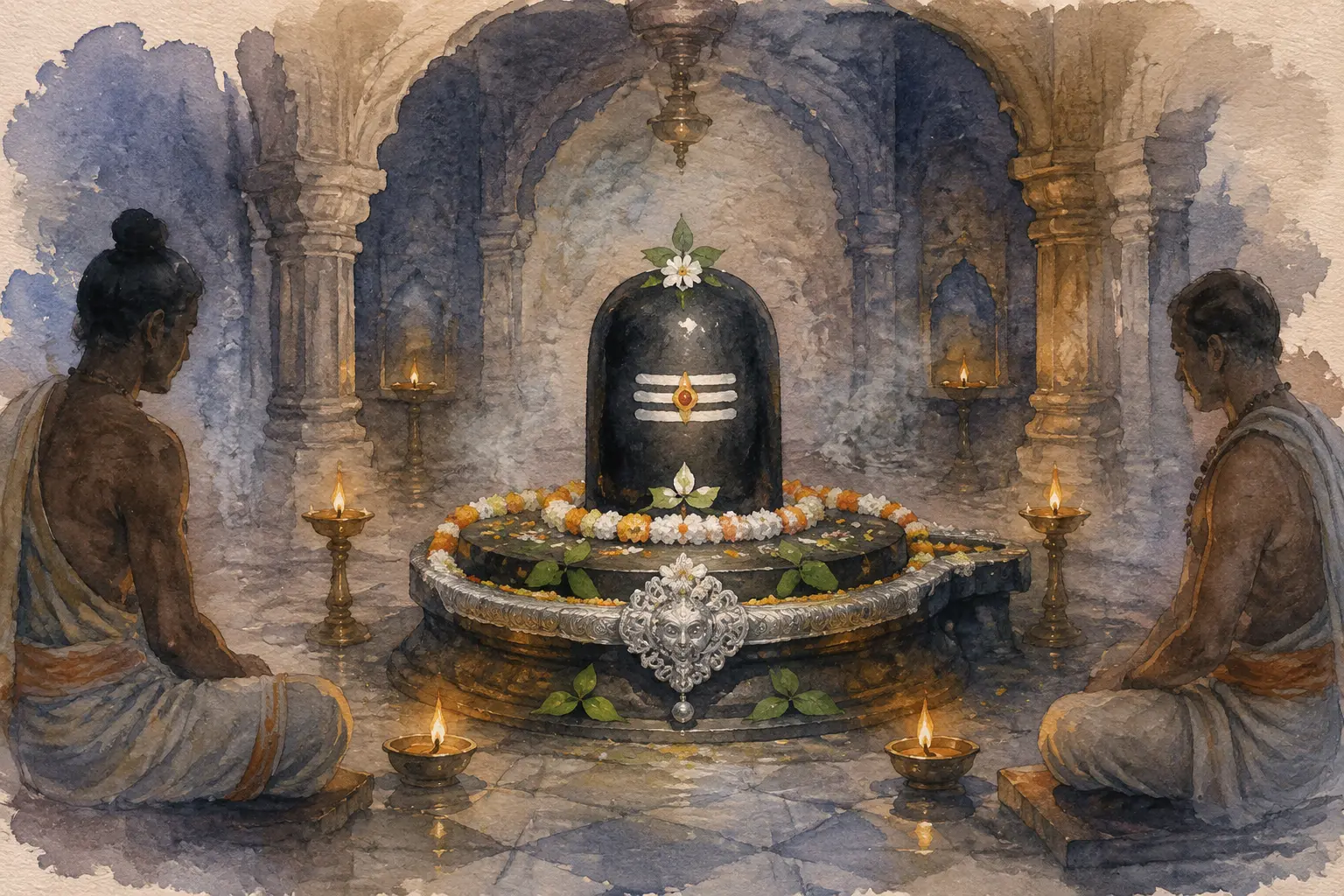
The early-morning Bhasma Aarti at Mahakaleshwar temple is one of Ujjain’s best-known rituals. Official tourism information states that it begins around 4:00 AM and that prior online registration is required for those wishing to attend. The ritual includes abhisheka, adornment and the offering of sacred ash to Mahakaleshwar.
Ash is among the most powerful symbols in Shaiva tradition. It reminds the devotee that every material form eventually returns to its elemental state. Applied in worship, bhasma is not a symbol of despair. It is a call to burn pride, possessiveness and false identity while life is still available for meaningful action.
How to Book Bhasma Aarti
- Use only the official Shri Mahakaleshwar website for current Bhasma Aarti registration and authorised services.
- Book well in advance when possible, especially for weekends, Shravan, Maha Shivaratri and public holidays.
- Carry the identification and confirmation requested in the booking instructions.
- Reach the designated reporting point at the time specified on the confirmation, not merely at the announced start of the aarti.
- Dress requirements, entry routes, permitted items and seating arrangements can change. Follow the current instructions issued with the booking.
- Photography and mobile-phone rules are controlled by temple authorities. Do not attempt to record the sanctum or ritual where prohibited.
Travellers who cannot obtain Bhasma Aarti entry should not feel that their pilgrimage is incomplete. Ordinary darshan, quiet japa, a visit to the Shipra and service through the temple annakshetra can be equally sincere forms of devotion.
Ujjain: The City of Sacred Time
Mahakaleshwar is best understood within the wider sacred personality of Ujjain. The city is remembered as Ujjayini and Avanti in classical and Puranic traditions. It is traditionally counted among the seven sacred cities associated with liberation and is one of the great Kumbh locations, where Simhastha is held on the banks of the Shipra.
Ujjain’s importance also extends beyond pilgrimage. The district administration notes its connection with traditional time calculation, while its association with Sanskrit learning and Mahakavi Kalidasa gives it a lasting place in India’s literary imagination. The city’s observatory, Ved Shala, preserves the later astronomical work associated with Maharaja Jai Singh II.
Vikramaditya, Kalidasa and the Cultural Memory of Ujjain
Ujjain is strongly associated in cultural memory with King Vikramaditya, the Vikrama tradition and Mahakavi Kalidasa. Historical layers and later legends should not be collapsed into a single biography, yet their continuing influence is undeniable. Kalidasa’s poetic remembrance of Mahakala helped carry Ujjain into the Sanskrit imagination, while modern cultural institutions and festivals continue to honour this literary inheritance.
This matters to Indian Ethos because ancient pilgrimage cities were rarely places of ritual alone. They could also sustain poetry, debate, teaching, calculation, music and the arts. Ujjain’s spiritual identity is richer when Mahakala and Kalidasa are seen not as competing subjects, but as expressions of a civilisation in which devotion and creativity could deepen each other.
This convergence is deeply Indian in spirit. Temple worship, mathematics, poetry, astronomy and the discipline of calendars were not always treated as isolated fields. Ujjain invites the visitor to see sacred time and measured time as two ways of contemplating order in the universe.
The Shipra River and Ram Ghat
The Shipra is the sacred river of Ujjain. Ram Ghat is among its principal pilgrimage spaces and becomes especially important during Simhastha and major festivals. An evening visit can be peaceful when crowds are moderate, but pilgrims should follow local safety instructions and avoid leaving plastic, cloth, food or ritual waste in the water.
A sacred river should be honoured through restraint. Taking darshan of the water is meaningful; protecting its cleanliness is also a form of worship.
History of Mahakaleshwar Temple
The antiquity of Mahakaleshwar belongs both to sacred memory and to the long history of Ujjain. These two forms of remembrance should be respected without being confused.
Government of India tourism material notes traditions and historical references connected with the temple from early periods, including Ujjain coins carrying Shiva imagery. It records reconstruction under the Paramara rulers Udayaditya and Naravarman in the twelfth century and major renovation by the Maratha commander Ranoji Shinde in the eighteenth century.
The temple passed through periods of disruption, renewal and patronage, as many important Indian sacred sites did. Its present form therefore reflects multiple phases rather than a single moment of construction. The survival of worship across changing political eras is itself part of the temple’s meaning: the Lord of Time has been remembered through time by communities that restored, served and returned to the shrine.
Mahakaleshwar also appears in the literary memory associated with Kalidasa. Government tourism sources refer to descriptions of Mahakala in works including Meghaduta. Ujjain is thus not only a destination on a map. It is a city carried across centuries through poetry.
Temple Architecture and Sacred Levels
The temple complex is described as a multi-level structure with the Mahakaleshwar sanctum below ground level. The architecture reflects Maratha, Bhumija and Chalukya influences, with sculpted surfaces, pillars, mandapas and a prominent shikhara.
The Omkareshwar form of Shiva is enshrined on the level above Mahakal. Images of Ganesha, Parvati and Kartikeya are arranged around the sanctum, and Nandi faces the deity. The Nagchandreshwar shrine on the third storey is traditionally opened for darshan only on Nag Panchami. This rare annual opening attracts very large crowds and requires careful planning.
Architecture here is not simply decorative. The movement through levels, thresholds and increasingly concentrated spaces prepares the mind to leave distraction behind. Pilgrimage becomes a change in attention before it becomes a view of the sanctum.
Darshan, Pujas and Worship
As checked on 17 August 2026, Government of India tourism information lists general temple darshan from approximately 4:00 AM to 11:00 PM. Actual access can change because of rituals, festivals, security, crowd management and temple decisions. Always verify the official website shortly before travel.
Authorised services visible through the official temple portal include Bhasma Aarti registration, sheeghra darshan, selected aarti bookings and pujan or abhishek services. Avoid unofficial agents and anyone promising guaranteed sanctum access outside the temple’s published system.
The temple’s daily worship rhythm includes the predawn Bhasma Aarti, morning offerings, bhog worship, Sandhya Aarti and Shayan Aarti. Exact times can vary with the Hindu calendar and special occasions. Traditional worship may include jalabhisheka, panchamrita abhisheka, bilva-patra offering, Rudrabhisheka, mantra japa, archana, aarti and darshan. Book rituals only through authorised systems and follow the current directions of the temple priests and administration.
A Simple Personal Practice
A pilgrimage does not require an elaborate private ritual. A devotee may sit quietly where permitted, breathe slowly and repeat:
ॐ नमः शिवाय।
Om Namah Shivaya.
Offer three inward intentions:
- May I use my time responsibly.
- May fear not control my decisions.
- May my actions protect rather than diminish others.
This transforms darshan from a moment of asking into a discipline of becoming.
Major Festivals and Significant Times to Visit
Maha Shivaratri
Maha Shivaratri is one of the most important celebrations at Mahakaleshwar. Worship continues through the night, and Ujjain receives very large numbers of pilgrims. The atmosphere is powerful, but accommodation, transport and darshan can be demanding. Families with elders or small children should weigh spiritual preference against crowd conditions.
Shravan and Mahakal Sawari
During Shravan and the following sacred period, Mahakal’s ceremonial procession or sawari moves through Ujjain on Mondays. The deity is carried in a decorated palanquin through the city, with worship at Ram Ghat and the participation of devotees, musicians and traditional groups. It expresses a beautiful idea: Mahakal does not remain confined within the sanctum but comes among the people as the guardian of Ujjain.
Nag Panchami
Nag Panchami is exceptional because the Nagchandreshwar shrine on the upper storey is opened for darshan. Crowds are usually intense. Visit only with current arrangements confirmed and allow ample time.
Simhastha
Ujjain is one of India’s great Kumbh cities. Simhastha is held periodically on the Shipra and transforms the city into an immense pilgrimage gathering. Dates, zones, transport systems and river access must be checked through official government announcements for the relevant cycle.
Best General Season
For a quieter Mahakaleshwar Jyotirlinga Ujjain travel guide, October to March is generally the most comfortable period. Summer can be extremely hot. Monsoon brings humidity and occasional travel disruption. Festival visits offer remarkable living tradition but require early bookings and patience.
Mahakal Lok Corridor
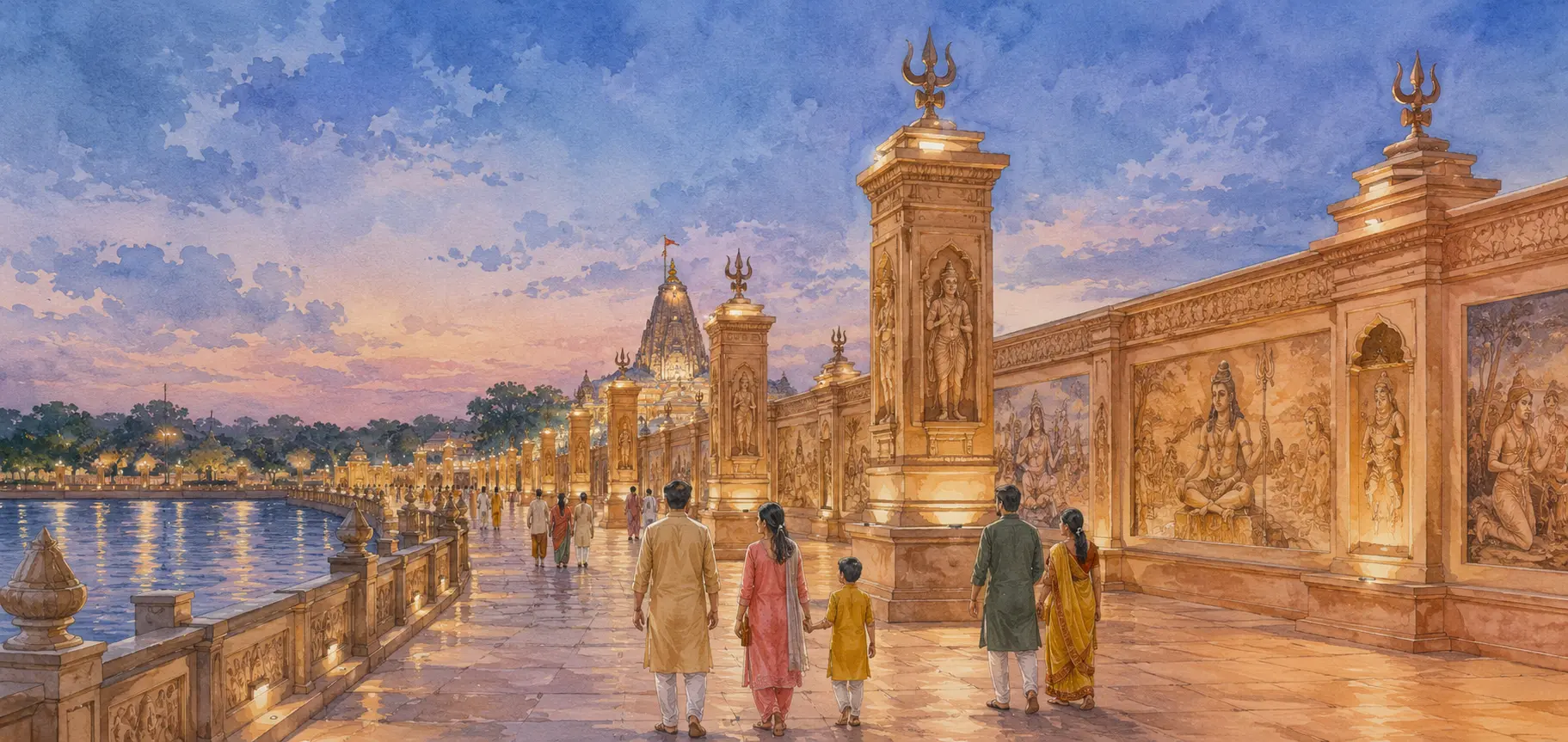
The Mahakal Lok corridor has become an important part of the modern pilgrimage experience. Madhya Pradesh Tourism describes a sacred passage extending more than 900 metres, with trishul-crowned columns, murals and sculptural narratives based on stories of Shiva. The corridor connects art, movement and preparation for darshan.
Official tourism information has listed corridor visiting hours from 6:00 AM until the last entry around 10:00 PM and no general entry fee, but these details should be reconfirmed before travel. Evening illumination creates a particularly attractive atmosphere, while early morning is often calmer.
The sculptures should be approached as narrative art, not merely photo backdrops. Moving slowly and reading available descriptions can turn the corridor into a visual introduction to Shaiva tradition.
Important Places to Visit Near Mahakaleshwar Temple
1. Harsiddhi Temple
Harsiddhi Devi is one of Ujjain’s most revered forms of the Divine Mother. The temple is especially known for its tall lamp pillars, which are illuminated on important occasions. Its proximity to Mahakaleshwar makes it an essential part of the Shiva-Shakti pilgrimage circuit.
2. Ram Ghat and the Shipra River
Ram Ghat is a principal sacred space on the Shipra. Visit in the early morning or near evening aarti, depending on current arrangements. Exercise caution on wet steps and keep the river clean.
3. Kal Bhairav Temple
Kal Bhairav is worshipped as a guardian of Ujjain. The shrine has a distinctive ritual tradition handled by its priests. Visitors may simply offer respectful darshan and should avoid treating the practice as a curiosity or spectacle.
4. Sandipani Ashram
Tradition remembers Sandipani Ashram as the place where Sri Krishna, Balarama and Sudama studied under Guru Sandipani. The ashram connects pilgrimage with the Indian ideal of learning shaped by discipline, service and the guru-shishya relationship.
5. Mangalnath Temple
Located near the Shipra, Mangalnath is associated with Mangala and with Ujjain’s astronomical and astrological traditions. The setting is often quieter than the central temple precinct.
6. Ved Shala or Jantar Mantar
Built under Maharaja Jai Singh II in the eighteenth century, Ved Shala contains instruments used to observe celestial movement and calculate time. It is one of the best places to understand why Ujjain’s identity includes both Mahakala and astronomy.
7. Chintaman Ganesh Temple
This ancient Ganesha shrine is visited by devotees seeking steadiness and relief from worry. It can be included when travelling towards the outer parts of the city.
8. Gadkalika Temple
Gadkalika is associated in tradition with Mahakavi Kalidasa and the worship of the Goddess. It adds a literary dimension to Ujjain’s sacred circuit.
9. Bhartrihari Caves
The caves are associated with Raja Bhartrihari, remembered in tradition as a king who turned towards renunciation. The site encourages reflection on the movement from worldly power to inner inquiry.
10. Gopal Mandir
Situated in the old market area, Gopal Mandir is a prominent Krishna temple associated with Maratha-period patronage. Its urban setting offers a glimpse of Ujjain’s living market culture.
11. Vikram Kirti Mandir and Cultural Sites
Travellers interested in the wider heritage of Ujjain may add Vikram Kirti Mandir or other currently open cultural institutions associated with Vikramaditya and Kalidasa. Confirm opening days and exhibition access locally, since museum arrangements can change.
The Living Culture of Ujjain
Ujjain carries the rhythm of Malwa together with the daily movement of a major pilgrimage city. Hindi and Malwi speech, temple bells, flower and puja markets, bhajans, Shravan processions, Navaratri lamps, Kartik observances and religious calendars shape the atmosphere of the old city. Sanskrit learning, astrology and the memory of classical literature continue to sit beside modern shops, transport and hospitality.
The most respectful way to experience this culture is slowly. Walk where permitted, buy from local vendors without aggressive bargaining, ask before photographing people and allow processions to remain acts of worship rather than tourist performances.
Vegetarian Food and Malwa Cuisine in Ujjain
Ujjain offers abundant vegetarian food, from temple annakshetra meals to robust Malwa dishes and popular street snacks. Madhya Pradesh Tourism notes that the Mahakaleshwar annakshetra serves free satvik food to devotees. Availability and serving arrangements should be confirmed locally.
Recommended vegetarian dishes include:
- Poha with sev: A light local breakfast, often gently sweet-spiced and topped with sev. Ask for no onion if required.
- Poha and jalebi: A beloved sweet-savoury combination across the Malwa region.
- Dal bafla: Wheat dough portions that are boiled and roasted, then served with dal, ghee and accompaniments. It is filling and best enjoyed as a proper meal.
- Bhutte ka kees: Grated corn cooked with milk, spices and tempering, especially enjoyable when corn is in season.
- Sabudana khichdi: A common vegetarian and fasting-friendly dish, though preparation practices vary.
- Kachori: Crisp pastry with a spiced filling, served with chutney. Confirm freshness and spice level.
- Samosa: A familiar but satisfying local snack, best eaten freshly fried and in moderation during a pilgrimage schedule.
- Aloo bada: Potato fritter traditionally served with green chutney.
- Sev and regional namkeen: Easy to carry, but check salt and spice if travelling with elders.
- Gulab jamun, jalebi and rabri: Popular sweets for those who wish to sample the city’s richer flavours.
- Simple thali: Dal, seasonal vegetables, roti, rice, curd and pickle provide a dependable vegetarian meal.
For strict satvik food, ask specifically about onion, garlic and hing. For fasting food, confirm whether grains, ordinary salt or shared frying oil are used. Choose busy, clean establishments with freshly prepared food, drink safe water and keep heavy street-food tasting separate from an early Bhasma Aarti morning.
How to Reach Mahakaleshwar Ujjain
By Air
The nearest major airport is Devi Ahilyabai Holkar Airport in Indore, approximately 53 to 56 km from Ujjain according to official sources. Taxis, buses and app-based services may be available, but late-night options should be planned in advance.
By Train
Ujjain Junction, station code UJN, is connected with many major cities. Train routes and frequencies change, so check the current railway timetable. The temple is only a few kilometres from the station, though travel time increases during festivals and traffic restrictions.
By Road
Ujjain has regular road connections with Indore, Bhopal, Omkareshwar and other regional centres. State buses, private buses, taxis and self-drive routes are available. Within the old city, traffic diversions and pedestrian zones may apply around Mahakaleshwar.
From Bengaluru
The most convenient option for many travellers is a flight from Bengaluru to Indore followed by a road transfer to Ujjain. Rail journeys may be direct on selected services or require a connection, depending on the date. A road journey is long and is better divided with adequate rest rather than attempted as a rushed overnight drive.
Where to Stay in Ujjain
Accommodation ranges from temple-area dharmashalas and simple guesthouses to government tourism properties, homestays and hotels around Freeganj, the railway station and Indore Road.
Choose according to pilgrimage priorities:
- Near Mahakaleshwar: Best for walking access and very early reporting, but can be noisy and crowded.
- Freeganj or railway-station area: Convenient for transport, restaurants and a wider range of hotels.
- Indore Road: Often suitable for travellers arriving by air or car and those preferring easier vehicle access.
- Government tourism properties: The Ujjain district accommodation directory lists options including MPT Ujjaini and Shipra Residency; verify current booking status directly.
- Temple guest accommodation: Consult the official temple website for current listings and booking rules.
Before paying, confirm check-in time, parking, lift availability, distance from the actual entry gate, hot water, cancellation policy and early-morning transport.
Suggested Two-Day Ujjain Pilgrimage Itinerary
Day One: Mahakal and the Sacred Centre
- Attend Bhasma Aarti if officially booked, or take early general darshan.
- Rest and have a light breakfast of poha or simple satvik food.
- Walk through Mahakal Lok when the temperature is comfortable.
- Visit Harsiddhi Temple and Bada Ganesh.
- Have lunch at the annakshetra when available or choose a vegetarian thali.
- Rest during the hottest part of the day.
- Visit Ram Ghat and attend the evening river aarti if operating.
- Return for an evening view of Mahakal Lok or temple darshan if energy and crowd conditions permit.
Day Two: Ujjain’s Wider Sacred Geography
- Begin with Kal Bhairav Temple before peak crowds.
- Visit Bhartrihari Caves and, if suitable, nearby Shipra sites.
- Continue to Mangalnath Temple.
- Visit Sandipani Ashram.
- Have a Malwa vegetarian lunch with dal bafla or a simple thali.
- Explore Ved Shala in the afternoon.
- Add Gadkalika, Chintaman Ganesh or Gopal Mandir according to time and interest.
- Keep buffer time for traffic, darshan queues and rest.
Practical Pilgrimage Guidance
- Use only the official temple website for paid services and aarti registration.
- Carry a physical identity document if required by the booking.
- Keep footwear, phones, bags and valuables only in authorised facilities.
- Avoid unofficial guides promising queue-free sanctum entry.
- Confirm special rules for Bhasma Aarti, Nag Panchami, Shravan Mondays and Maha Shivaratri.
- Wear modest, comfortable clothing and carry a light shawl for predawn hours in winter.
- Expect long walking distances around controlled traffic zones.
- Use a wheelchair or assistance facility only after confirming the current entry route.
- Keep children and elders hydrated, but check where bottles are permitted.
- Treat every sacred space and local ritual with dignity; ask before photographing people.
- Do not leave plastic, flowers, food or ritual materials at the Shipra ghats.
- Verify timings again shortly before departure because official schedules can change.
Four Indian Ethos Reflections From Mahakaleshwar
Time Is a Teacher, Not an Enemy
Mahakala does not ask us to fear time. He asks us to use it. A life guided by awareness becomes less wasteful, less resentful and more purposeful.
Courage Begins by Facing Reality
The south-facing Shiva reminds us that freedom is not achieved by avoiding difficult truths. We grow when we look at change, loss and responsibility without surrendering to panic.
Devotion Is Not Measured by Status
In the Sthala Purana, a king and a child both become part of the sacred story. Bhakti is not owned by position, age or wealth. Sincerity is itself a form of access.
Knowledge and Worship Can Strengthen Each Other
Ujjain holds Mahakala, poetry and astronomy within the same cultural memory. Indian civilisation at its best did not ask the seeker to choose between wonder and inquiry. Reverence can inspire careful observation, while knowledge can deepen humility.
Carry This With You
Mahakaleshwar is the Lord beyond time, yet his lesson belongs to every ordinary day. Use time before it is lost. Speak affection before distance grows. Perform duty before excuses multiply. Let fear inform caution but never become the ruler of the mind.
The ash of Bhasma Aarti reminds us that pride will not endure. The child Shrikhar reminds us that sincere prayer is never insignificant. The south-facing Jyotirlinga reminds us that truth can be faced. Ujjain’s observatory reminds us to look carefully at the heavens and at our own conduct.
The Mahamrityunjaya Mantra is also deeply resonant with Mahakala’s teaching:
ॐ त्र्यम्बकं यजामहे सुगन्धिं पुष्टिवर्धनम् ।
उर्वारुकमिव बन्धनान्मृत्योर्मुक्षीय मामृतात् ॥
Its prayer is not an escape from responsible living. It is a movement from bondage to inner freedom, asking that fear of mortality no longer prevent a life of courage, nourishment and purpose.
When a pilgrim leaves Mahakal’s city, the best offering carried home is not merely a souvenir. It is a more conscious relationship with time.
हर हर महादेव। जय श्री महाकाल।
Frequently Asked Questions
Where is Mahakaleshwar Jyotirlinga located?
Mahakaleshwar Jyotirlinga is in Ujjain, Madhya Pradesh, near the sacred Shipra River. Ujjain Junction is the nearest railway station, and Indore has the nearest major airport.
Why is Mahakaleshwar temple so important?
It is one of the twelve Jyotirlingas, revered as swayambhu and south-facing. Shiva is worshipped here as Mahakala, the Lord beyond time and death.
What is the Sthala Purana of Mahakaleshwar?
A principal tradition tells of King Chandrasena, the child devotee Shrikhar and prayers offered when Ujjain was threatened. Shiva manifested as Mahakala, protected the city and agreed to remain there.
Why does Mahakaleshwar Jyotirlinga face south?
The south is traditionally associated with mortality. Shiva facing south is understood as mastery over death and as protection from fear. The Ujjain district administration describes this orientation as unique among the twelve Jyotirlingas.
What is Bhasma Aarti?
Bhasma Aarti is the predawn worship in which Mahakaleshwar is honoured through abhisheka, adornment and sacred ash. It begins around 4:00 AM according to current official tourism information, and advance registration is generally required.
How can I book Bhasma Aarti at Mahakaleshwar?
Book only through the official Shri Mahakaleshwar website. Follow the identification, reporting-time, dress and entry instructions shown in the current confirmation.
What are the current Mahakaleshwar temple timings?
As checked on 17 August 2026, Government of India tourism information lists general darshan from about 4:00 AM to 11:00 PM. Ritual intervals and festival arrangements may alter access, so verify before travel.
Which is the best time to visit Ujjain?
October to March is usually the most comfortable season. Shravan, Maha Shivaratri and Nag Panchami have exceptional spiritual importance but much larger crowds.
How many days are sufficient for Ujjain?
Two days allow time for Mahakaleshwar, Mahakal Lok, Harsiddhi, Ram Ghat, Kal Bhairav, Sandipani Ashram, Mangalnath and Ved Shala without excessive rushing.
What vegetarian food should I try in Ujjain?
Try poha with sev, jalebi, dal bafla, bhutte ka kees, sabudana khichdi, kachori, aloo bada, Malwa namkeen and a simple vegetarian thali. Ask about onion, garlic and shared cooking if following a strict satvik diet.
What places should I visit near Mahakaleshwar temple?
Mahakal Lok, Harsiddhi Temple, Ram Ghat, Kal Bhairav, Sandipani Ashram, Mangalnath, Ved Shala, Chintaman Ganesh, Gadkalika and Bhartrihari Caves are important choices.
Can Mahakaleshwar and Omkareshwar be visited in one trip?
Yes. Many pilgrims combine Ujjain and Omkareshwar through Indore. A comfortable itinerary usually allows separate time for both Jyotirlingas instead of compressing them into one exhausting day.
Read next: The Dwadasha Jyotirlingas | Somnath Jyotirlinga | Srisailam Mallikarjuna Jyotirlinga | Temples of India
Sources and Editorial Note
- Shri Mahakaleshwar Temple: official website and authorised booking
- Ujjain District Administration: Shri Mahakaleshwar Temple
- Incredible India: Mahakaleshwar Temple
- Madhya Pradesh Tourism: Ujjain
- Madhya Pradesh Tourism: Mahakal Lok Corridor
- Ujjain District Administration: Festivals
- Incredible India: Mahakal Sawari
- Incredible India: Ved Shala
- Ujjain District Administration: Culinary Delights
- Madhya Pradesh Tourism: Malwa Cuisine
- Ujjain District Administration: Accommodation
Visitor information was checked on 17 August 2026. Timings, registration, dress requirements, darshan routes, prices, accommodation and festival arrangements can change. Sacred stories are identified as Puranic or local tradition. Symbolic interpretations are presented as Indian Ethos reflections rather than archaeological claims.