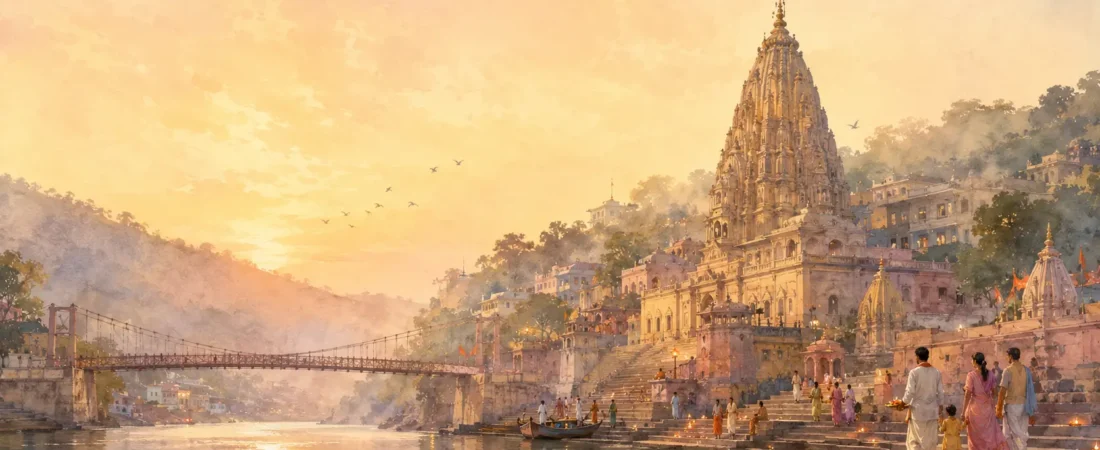
On an island embraced by the Narmada, the sound of Om seems to become landscape. Water curves around Mandhata Parvat, temple bells cross the river, pilgrims carry flowers over the bridge, and Lord Shiva is worshipped on both banks as Omkareshwar and Mamleshwar.
Omkareshwar is one of the twelve sacred Jyotirlingas. It is located at Mandhata in Khandwa district, Madhya Pradesh. The main Omkareshwar temple stands on the island, while Mamleshwar, whose older name is given by the temple trust as Amreshwar, stands on the southern mainland bank. Devotees traditionally visit both shrines. This twin pilgrimage is important because the sacred story does not treat the two temples as rivals. It remembers one divine manifestation through two forms.
The name Omkareshwar means the Lord of Omkara, the Lord of the primordial sacred sound. Om is not merely a syllable placed at the beginning of a prayer. In Indian spiritual thought it points towards the unity beneath apparent difference, the wholeness from which creation emerges and into which it returns. Beside the Narmada, this philosophy is not confined to a text. It is walked across bridges, heard in aarti, carried as river water and completed by visiting both sides of the sacred town.
Omkareshwar is therefore a pilgrimage of relationship: island and mainland, sound and silence, Shiva and Shakti, teacher and disciple, temple and river. Its deepest message is simple. The Divine may be approached through many names and places, yet the source is one.
ॐ ओंकारेश्वराय नमः।
Om Omkareshwaraya Namah: Salutations to Lord Omkareshwar.
Continue the Jyotirlinga journey through our Dwadasha Jyotirlingas guide, Mahakaleshwar guide, Somnath guide and Srisailam Mallikarjuna guide.
Contents
- Omkareshwar Jyotirlinga at a glance
- Why pilgrims visit both Omkareshwar and Mamleshwar
- Sthala Purana and sacred legends
- The meaning of Om and the sacred island
- Narmada, Kaveri Sangam and sacred geography
- Adi Shankaracharya and Govinda Bhagavatpada
- Temple history and architecture
- Darshan timings, booking and worship
- Omkar Parvat parikrama
- Festivals and best time to visit
- Places to visit in and near Omkareshwar
- Vegetarian food and regional cuisine
- How to reach Omkareshwar
- Accommodation, accessibility and practical guidance
- Suggested two-day pilgrimage itinerary
- Indian Ethos reflections
- Frequently asked questions
Omkareshwar Jyotirlinga at a Glance
| Detail | Information |
|---|---|
| Sacred names | Shri Omkareshwar Jyotirlinga and Shri Mamleshwar, also called Amreshwar |
| Location | Mandhata, Khandwa district, Madhya Pradesh |
| Sacred status | One of the twelve Jyotirlingas of Lord Shiva |
| Main geography | Omkareshwar on Mandhata island; Mamleshwar on the southern mainland bank |
| Sacred river | Narmada, with the local Kaveri stream or channel joining in the sacred landscape |
| Distinctive pilgrimage | Darshan at both Omkareshwar and Mamleshwar |
| Traditional parikrama | Omkar Parvat circuit, approximately 7 km according to the temple trust |
| Principal festivals | Maha Shivaratri, Shravan, Monday palki processions and other Shaiva observances |
| Nearest airport | Devi Ahilyabai Holkar Airport, Indore, approximately 84 to 87 km by official sources |
| Nearest local rail point | Omkareshwar Road, approximately 12 km from the town according to MP Tourism |
| Better connected railheads | Indore and Khandwa, subject to current train schedules |
| Best general season | October to March for more comfortable walking and sightseeing |
| Ideal visit length | One full day for the twin shrines; two days for parikrama and nearby sacred places |
| Official temple information | Shri Omkareshwar Mandir Trust |
Distances differ slightly among official sources because they may measure different road points. Treat all figures as planning estimates and verify the final route before travel.
Why Should Pilgrims Visit Both Omkareshwar and Mamleshwar?
The official Omkareshwar Temple Trust identifies Omkareshwar and Mamleshwar as the two forms associated with the sacred manifestation. Its account says that after the prayers of the devas, the linga divided into two: Omkareshwar and Mamleshwar. It describes Omkareshwar as the Pranava linga and Mamleshwar as the physical or parthiva linga.
Mamleshwar stands on the southern bank of the Narmada. The trust explains that its older or actual name is Amreshwar and that devotees visit both temples for worship. The Khandwa district tourism portal similarly refers to the sacred site as Omkar Mamleshwar. This shared language is helpful because popular discussions sometimes ask which of the two is the real Jyotirlinga. The living pilgrimage tradition offers a wiser answer: visit both with reverence.
Omkareshwar expresses the subtle principle of Om, the unbounded reality invoked through sacred sound. Mamleshwar preserves the intimacy of worship through a tangible linga and an ancient temple. One is not diminished by the other. Together they teach that the Divine may be contemplated as both beyond form and lovingly present within form.
For a pilgrim with limited time, the main Omkareshwar shrine may naturally receive first attention. Yet crossing to Mamleshwar completes the spiritual and geographical experience. It also encourages the visitor to slow down. A Jyotirlinga journey is not a checklist of famous doorways. It is an opportunity to recognise unity across difference.
Sthala Purana of Omkareshwar Jyotirlinga
Sthala Purana is sacred narrative. It transmits religious memory, ethical meaning and a community’s experience of place. It should not be presented as modern historical proof. Details can vary across Puranic, temple and oral tellings, but several central traditions are consistently associated with Omkareshwar.
Vindhya’s Penance and the Two Forms of Shiva
The principal legend related by the official temple trust begins with Vindhya, the sacred mountain range. Vindhya performed severe penance and worshipped Lord Shiva through a parthiva linga, a linga made of earthly material. Pleased by this devotion, Shiva appeared and blessed Vindhya, manifesting as the Pranava linga.
The story then speaks of the divine manifestation in two forms. One came to be worshipped as Omkareshwar, connected with Pranava or the sacred syllable Om. The other became Mamleshwar or Amreshwar, connected with the parthiva linga. The legend is an elegant spiritual teaching. The clay linga represents the devotee’s humble effort. The Pranava linga represents the boundless reality that answers that effort. Human devotion and divine grace meet beside the river.
Vindhya’s story can also be read as a warning against spiritual pride. A mountain may be vast, yet it bows in worship. True greatness is not proved by standing above others. It is revealed by knowing before what one should bow.
King Mandhata and the Sacred Island
Another revered tradition connects the island with King Mandhata of the Ikshvaku dynasty. The king is remembered as having performed deep tapas here until Shiva revealed his presence. The island consequently became known as Mandhata, and the sacred town is also called Omkar Mandhata.
Some tellings extend the association to Mandhata’s sons, Ambarisha and Muchukunda, who are also remembered for austerity. As with many ancient pilgrimage narratives, versions vary. Their shared meaning is more stable than every narrative detail: power becomes sacred only when placed in service of dharma.
Mandhata is remembered not for conquering the river but for surrendering beside it. This distinction matters. Indian sacred geography repeatedly honours rulers at the moment they become seekers. Authority may organise a kingdom, but humility opens the inward kingdom.
The Devas and the Defeat of Destructive Forces
A further tradition says that the devas were overcome by destructive forces and turned to Shiva for protection. Shiva appeared as Omkareshwar and restored balance. This belongs to the familiar Puranic pattern in which divine power does more than defeat an opponent. It re-establishes dharma when disorder has become dominant.
For the modern devotee, the battle may be inward. Anger, envy, addiction, fear and self-deception can occupy the mind as firmly as an external enemy occupies a city. Omkareshwar represents the steady vibration of awareness through which confusion is recognised and released.
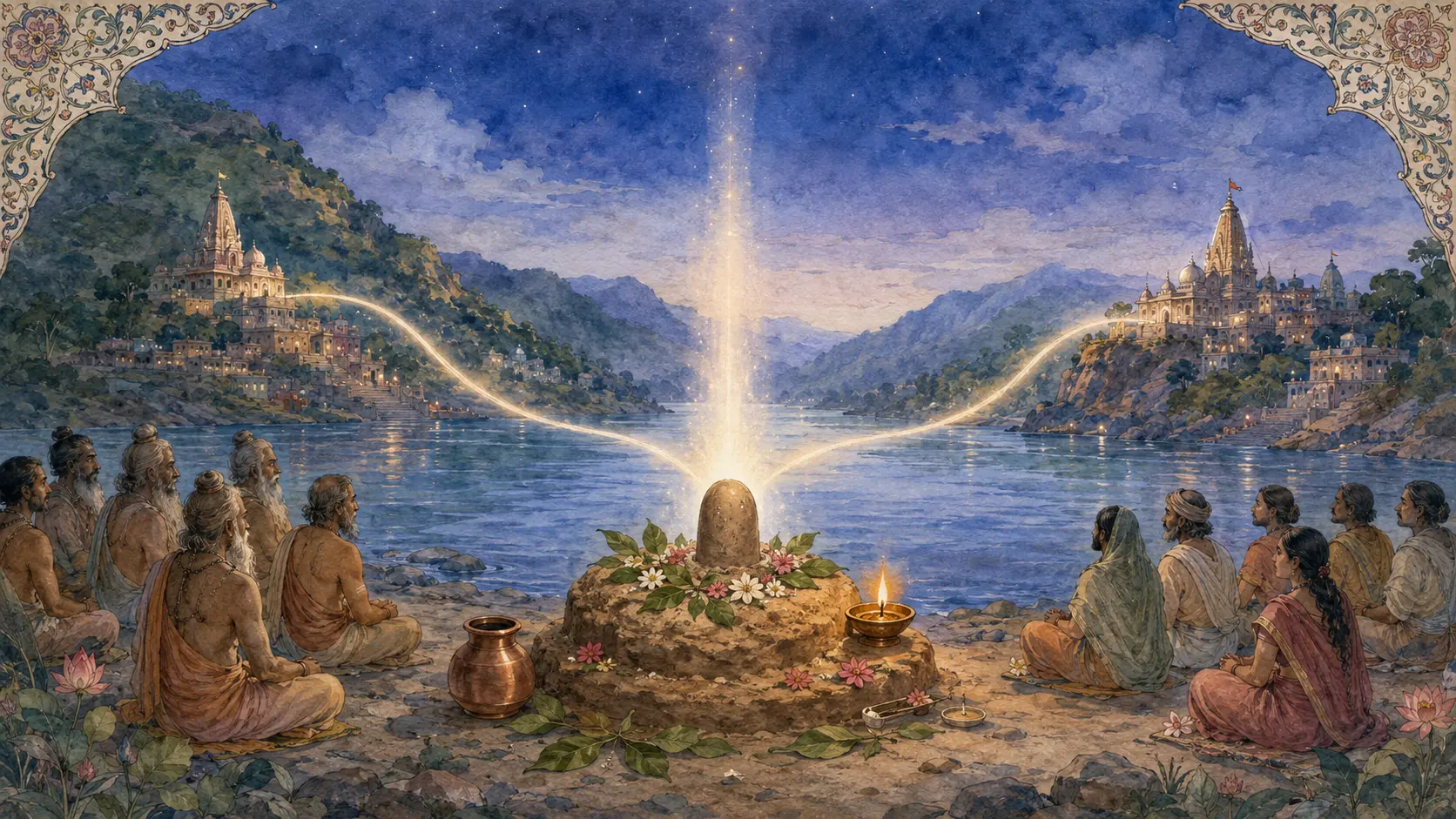
Editorial image note: This is an original, symbolic Indian Ethos illustration of the sacred legend. It is not a documentary reconstruction.
The Meaning of Om and the Sacred Island
Official temple and tourism sources describe Mandhata island as resembling the visual form of Om or Omkara. This should be understood respectfully as sacred geography. It is a traditional way of seeing spiritual meaning in the meeting of river, island and pilgrimage paths, not a claim that every modern aerial image must reproduce a perfectly written character.
Om, also called Pranava, holds a special place in the Upanishadic and later philosophical traditions. It can be contemplated as the sound-symbol of totality. It gathers waking, dreaming and deep sleep, as well as the silence beyond them, into a single spiritual practice. To repeat Om is to remember that the many experiences of life arise within a deeper wholeness.
Omkareshwar gives this contemplation a landscape. The Narmada divides around the island and reunites. Pilgrims cross from one bank to another. The shrines are two, yet the Jyotirlinga tradition is one. The mind sees difference; the pilgrimage trains it to see relationship.
The island is approximately 4 km long and 2 km wide according to the temple trust. The Omkar Parvat parikrama follows a longer circuit of about 7 km, passing temples, old gateways, sculptural remains and viewpoints. Walking the circuit can make the meaning of Om bodily rather than abstract: every step leaves the starting point, moves through variety and returns to the source.
Narmada, Kaveri Sangam and Sacred Geography
The Narmada is not simply a scenic background to Omkareshwar. She is worshipped as a sacred mother and forms the living centre of the town. The traditional Jyotirlinga verse remembered by the temple trust places Omkareshwar at the holy meeting of the Narmada and Kaveri. MP Tourism also refers to the Narmada-Kaveri Sangam as part of the pilgrimage landscape.
The local Kaveri should not be confused with the major Kaveri River of southern India. At Omkareshwar, the name refers to the local stream or channel associated with the island and its sacred confluence.
Pilgrims often take water for worship, sit near the ghats, attend Narmada aarti or begin parikrama from the riverfront. These practices are meaningful only when joined with care. Soap, plastic, cloth, food waste and ritual packaging should never be left in the water. A biodegradable offering is not automatically harmless when thousands of people offer it. Restraint is a contemporary form of river worship.
River levels and currents can change, especially during the monsoon or dam releases. Use maintained ghats, obey barriers and local instructions, supervise children closely and avoid entering deep water. Sacred confidence is not a substitute for physical safety.
Adi Shankaracharya and Govinda Bhagavatpada
Omkareshwar holds an important place in the spiritual memory of Adi Shankaracharya. The official temple trust identifies the Govindeshwar Temple and cave near the entrance of the main temple as the place associated with Shankaracharya’s initiation and instruction under his guru, Govinda Bhagavatpada.
The story of their meeting beautifully joins river, cave and knowledge. A young seeker from Kerala travels across the land, finds his teacher beside the Narmada and receives the discipline that will shape his later work. The cave reminds visitors that great intellectual traditions are rooted in listening. Before Shankara became a teacher whose thought travelled across India, he sat as a student before his guru.
Advaita Vedanta teaches non-duality, the insight that the deepest Self is not separate from Brahman, ultimate reality. Omkareshwar’s twin shrines offer a gentle visual meditation on this principle. Two banks do not divide the river’s sacredness. Two forms do not divide Shiva.
The modern Ekatma Dham and its 108-foot Statue of Oneness honour this association with Adi Shankaracharya. Madhya Pradesh Tourism records that the statue was unveiled in September 2023 and stands about 4.1 km from Omkareshwar. Travellers should verify current entry arrangements and the operational status of individual museum or visitor facilities before going.
Temple History and Architecture
Sacred antiquity and architectural history should be described carefully. The official temple trust says there is no authentic record establishing exactly who first built the main Omkareshwar temple or when. It describes the shrine as North Indian in style, with an old sanctum, a high spire and a large assembly hall supported by substantial pillars.
The main temple rises through five levels, associated by the trust with Shri Omkareshwar, Shri Mahakaleshwar, Shri Siddhnath, Shri Gupteshwar and a flag-bearing deity at the top. The sanctum and later construction do not align in a simple straight axis, suggesting multiple architectural phases.
The history is therefore best understood as a long process of patronage, repair and continuing worship rather than a building created in a single year. Maratha-era royal houses remain part of the daily ritual memory. The trust states that morning worship is conducted by the temple trust, afternoon worship by priests associated with the Scindia family and evening worship by priests associated with the Holkar family.
Mamleshwar Temple
Mamleshwar presents a more intimate ancient-stone experience. The temple trust notes inscriptions of Mahimna Stotra verses on its walls and dates associated inscriptions to 1063 CE. It also records Maharani Ahilyabai Holkar’s connection with worship at the temple. Mamleshwar is managed by the Ahilyabai Khasgi Trust and is identified by the Omkareshwar trust as a protected monument of the Archaeological Survey of India.
The stonework rewards quiet observation. Pillars, sculpted surfaces and the compact sanctum show how devotion and craftsmanship have been carried together. Visitors should avoid touching carvings, scratching names or leaning ritual objects against old stone. Heritage is a form of inherited trust.
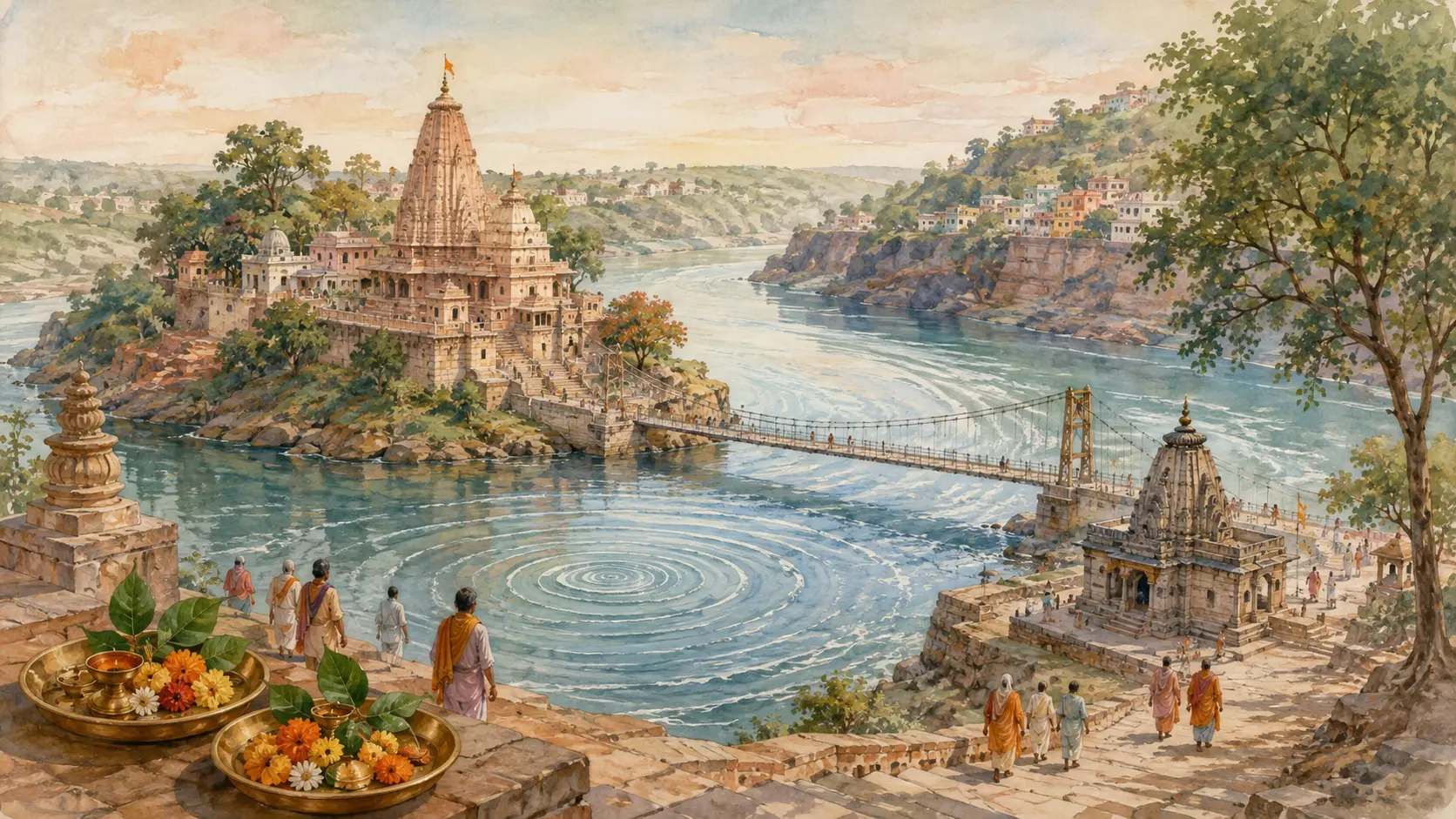
Editorial image note: The twin-shrine composition is conceptual and designed to explain the sacred geography. It is not a precise map or architectural record.
Omkareshwar Darshan Timings and Worship
As checked on 17 August 2026, the official temple trust lists the following daily schedule for Shri Omkareshwar:
| Time | Ritual or darshan |
|---|---|
| 4:30 AM to 5:00 AM | Mangal Aarti and Bhog |
| 5:00 AM to 12:20 PM | Mangal Darshan |
| 12:20 PM to 1:15 PM | Madhyanha Bhog, darshan closed |
| 1:15 PM to 4:00 PM | Madhyanha Darshan |
| 4:00 PM to 4:30 PM | Evening Shringar, darshan closed |
| 4:30 PM to 9:30 PM | Shringar Darshan |
| 9:30 PM to 10:00 PM | Shayan Aarti |
| 10:00 PM to 10:30 PM | Shayan Darshan |
The trust states that darshan is closed before 5:00 AM, after 10:30 PM and during aarti and shringar periods. Festival, security and crowd-management arrangements can change these times. Verify the official timetable shortly before travel.
Shighra Darshan and Online Booking
The official portal offers time-slot-based Shighra Darshan and selected puja services. Current trust information lists Shighra Darshan at Rs 300, but prices and conditions can change. Use only the official temple website. Avoid agents promising guaranteed access.
Online visitors must follow the instructions shown on their confirmation. The trust currently asks booked visitors to carry valid identification and collect the required wristband at the designated distribution point. Its ticket page mentions Bramhapuri Parking Center for wristband collection. Check the latest confirmation because reporting locations can change.
The temple rules state that:
- There is no prescribed special dress code, but clothing should be simple and modest.
- Touching the Jyotirlinga is prohibited.
- Darshan and water offering are allowed according to the authorised method.
- Tickets should be shown only to authorised staff.
- Quick Darshan is valid only for the booked time slot.
- Children below 12 may accompany parents under the current Special Darshan policy.
- Darshan can be suspended temporarily for administration, security or special events.
- Festival rules can differ from ordinary-day rules.
Temple practices can change. The latest official notice always takes priority over a travel article.
Daily Worship and Monday Palki
The temple maintains morning, afternoon and evening worship. Devotees may see abhisheka, offerings, shringar and aarti according to the day’s arrangements. The official portal also lists authorised services such as Abhishek Pujan, Partheshwar Pujan, Narmada Pujan and Maha Mrityunjaya practices.
Every Monday, a ceremonial golden palanquin carrying a three-faced form of Omkareshwar moves through the town with music and worship. The procession, called the Dola or Palki, is especially grand during Shravan. It expresses an important Indian temple idea: the deity comes out among the people, and the whole town briefly becomes a moving mandapa.
A Simple Personal Practice
No pilgrim needs an elaborate private ritual to make the visit meaningful. Where sitting is permitted, pause for a few quiet breaths and repeat:
ॐ नमः शिवाय।
Om Namah Shivaya.
Offer three inward intentions:
- May my words create harmony rather than division.
- May I bow before truth without pride.
- May my devotion protect the river, the temple and those who travel with me.
Omkar Parvat Parikrama
The official temple trust describes the Omkar Parvat parikrama as an approximately 7 km circuit around Mandhata Parvat. Along the way, pilgrims encounter active shrines, old monuments, ruined gateways and elevated views of the Narmada landscape.
Important points listed by the trust include:
- Rin Mukteshwar Temple: Located near the Narmada-Kaveri confluence and associated in local belief with release from debt.
- Gauri Somnath Temple: A distinctive old shrine containing a large black stone linga and Nandi.
- Siddhnath Temple: A major stone monument on the island plateau, known for its carved elephant frieze and pillared hall.
- Aashapuri Devi Temple: Connected with the local ruling family and tribal devotional tradition.
- Chand Suraj and Bhim Arjun Dwaar: Surviving architectural remnants along the circuit.
Practical Parikrama Guidance
- Begin after sunrise or in the cooler part of the morning.
- Allow about three to five hours, depending on fitness, worship stops and weather.
- Wear footwear with reliable grip. Some sections include uneven stone, slopes and steps.
- Carry water in a reusable bottle, but do not leave packaging behind.
- Avoid the full circuit in extreme heat, heavy rain or poor visibility.
- Elders, children and those with heart, knee or mobility concerns may choose selected accessible sections rather than the full route.
- Walk with a companion and follow current local instructions if any path is diverted or closed.
- Do not treat ruins as picnic furniture or climb fragile structures for photographs.
Parikrama is not a competition. A short, attentive walk can be more meaningful than completing the entire circuit in discomfort.
Festivals and Best Time to Visit Omkareshwar
Maha Shivaratri
Maha Shivaratri is among the most important occasions at Omkareshwar. Worship, chanting and pilgrim numbers increase greatly. The spiritual atmosphere can be powerful, but queues, traffic diversions and accommodation demand also rise sharply.
Shravan and Mondays
Shravan is especially sacred to Shiva. Mondays bring the ceremonial palki, and the town receives substantial pilgrim traffic. Devotees who seek the festival atmosphere should book early and prepare for controlled routes. Families seeking a quieter visit may prefer an ordinary weekday outside major festival periods.
Kartik and Narmada Observances
Kartik brings riverfront worship and local gatherings. Narmada Jayanti and full-moon observances can also draw devotees. Dates follow the Hindu calendar and vary each year, so consult the official temple festival page and local administration notices.
Best Weather
October to March is generally the most comfortable period for temple visits, parikrama and nearby sightseeing. Summer afternoons can be intensely hot. The monsoon makes the landscape green and beautiful, but rain, slippery stone and changing river conditions require caution.
Early morning offers softer weather and a more contemplative atmosphere on ordinary days. Sunset by the ghats can be peaceful, but return routes and crowd conditions should be considered before staying late.
Places to Visit in Omkareshwar
1. Mamleshwar or Amreshwar Temple
This is essential to the twin-shrine pilgrimage. Give the stone temple time rather than treating it as a secondary stop.
2. Govindeshwar Temple and Cave
Associated with the meeting of Adi Shankaracharya and Govinda Bhagavatpada, the cave invites a quieter kind of darshan centred on the guru-shishya tradition.
3. Gauri Somnath Temple
Located on the parikrama route, this temple is known for its large black stone linga and substantial Nandi. Reach it with appropriate footwear and respect the old structure.
4. Siddhnath Temple
This protected monumental site is valued for its powerful stone base, carved elephants and pillared architecture. It is one of the finest heritage stops on the island circuit.
5. Koti Tirth Ghat and Narmada Aarti
The official temple rules identify Koti Tirth Ghat as the place for Narmada Aarti and Narmada Pujan under trust arrangements. Attend respectfully and keep the riverfront free of waste.
6. Ekatma Dham and Statue of Oneness
The 108-foot statue honours Adi Shankaracharya and the message of Advaita. The site is about 4.1 km from Omkareshwar according to MP Tourism. Verify current access, ticketing and operational areas before visiting.
7. Narmada-Kaveri Sangam
The confluence belongs to the sacred geography of Omkareshwar. Conditions for walking, boating or access can vary with water level. Follow local safety directions.
8. Omkareshwar Dam Viewpoints
The dam and reservoir form part of the modern landscape. View only from authorised areas and obey all barriers. Infrastructure sites are not places for unsafe photography.
9. Siddhwar Koot Jain Tirth
This Jain pilgrimage centre on the southern side of the Narmada contains several temples and represents the multi-tradition sacred character of the region.
10. Maheshwar
Approximately 70 km away according to the temple trust, Maheshwar is known for Ahilyabai Holkar’s legacy, Narmada ghats, temples and Maheshwari weaving. It deserves a separate day if the schedule allows.
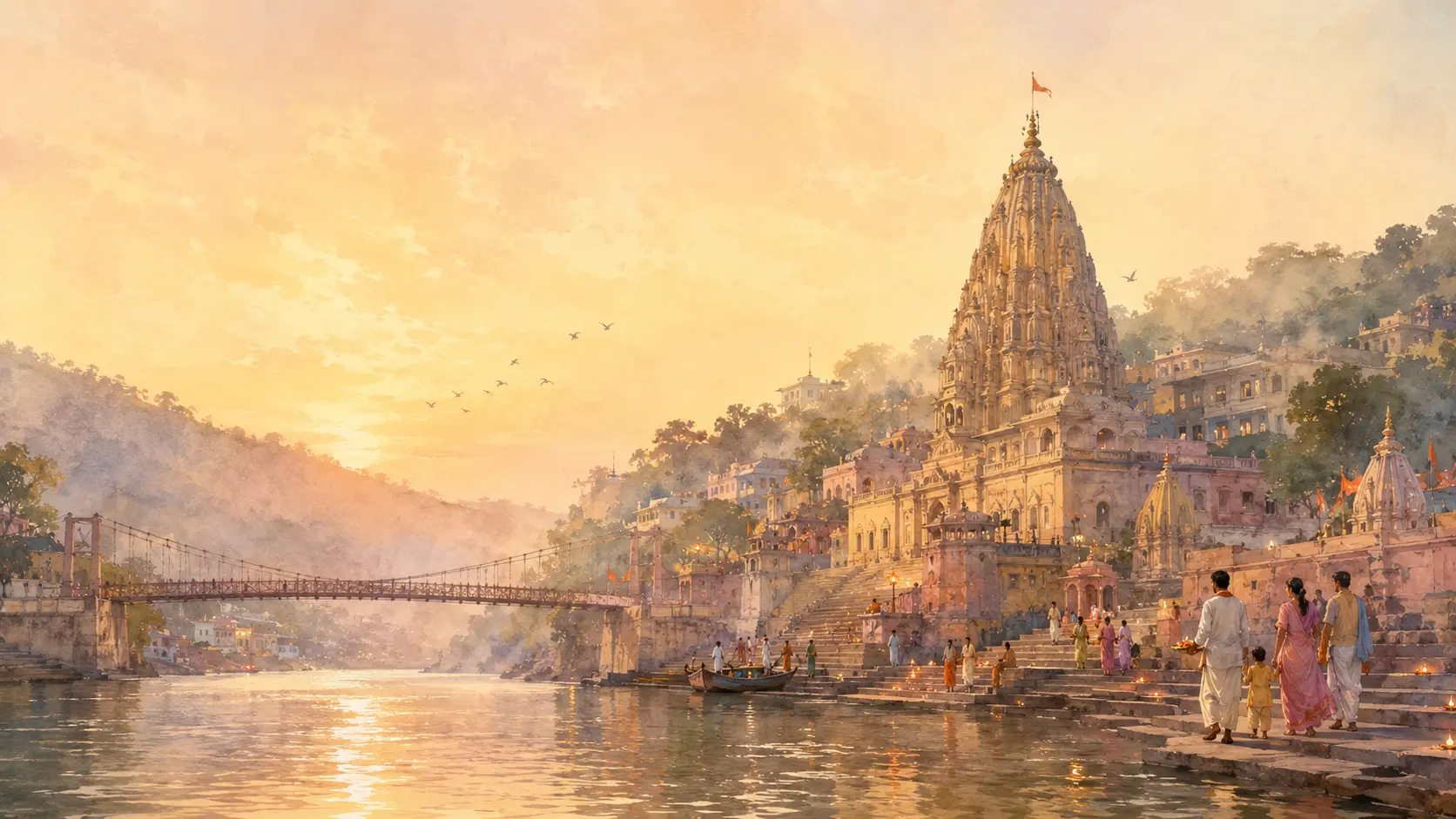
Editorial image note: This original hero image evokes Omkareshwar’s riverfront setting and is not a documentary photograph.
Vegetarian Food in Omkareshwar and the Malwa-Nimar Region
Pilgrimage food is at its best when it is simple, fresh and respectful of local rhythms. Omkareshwar has temple-area eateries, dharmashala kitchens and small restaurants serving vegetarian meals. Standards and opening hours vary, so choose busy, clean establishments and ask for freshly prepared food.
Madhya Pradesh Tourism describes the wider Malwa food tradition through vegetarian dishes such as poha, dal bafla, bhutte ka kees, sabudana khichdi, papad ki sabzi and regional sweets. Omkareshwar lies in the Nimar cultural region, with strong exchange across nearby Malwa. Not every dish will be available in every restaurant, but these are excellent regional foods to look for.
What to Eat
- Poha with sev and lemon: A light breakfast, often mildly sweet and savoury.
- Dal bafla: Boiled and baked wheat dumplings served with dal, ghee and accompaniments. Ask for the amount of ghee you prefer.
- Bhutte ka kees: Grated corn cooked with milk, spices and a gentle tempering.
- Sabudana khichdi: A common fasting and breakfast dish made with tapioca pearls, peanuts and potato.
- Kadhi with rice or roti: Comforting for travellers who want a simple meal.
- Seasonal vegetable thali: Usually the most reliable way to eat a balanced local lunch.
- Jowar or maize roti: Available in some regional kitchens, especially when paired with seasonal vegetables.
- Khopra patties: Potato patties filled with coconut and spices, more commonly found toward Indore.
- Jalebi or imarti: Traditional sweets best shared in moderation.
- Indori shikanji: Despite the name, this regional version is a rich, sweet milk-based drink, not ordinary lemon water.
Strict Vegetarian and Sattvic Guidance
- Ask clearly for food without onion and garlic when required; do not assume every temple-town dish is sattvic.
- Confirm whether the kitchen uses separate utensils if cross-contact matters to you.
- During fasting, ask whether rock salt or ordinary salt is used.
- Carry fruit, nuts and safe packaged water for long queue periods.
- Avoid raw chutneys, cut fruit and uncovered sweets if hygiene appears uncertain.
- Temple prasad is sacred, but travellers with diabetes, allergies or dietary restrictions should still make safe choices.
The Omkareshwar Temple Trust also operates or lists prasadalaya-related services through its official portal. Availability, coupon rules and timings should be checked directly.
How to Reach Omkareshwar
By Air
The nearest major airport is Devi Ahilyabai Holkar Airport in Indore. Khandwa district administration places Omkareshwar at about 84 km from Indore, while MP Tourism gives approximately 87 km for the airport route. Road time is commonly around two to three hours depending on traffic, road works and the final drop point.
By Train
MP Tourism identifies Omkareshwar Road railway station at roughly 12 km from the town. Train frequency and connectivity may be limited, so check the current timetable before choosing it.
Indore and Khandwa are better connected railheads for many travellers. MP Tourism gives Khandwa at about 70 to 77 km and Indore at about 78 km, with variations by source and route. Pre-arrange onward transport when arriving early or late.
By Road
Regular road connections link Omkareshwar with Indore, Khandwa and Ujjain. Government and private buses, taxis and self-drive vehicles are commonly used. Festival traffic restrictions may require parking outside the town and continuing on foot or by authorised local transport.
From Bengaluru
The simplest route for most Bengaluru travellers is:
- Fly from Bengaluru to Indore.
- Continue by pre-booked taxi or reliable bus to Omkareshwar.
- Stay overnight if planning both temples, parikrama and Ekatma Dham without rushing.
An all-rail journey is possible through Indore or Khandwa, depending on the current train schedule. It takes substantially longer but may suit travellers who prefer rail.
Combining Ujjain and Omkareshwar
Madhya Pradesh has two Jyotirlingas: Mahakaleshwar at Ujjain and Omkareshwar at Mandhata. The temple trust gives Ujjain at about 130 km from Omkareshwar. A practical circuit is Indore, Ujjain, Indore or directly onward, Omkareshwar, and return to Indore. Allow at least three days for the two Jyotirlingas, more if elders are travelling or if Maheshwar is included.
Accommodation, Accessibility and Practical Guidance
Accommodation ranges from dharmashalas and trust-linked lodging to small hotels and MP Tourism properties. Khandwa district listings include Bhakt Niwas in Omkareshwar, while MP Tourism lists MPT Temple View or Narmada Retreat accommodation. Verify current room conditions, parking, stairs, meal service and cancellation rules before payment.
For Elders and Travellers with Limited Mobility
Omkareshwar includes slopes, steps, bridge approaches and uneven old surfaces. A full parikrama is not suitable for everyone. The official temple website lists wheelchair and medical facilities, but availability, reach and route access should be confirmed with the temple helpline before travel.
Helpful planning steps include:
- Stay close to the main access route or bridge to reduce repeated climbing.
- Visit the main shrine during a quieter time rather than a festival peak.
- Use Shighra Darshan only through the official system if shorter queue exposure is important.
- Carry prescribed medicines, a water bottle and a compact sitting aid if required.
- Keep one family member free to manage footwear, tickets and bags.
- Treat Mamleshwar and selected ghats as the essential second part of the pilgrimage, and make the full hill circuit optional.
Parking
The temple trust lists public and private parking areas near the new bus stand, old bus stand, Hat Bazar, Kashivishwanath and Mamleshwar, Bramhapuri, Kuber Bhandari and other points. Vehicle entry may be restricted during festivals or dignitary visits. Follow official signs and keep the parking receipt.
Safety and Temple Etiquette
- Wear modest, weather-appropriate clothing and slip-resistant footwear.
- Carry only essential items into the queue.
- Never hand money, identification or booking documents to unauthorised intermediaries.
- Ask permission before photographing people, rituals or private worship.
- Do not photograph where temple signage prohibits it.
- Keep children away from unguarded river edges.
- Use authorised boats only, wear provided safety equipment and avoid river travel in unsafe weather.
- Do not feed monkeys or stray animals from the hand.
- Do not leave flowers, plastic bags or cloth in the Narmada.
Suggested Two-Day Omkareshwar Pilgrimage Itinerary
Day One: Twin Shrines and the Narmada
Early morning
- Arrive before the main heat and complete Omkareshwar Jyotirlinga darshan.
- Visit Panchmukhi Ganesh where appropriate in the local sequence.
- Spend a few quiet minutes near Govindeshwar Temple and cave.
Late morning
- Cross to Mamleshwar or approach it from the mainland side.
- Observe the ancient stone architecture and offer worship without rushing.
- Have a simple vegetarian lunch and rest during the warmest period.
Late afternoon
- Visit a maintained ghat and walk a safe portion of the riverfront.
- See the Narmada-Kaveri sacred landscape if access conditions are suitable.
- Attend Narmada aarti at the authorised location if it fits the day’s official schedule.
Evening
- Have an early vegetarian dinner.
- Review weather and fitness before confirming the next morning’s parikrama.
Day Two: Parikrama, Heritage and Advaita
Morning
- Begin the Omkar Parvat parikrama after sunrise.
- Visit Gauri Somnath, Siddhnath and other open shrines along the approved route.
- If the full circuit is unsuitable, visit only accessible heritage points with local transport and short walks.
Afternoon
- Rest and eat a regional vegetarian meal such as dal bafla, poha or a simple thali.
- Visit Ekatma Dham and the Statue of Oneness after verifying current opening arrangements.
Evening
- Return to the river for a final quiet prayer.
- Depart for Indore, Khandwa or the next pilgrimage destination before late-night road fatigue becomes a concern.
Indian Ethos Reflections
One Truth, Two Shrines
Omkareshwar and Mamleshwar teach that unity does not require sameness. The shrines stand apart, yet together they complete the pilgrimage. Families, communities and traditions also remain healthy when difference is held within a deeper shared purpose.
The Mountain That Bowed
Vindhya’s penance reminds us that size, achievement and influence do not remove the need for humility. The person who cannot bow before wisdom eventually becomes imprisoned by pride.
The River as Mother
Calling the Narmada Maa creates a responsibility. A mother is not honoured by praise alone while her home is polluted. Carrying back our plastic and limiting offerings are acts of bhakti.
The Guru Before the Teacher
Omkareshwar remembers Shankaracharya not only as a great philosopher but as a young student before Govinda Bhagavatpada. Every enduring teacher first learns how to listen.
Parikrama as Family Practice
To walk around the sacred centre is to place the Divine, not the ego, at the centre of life. A family can carry this home through a simple weekly practice: one shared meal without devices, one act of service and one honest conversation.
Frequently Asked Questions
Is Omkareshwar one of the twelve Jyotirlingas?
Yes. Omkareshwar at Mandhata in Madhya Pradesh is traditionally revered as one of the twelve Jyotirlingas of Lord Shiva.
Are Omkareshwar and Mamleshwar the same Jyotirlinga?
They are two sacred shrines associated with the one Omkareshwar Jyotirlinga tradition. The official temple trust explains the manifestation as Omkareshwar and Mamleshwar or Amreshwar, and devotees traditionally visit both.
Which temple should be visited first?
Many pilgrims begin with Omkareshwar and then visit Mamleshwar. Local conditions, queue arrangements and family needs may change the practical order. Reverence is more important than anxiety about sequence.
What are the current Omkareshwar temple timings?
As checked on 17 August 2026, the official trust lists darshan periods from 5:00 AM to 12:20 PM, 1:15 PM to 4:00 PM and 4:30 PM to 9:30 PM, followed by Shayan Aarti and Shayan Darshan until 10:30 PM. Verify before travel because festival and administrative changes can occur.
Can devotees touch the Omkareshwar Jyotirlinga?
No. The current official rules state that touching the Jyotirlinga is prohibited. Follow the authorised method for darshan and water offering.
Is there a dress code?
The official rules state that there is no special prescribed dress code, but devotees should wear simple and modest clothing.
How long is the Omkar Parvat parikrama?
The temple trust describes the route as approximately 7 km. Allow three to five hours depending on pace, worship stops, weather and the open route.
Can elders complete the parikrama?
Some elders can, but the route includes slopes, steps and uneven surfaces. A shorter selection of temples may be wiser for travellers with mobility, heart or knee concerns.
What is the best time to visit Omkareshwar?
October to March usually offers more comfortable weather. Shravan and Maha Shivaratri are spiritually vibrant but very crowded. Ordinary weekdays are often easier for families and elders.
How far is Omkareshwar from Indore?
Official sources give approximately 77 to 87 km depending on the start and end points. Allow about two to three hours by road.
What vegetarian food should I try?
Look for poha, dal bafla, bhutte ka kees, sabudana khichdi, regional thalis, kadhi, seasonal vegetables and local sweets. Ask specifically for no onion and no garlic when required.
Can Omkareshwar and Mahakaleshwar be visited in one trip?
Yes. They form Madhya Pradesh’s two-Jyotirlinga circuit. Plan at least three days for a reasonably comfortable journey through Indore, Ujjain and Omkareshwar.
Is the island literally shaped exactly like the written Om symbol?
Temple and tourism traditions describe the island and river course as resembling Om. It is best understood as sacred geography rather than a demand for exact cartographic lettering.
A Closing Prayer Beside the Narmada
At Omkareshwar, the river does not argue with the island. It surrounds it. The two temples do not compete for devotion. They complete a sacred relationship. The mountain becomes great by bowing, and the future teacher becomes wise by sitting before his guru.
May the pilgrimage teach us to carry unity without erasing difference. May it help us speak with less pride, listen with greater patience and protect the waters that sustain life. When we return home, may Om remain not only a sound on our lips but a discipline in our relationships.
ॐ त्र्यम्बकं यजामहे सुगन्धिं पुष्टिवर्धनम्।
उर्वारुकमिव बन्धनान्मृत्योर्मुक्षीय मामृतात्॥
May Lord Omkareshwar bless every traveller with clarity, humility and an inward sense of wholeness.
Sources and Editorial Note
Practical information was checked on 17 August 2026. Temple timings, prices, routes and rules can change. Readers should verify official information shortly before travel.
Authoritative sources used:
- Shri Omkareshwar Mandir Trust, official website
- Official main temple history, architecture and timetable
- Official Omkar Parvat parikrama guide
- Official guide to Mamleshwar and other temples
- Official temple rules and regulations
- Official temple parking information
- Omkareshwar Mandhata, Khandwa district administration
- MP Tourism destination guide to Omkareshwar
- MP Tourism Jyotirlinga circuit
- MP Tourism Malwa cuisine guide
- MP Tourism guide to Ekatma Dham
- Government of Madhya Pradesh Ekatma Dham portal
Sacred legends are presented as living religious tradition. Archaeological or chronological claims are kept separate from devotional narration. The three accompanying watercolours are original Indian Ethos editorial illustrations and are clearly treated as conceptual art rather than documentary photographs.