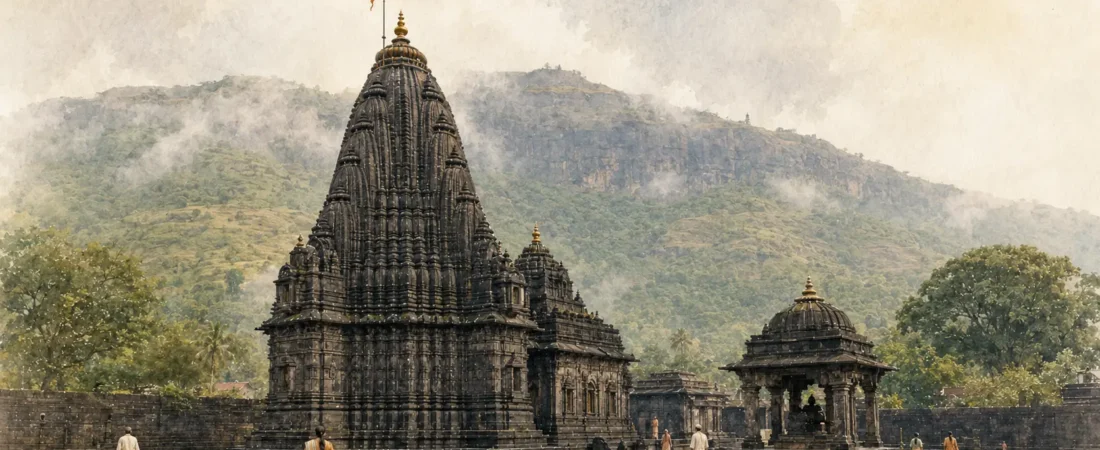
Where Lord Shiva, the Godavari and the green folds of Brahmagiri meet, pilgrimage becomes a journey of purification and renewal.
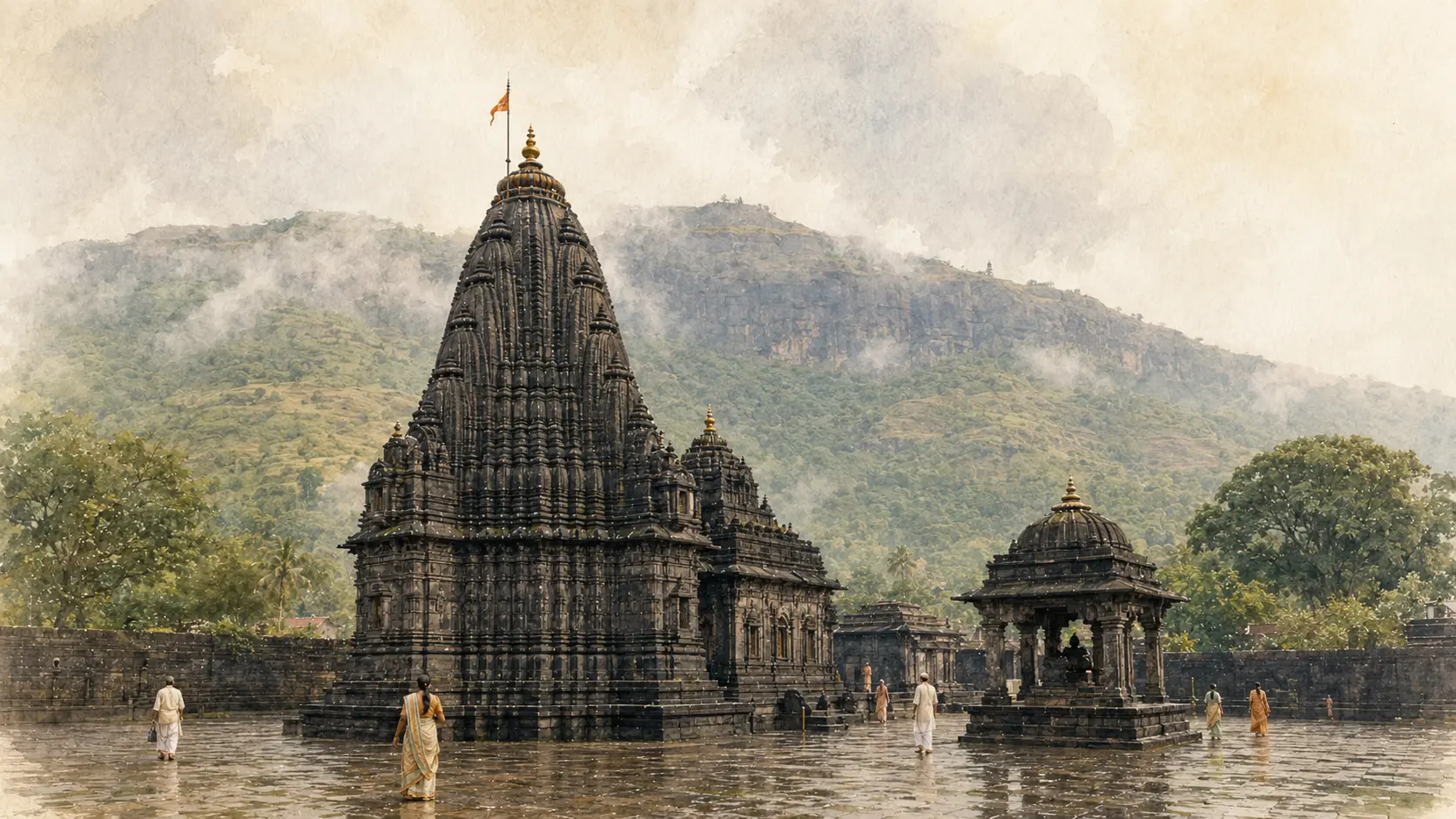
Trimbakeshwar Jyotirlinga in Nashik district, Maharashtra, is a sacred landscape as much as it is a temple. The dark-stone shrine stands in the town of Trimbak at the foot of Brahmagiri Hill, where the Godavari begins her long eastward journey across peninsular India. Here, sacred tradition remembers the tapas of Gautama Rishi and Ahalya, the compassionate descent of the river, and Lord Shiva’s presence in a form associated with the Trideva: Brahma, Vishnu and Mahesh.
For the Indian Ethos Jyotirlinga series, Trimbakeshwar carries the value of purification and renewal. It teaches that sincere reflection is not an end in itself. It can become the source of a wiser, kinder beginning, just as a small stream from Brahmagiri becomes one of India’s great rivers.
Indian Ethos theme: Purification and renewal
Contents
- Trimbakeshwar at a glance
- Where is Trimbakeshwar Jyotirlinga?
- Why is the name Trimbakeshwar significant?
- Sthala Purana: Gautama Rishi, Ahalya and the Godavari
- The Godavari’s sacred geography
- What makes this Jyotirlinga unique?
- Spiritual significance and values
- Temple history and architecture
- Darshan, daily worship and important guidance
- Sacred rites and responsible planning
- Festivals and living traditions
- Sant Nivruttinath and Maharashtra’s spiritual heritage
- Places to visit around Trimbakeshwar and Nashik
- Strictly vegetarian food to enjoy
- How to reach Trimbakeshwar
- Best time to visit
- Suggested one-day and two-day itineraries
- Guidance for seniors, families and hill walkers
- Frequently asked questions
Trimbakeshwar Jyotirlinga at a glance
| Detail | Information |
|---|---|
| Sacred shrine | Shri Trimbakeshwar Jyotirlinga |
| Location | Trimbak, Nashik district, Maharashtra |
| Distance from Nashik | About 28–30 km by road |
| Sacred landscape | Brahmagiri Hill, Gangadwar and Kushavarta Kund |
| Presiding deity | Lord Shiva as Trimbakeshwar |
| Distinctive tradition | The sacred form is associated with Brahma, Vishnu and Mahesh |
| River connection | Source region of the Godavari, revered as Dakshina Ganga |
| Present temple | Built under Peshwa Balaji Bajirao in the eighteenth century on an older sacred site |
| Central Sthala Purana | Gautama Rishi’s tapas and the descent of the Godavari |
| Major observances | Maha Shivaratri, Shravan, weekly Monday palanquin tradition and Simhastha Kumbh |
| Nearest railway gateway | Nashik Road Railway Station, about 39–40 km away |
| Nearest airport | Nashik Airport at Ozar; routes should be checked before travel |
| Comfortable travel season | October to March |
| Indian Ethos value | Purification and renewal |
Timings, access arrangements and festival schedules may change. Check the Shri Trimbakeshwar Devasthan Trust’s official website before travelling.
Where is Trimbakeshwar Jyotirlinga?
Trimbakeshwar Temple is in Trimbak, a pilgrimage town around 28 kilometres from Nashik. Brahmagiri rises immediately beyond the town, giving the shrine an intimate relationship with the Western Ghats. During the monsoon, the mountain turns deep green and seasonal streams appear across its slopes. In the cooler months, the clear air and gentler weather make temple visits and local exploration more comfortable.
This setting is central to Trimbakeshwar’s identity. The pilgrim does not encounter the Jyotirlinga in isolation. Temple, mountain, river and kund form one sacred geography. The Godavari is understood to emerge in the Brahmagiri region, appear at Gangadwar, and re-emerge at Kushavarta Kund in the town before continuing towards Nashik and beyond.
Why is the name Trimbakeshwar significant?
Trimbakeshwar is linked to the Sanskrit name Tryambaka, a revered epithet of Lord Shiva. It is often understood as “the three-eyed one”, recalling Shiva’s third eye of insight. The two ordinary eyes perceive the visible world, while the inner eye points towards discernment beyond appearance.
This meaning is beautifully echoed in the Mahamrityunjaya Mantra, which begins with the words Om Tryambakam Yajamahe. The mantra invokes Tryambaka as the fragrant, life-nourishing Lord and prays for freedom from bondage, with the natural ripening and release of a fruit from its stem as its central metaphor.
At Trimbakeshwar, the name also resonates with the shrine’s distinctive Trideva symbolism. The sacred form within the sanctum is traditionally described by the Devasthan Trust as embodying Brahma, Vishnu and Shiva. Rather than reducing this mystery to a visual curiosity, it is more meaningful to understand it as a contemplation of creation, preservation and transformation within one sacred reality.
Sthala Purana: Gautama Rishi, Ahalya and the Godavari
The Sthala Purana of Trimbakeshwar is preserved through sacred texts, temple tradition and local retellings. Details vary across narrations, but the spiritual movement of the story remains consistent.
A hermitage sustained during famine
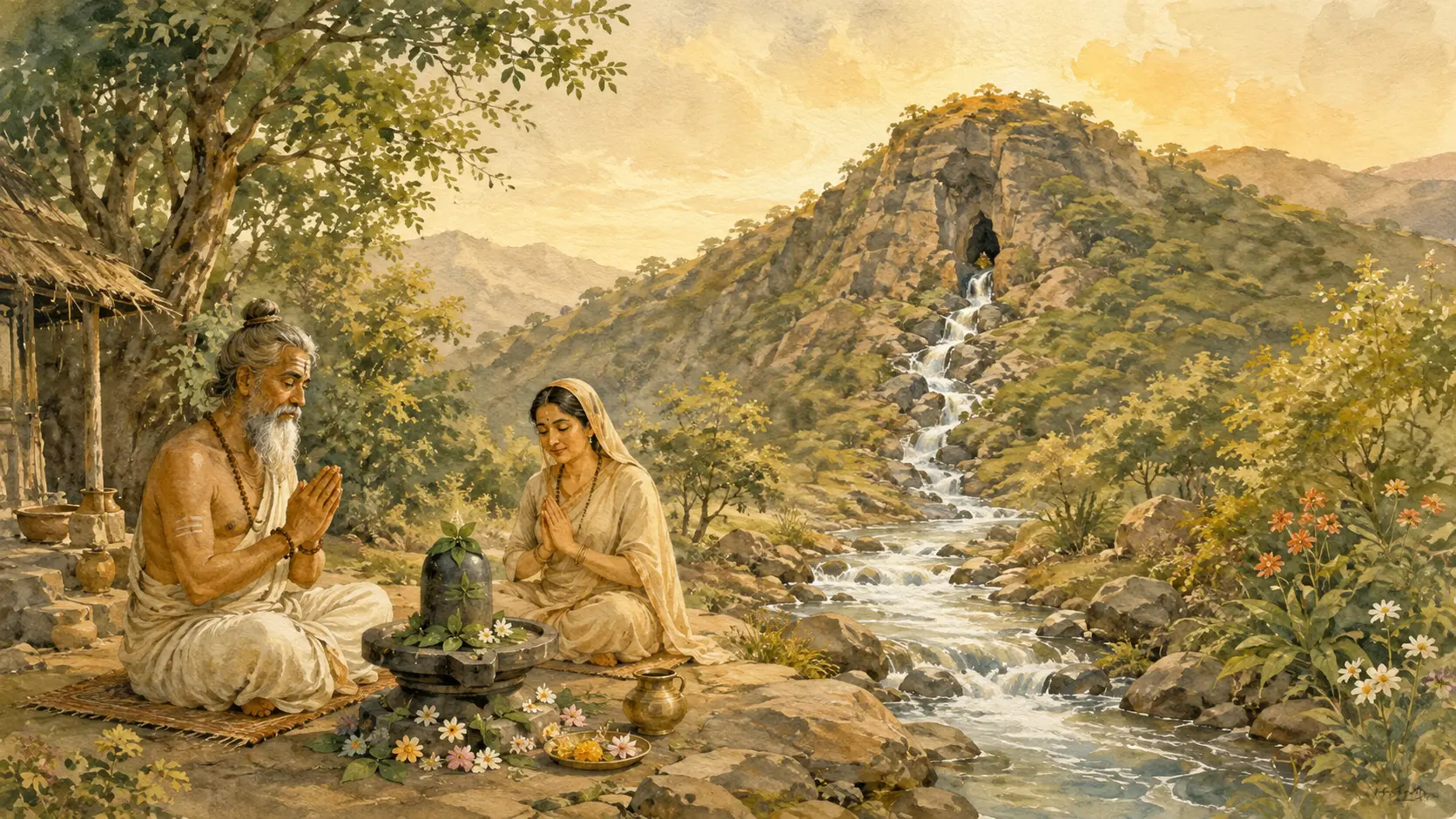
Gautama Rishi and Ahalya are remembered as living a life of tapas and service in the Brahmagiri region. During a severe famine, divine grace sustained their hermitage. Food and water remained available, allowing them to shelter and nourish other sages.
Their abundance, however, became the cause of resentment. In traditional accounts, a cow entered Gautama Rishi’s field as part of a deception. When he tried gently to move her away, she fell and died. Some versions describe the cow as illusory; others emphasise that the sage was made to bear an accusation for an act he had never intended.
The story should be read with care. It does not celebrate blame or punishment. It turns our attention towards Gautama Rishi’s response. Faced with grief and accusation, he did not choose anger, revenge or self-righteousness. He sought a path of purification through sustained prayer.
Tapas, compassion and the descent of the river
Gautama Rishi and Ahalya worshipped Lord Shiva and prayed for the purifying presence of Ganga. Pleased by their devotion, Shiva granted their prayer. The sacred river descended in the Brahmagiri region and became known here as Gautami Godavari.
Ganga is said to have moved away from the place more than once, and Gautama Rishi followed with devotion. At Kushavarta, the sacred flow was gathered and made accessible to pilgrims. Lord Shiva remained at Trimbakeshwar, sanctifying the kshetra as one of the twelve Jyotirlingas.
This sacred account holds a profound ethical lesson. Gautama Rishi’s greatness lies not merely in receiving a boon, but in responding to suffering with humility, steadiness and constructive action. His tapas does not erase the past. It creates a life-giving future.
When we cannot change what has happened, we can still purify what follows through humility, awareness and right action.
The Godavari’s sacred geography
The Godavari is one of India’s great rivers and the longest river of peninsular India. She is revered as Gautami in honour of Gautama Rishi and as Dakshina Ganga, the Ganga of the south.
Brahmagiri Hill
Brahmagiri is the mountain source region of the Godavari and the natural backdrop to Trimbakeshwar. Its very name, “the hill of Brahma”, complements the Trideva symbolism of the Jyotirlinga. The ascent is spiritually meaningful but physically demanding. Stone steps climb steeply through exposed and sometimes slippery terrain. Weather, fitness and local safety conditions should guide any decision to attempt it.
Gangadwar
Gangadwar, a sacred cave-temple area on Brahmagiri, is traditionally revered as an early visible emergence point of the Godavari. Reaching it requires a hill climb. Pilgrims should begin only in safe weather, wear footwear with reliable grip, carry water and avoid isolated stretches after dark.
Kushavarta Kund
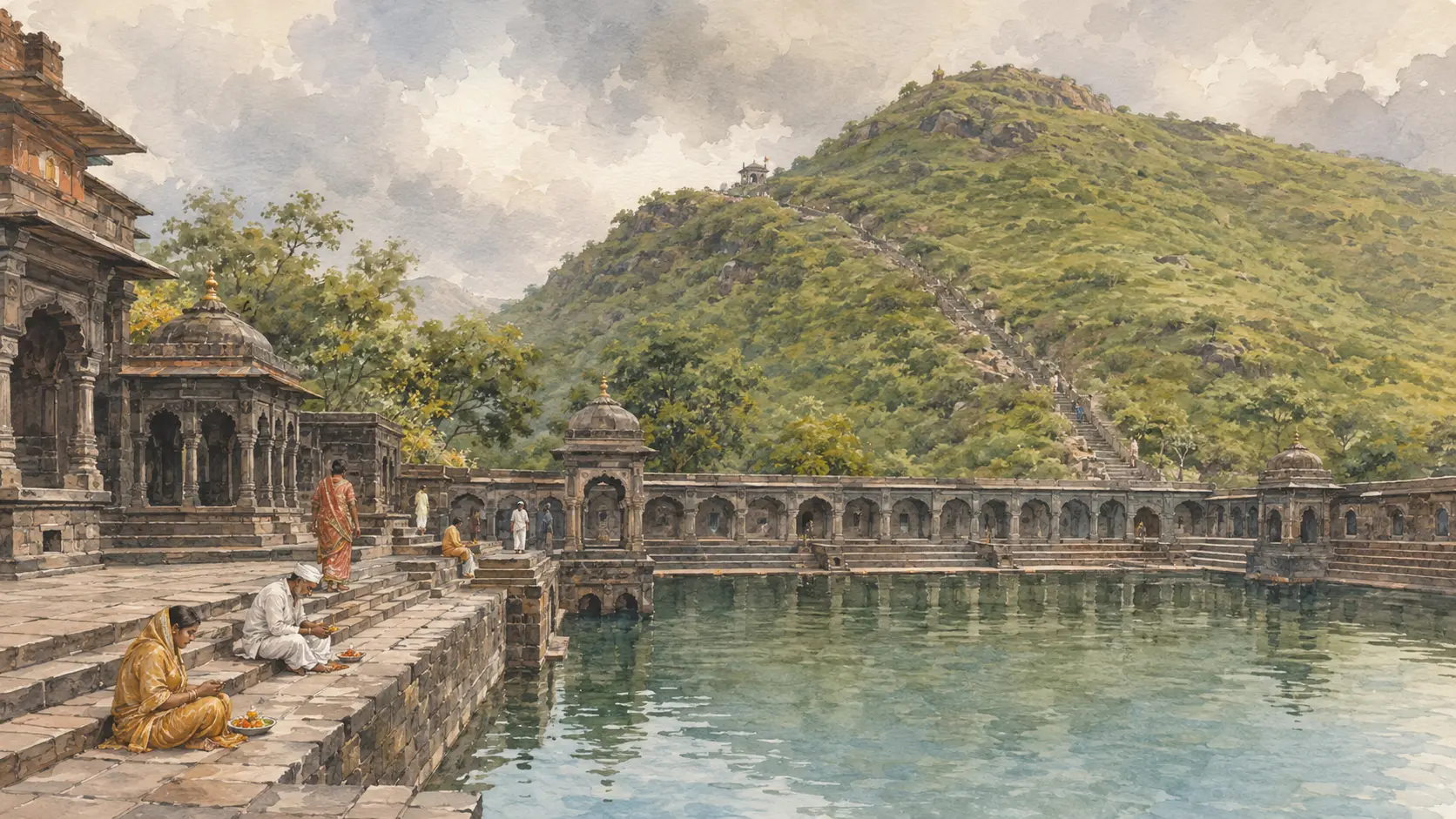
Kushavarta Kund stands in the heart of Trimbak, around 400 metres from the Jyotirlinga temple. Nashik district’s official tourism information describes the present kund as an eighteenth-century structure supplied by natural aquifers and reveres it as the place where the Godavari re-emerges after disappearing at Brahmagiri.
Kushavarta is therefore not simply a water tank beside the temple. It is an important tirtha in its own right and a principal sacred bathing place during the Nashik–Trimbakeshwar Simhastha Kumbh. Visitors should observe local instructions, avoid using soap or leaving offerings in the water, and help protect the sanctity and cleanliness of the kund.
Brahmagiri Pradakshina
The Brahmagiri Pradakshina, also called the Trimbakeshwar Darshan Feri, turns the surrounding landscape into a path of worship. The Ministry of Tourism’s Utsav portal recognises this Shravan pilgrimage tradition. It is a long and demanding religious walk, not a casual sightseeing trail. Pilgrims should seek current local guidance about the route, weather and permitted access before setting out.
What makes Trimbakeshwar Jyotirlinga unique?
At most Jyotirlinga shrines, devotees visualise Shiva primarily through a single linga form. At Trimbakeshwar, the sanctum’s sacred form is traditionally associated with three small manifestations or faces representing Brahma, Vishnu and Mahesh. The official Trust itself describes this as the extraordinary feature of the shrine.
Because the sanctum is sacred and direct access or photography is restricted, travellers should not approach this tradition as a spectacle. Its deeper significance is philosophical:
- Brahma represents creation and new beginnings.
- Vishnu represents preservation, order and continuity.
- Shiva represents transformation and release.
Life continually moves through these three processes. A thought begins, a relationship is sustained, an old identity changes. Trimbakeshwar asks us to see all three movements as part of one sacred whole.
The water-worn sacred form is also traditionally protected and honoured through special ornamentation on designated occasions. Devotees should rely on the temple’s own ritual calendar and follow the directions of authorised temple personnel.
Spiritual significance: purification and renewal
Purification at Trimbakeshwar is not presented as fear of impurity. It is an invitation to return to clarity.
The third eye as discernment
Tryambaka, the three-eyed Lord, reminds us that visible events are not the whole truth. The inner eye asks: What is my intention? What is the wisest response? What can this experience teach me?
Water as grace in motion
The Godavari begins as a modest flow, yet sustains vast regions. In the same way, a small act of sincerity may become the beginning of far-reaching change. Sacred water is not only something to receive. It is something to protect.
Gautama Rishi as responsibility without bitterness
The sage’s response to accusation offers a demanding spiritual value. Responsibility does not always mean accepting a false claim. It can mean refusing to let injury decide our character. Gautama Rishi turns towards tapas, service and renewal.
Brahmagiri as disciplined ascent
A mountain path cannot be hurried. Each step requires attention. Brahmagiri therefore becomes a symbol of sadhana: steady effort, humility before limits and respect for the journey.
The Trideva as the cycle of life
Creation, preservation and transformation are not enemies. Wisdom lies in knowing what should begin, what should be lovingly sustained and what must be released.
Temple history and architecture
The sacredness of Trimbakeshwar is ancient, while the present temple belongs to a more clearly documented historical period. The Shri Trimbakeshwar Devasthan Trust records that the current temple was constructed by the third Peshwa, Balaji Bajirao, also known as Nanasaheb Peshwa, between 1740 and 1760 on the site of an older shrine.
Built in dark basalt, the temple has a weighty, sculptural presence that harmonises with the rain-darkened hills around it. Maharashtra Tourism describes its architecture as Hemadpanthi in style, although the structure itself is Peshwa-era. Its carved walls, compact shikhara, stone courtyard and entrances on four sides create an atmosphere of strength and inwardness.
The Trust associates the four directions with a spiritual progression: east with beginning, west with maturity, south with fulfilment and north with revelation. Whether one enters through this symbolism or simply pauses before the stonework, the architecture encourages a slower rhythm.
Photography rules may change and are especially strict around sacred interiors. Ask before photographing and never attempt to record the sanctum.
Darshan, daily worship and important guidance
The temple’s day traditionally begins around 5:30 AM and concludes around 9:00 PM, but entry windows and queue arrangements may change on Mondays, during Shravan, on festival days and during major gatherings.
The official Trust lists three principal daily pujas:
| Daily worship | Published time |
|---|---|
| Morning puja associated with Brahma Deva | 7:00 AM–8:30 AM |
| Midday puja of Mahadev | 10:45 AM–12:30 PM |
| Evening puja associated with Vishnu | 7:00 PM–8:30 PM |
These are ritual schedules, not a guarantee that every visitor will enter the sanctum at those times. The Trust cautions that timings may change on festival days.
Before you go
- Check the official Shri Trimbakeshwar Devasthan Trust website for notices, access changes and current services.
- Dress modestly and follow the queue, security and footwear instructions.
- Carry a government-issued identity document if using a booked donation darshan pass.
- Avoid agents offering unofficial priority access. Use only the Trust’s own booking channel.
- Keep phones silent and respect restrictions around photography and personal belongings.
- Allow additional time on Mondays, weekends, Shravan days and Maha Shivaratri.
As of August 2026, the Trust’s booking page states that a donation darshan pass is date-specific and that the latest entry is 9:00 PM. The Trust also posts temporary closures or changes, including special arrangements during Shravan Mondays. Because such notices are time-sensitive, readers should verify them again immediately before travel.
Sacred rites and responsible planning
Trimbakeshwar is associated with Rudrabhishek, Laghurudra and several specialised rites observed according to family tradition and priestly guidance.
The Devasthan Trust currently offers online booking for Rudrabhishek and Laghurudra, but its official page clearly states that these booked pujas are conducted remotely, without physical participation at the temple. Devotees should read all terms before making a payment.
Trimbak town is also widely known for rites such as Narayan Nagbali, Tripindi Shraddha and Kalsarpa-related worship. These may be conducted by qualified local priests according to specific customs and are not necessarily Trust-operated temple services. If considering one:
- consult a priest or family spiritual guide you already trust;
- ask for the complete procedure, duration and charges in writing;
- confirm whether any ritual is performed inside the temple or elsewhere in Trimbak;
- avoid anyone who uses fear, guarantees a result or pressures you into immediate payment;
- remember that a sacred rite is an act of faith, not a substitute for medical, legal or financial advice.
The purpose of pilgrimage is inner steadiness. Responsible planning protects both faith and the devotee.
Festivals and living traditions
Maha Shivaratri
Maha Shivaratri is Trimbakeshwar’s principal annual Shiva festival. The Trust records a palanquin procession of Trimbakraja through the town and night-time kirtan. Devotees keep vigil, chant, worship and contemplate Shiva as the still awareness within darkness.
Shravan and Shravan Mondays
Shravan fills Trimbak with Shiva bhakti. Mondays are especially important, and the Trust’s festival calendar notes a weekly Monday palanquin procession to Kushavarta Tirtha for worship. The atmosphere is memorable, but crowds can be intense and special-access services may be suspended.
Nashik–Trimbakeshwar Simhastha Kumbh
Nashik and Trimbakeshwar host the Simhastha Kumbh approximately once every twelve years. Shaiva akhadas perform the sacred bath at Kushavarta in Trimbak, while Nashik city has its own Godavari ghats and traditions. The event brings together sacred time, river worship, renunciant lineages and millions of pilgrims. Travel during a Kumbh period requires official planning information, advance accommodation and careful attention to crowd controls.
Kartik and other observances
The Trust’s calendar includes a chariot procession and worship at Kushavarta during Kartik, special ornamentation on several festival days, and processions that bind temple worship to the life of the town.
Sant Nivruttinath and Maharashtra’s spiritual heritage
Trimbakeshwar also belongs to the spiritual story of Maharashtra. Sant Nivruttinath, elder brother and guru of Sant Dnyaneshwar, is closely associated with the town. The Devasthan Trust records that Nivruttinath received guidance from Gahininath of the Nath tradition and that Sant Dnyaneshwar accepted him as guru.
Nivruttinath’s samadhi at Trimbakeshwar draws Varkari devotees during his punyatithi yatra. This connection brings Shaiva, Nath and Varkari currents into the same landscape. It also reminds us that Indian sacred places rarely belong to only one strand of devotion. They grow through dialogue, memory, pilgrimage and shared song.
Places to visit around Trimbakeshwar and Nashik
Kushavarta Kund
Visit with quietness, preferably when the precinct is less crowded. It is a living tirtha, not merely a photo stop.
Brahmagiri and Gangadwar
Choose the climb only when weather and fitness permit. The hill is especially beautiful in and after the monsoon, but rain increases the risk of slippery steps and low visibility.
Anjaneri Hill
Near the Trimbak–Nashik route, Anjaneri is traditionally associated with Mata Anjana and Lord Hanuman. The landscape is lovely, but the hill trail requires time, suitable footwear and safe weather.
Panchavati
Panchavati lies on the left bank of the Godavari in Nashik and is associated with the Ramayana tradition. Its sacred circuit includes Sita Gumpha and numerous temples. A respectful visit connects Trimbakeshwar’s Shaiva geography with Nashik’s Rama tradition.
Ramkund
Ramkund is an important Godavari ghat in Nashik. It also serves families performing ancestral rites, so visitors should behave with particular sensitivity and avoid intrusive photography.
Kalaram Mandir
This striking black-stone Rama temple in Panchavati was built in the late eighteenth century. It is both a sacred shrine and an important place in the social history of Maharashtra.
Pandav Caves, also called Trirashmi Caves
The rock-cut caves on Trirashmi Hill represent the region’s ancient Buddhist heritage. The Nashik district administration dates the cave group broadly from around the third century BCE to the sixth century CE. Use the historically clearer name “Trirashmi Caves” alongside the popular local name.
Saptashrungi Gad
Saptashrungi is an important Shakti shrine in Nashik district, around 60–65 kilometres from Nashik. It is best treated as an extended third-day excursion rather than squeezed into a short Trimbakeshwar visit.
Strictly vegetarian food in Trimbak and Nashik
The most harmonious food during a pilgrimage is fresh, simple and moderate. Trimbak has small eateries and bhojanalayas serving vegetarian meals, while Nashik offers a wider range of Maharashtrian cuisine. Ask about ingredients if you follow a specific fasting or sattvic discipline.
Pilgrim-friendly morning choices
- Kanda-free poha on request: Light flattened rice with peanuts, lemon and coriander. Ask for a fasting-appropriate or onion-free version when required.
- Sabudana khichdi: Sago pearls with roasted peanuts, potato and cumin, commonly enjoyed on fasting days.
- Sabudana vada: Crisp sago and potato patties, best enjoyed freshly prepared and in moderation.
- Thalipeeth: A savoury multigrain flatbread, often served with curd or a simple chutney.
- Upma: A warm semolina breakfast that is gentle before an early darshan.
Traditional Maharashtrian meals
- Varan-bhat: Plain dal and rice, comforting and suitable for a simple pilgrim meal.
- Pithla-bhakri: Gram-flour preparation served with jowar or bajra bhakri. Request an onion-free accompaniment if desired.
- Bharli vangi: Small brinjals filled with a spiced peanut and coconut mixture.
- Matki usal: Sprouted moth beans cooked with Maharashtrian spices.
- Amti with rice: A balanced sweet, sour and gently spiced lentil preparation.
- Vegetarian thali: Dal, rice, seasonal vegetables, roti or bhakri, curd and a small sweet provide a complete meal.
Nashik favourites and sweets
- Misal pav: Nashik is celebrated for its robust misal. Choose a milder version if travelling with children or older family members.
- Puran poli: A festive flatbread filled with sweetened chana dal and fragrant cardamom.
- Shrikhand: Strained yoghurt flavoured with saffron or cardamom.
- Basundi: Slowly thickened sweetened milk, often served on festive menus.
- Seasonal grapes and raisins: Nashik’s agricultural landscape is closely associated with grape cultivation.
For a sattvic meal, request preparations without onion and garlic, confirm that separate utensils are used if this matters to your observance, and prefer clean, busy establishments where food is prepared fresh. Carry drinking water, but reduce disposable plastic wherever possible.
How to reach Trimbakeshwar
By road
Trimbakeshwar is about 28–30 kilometres from Nashik. State transport buses, taxis and private vehicles use the Nashik–Trimbak road. Travel time is usually about an hour, but festival traffic can make the journey considerably longer.
By train
Nashik Road Railway Station is the principal rail gateway, around 39–40 kilometres from Trimbakeshwar. From the station, continue by taxi or local transport towards Nashik city and Trimbak. Confirm the train schedule through official railway channels.
By air
Nashik Airport at Ozar is the nearest airport serving the district. Flight routes and frequency can change, so check current connections before booking. Mumbai’s Chhatrapati Shivaji Maharaj International Airport is the larger international gateway, followed by an onward road or rail journey.
Local transport
Trimbak town becomes crowded near the temple, and vehicles may be stopped at designated points. Wear comfortable footwear for the final approach. Agree on taxi fares or use a metered or app-based service where available.
Best time to visit Trimbakeshwar
October to March: most comfortable
Cooler, drier weather makes darshan, Nashik sightseeing and moderate walking easier. Early mornings can be cool, so carry a light layer.
June to September: green and dramatic
The monsoon transforms Brahmagiri, but heavy rain can make hill routes slippery and can disrupt travel. Enjoy the landscape without treating a difficult climb as compulsory.
Shravan: deepest Shiva-bhakti atmosphere
Shravan and its Mondays are spiritually vibrant but extremely busy. Book accommodation early, expect long queues and check official notices for special arrangements.
Maha Shivaratri: powerful but crowded
Choose this period for its devotional intensity, not for a quiet visit. Families with very young children or elders may prefer a calmer date.
Suggested pilgrimage itineraries
One-day Trimbakeshwar pilgrimage
Early morning: Travel from Nashik and begin with Trimbakeshwar darshan.
Late morning: Walk respectfully to Kushavarta Kund and spend time in quiet contemplation.
Lunch: Choose a simple vegetarian Maharashtrian thali in Trimbak.
Afternoon: Visit Sant Nivruttinath’s samadhi area or return slowly through the temple town. Attempt Brahmagiri only if you have set aside sufficient time and conditions are safe.
Evening: Return to Nashik before traffic becomes heavy.
Two-day Trimbakeshwar and Nashik sacred circuit
Day one: Shiva and the Godavari’s source landscape
- Early Trimbakeshwar Jyotirlinga darshan
- Kushavarta Kund
- Vegetarian lunch and rest
- Brahmagiri or Gangadwar only for fit walkers in safe conditions
- Quiet evening in Trimbak or Nashik
Day two: The Godavari through Nashik
- Panchavati and Kalaram Mandir
- Ramkund, with sensitivity towards ongoing rites
- Vegetarian Maharashtrian lunch
- Trirashmi Caves for history and sculpture, or Anjaneri for travellers prepared for another hill experience
This sequence follows the river symbolically: from the sacred source near Brahmagiri to the devotional life of Nashik.
Guidance for seniors, families and hill walkers
For seniors
- Prioritise temple darshan and Kushavarta over the Brahmagiri climb.
- Visit on a weekday outside major festivals when possible.
- Confirm wheelchair or assisted access directly with the Trust.
- Carry regular medicines, water and a light snack.
- Allow time for rest after the road journey and queue.
For families with children
- Keep children close in queues and near water.
- Explain photography and sanctum rules before entering.
- Avoid long waits in direct sun or heavy rain.
- Choose mild, freshly prepared vegetarian food.
For Brahmagiri walkers
- Check the weather and local access conditions that morning.
- Use footwear with good grip and carry sufficient water.
- Do not climb during thunderstorms, very heavy rain or poor visibility.
- Begin early and turn back before fatigue compromises safety.
- Never leave litter, food wrappers or ritual materials on the hill.
Frequently asked questions about Trimbakeshwar Jyotirlinga
Where is Trimbakeshwar Jyotirlinga located?
It is in Trimbak town in Nashik district, Maharashtra, about 28–30 kilometres from Nashik city.
Why is Trimbakeshwar one of the most distinctive Jyotirlingas?
The sanctum’s sacred form is traditionally associated with Brahma, Vishnu and Mahesh, symbolising creation, preservation and transformation.
What is the Sthala Purana of Trimbakeshwar?
Sacred tradition connects the shrine with Gautama Rishi and Ahalya, whose tapas led to the descent of Ganga as the Gautami Godavari and to Lord Shiva’s abiding presence at Trimbakeshwar. Narrative details vary across retellings.
Does the Godavari originate at Trimbakeshwar?
The Godavari’s source region is Brahmagiri near Trimbakeshwar. Gangadwar is revered as an early visible emergence point, while Kushavarta is honoured as the place where the sacred flow re-emerges and continues onward.
What is Kushavarta Kund?
Kushavarta is a sacred kund around 400 metres from the temple. It is central to Trimbak’s Godavari tradition and to the Shaiva sacred bath during Simhastha Kumbh.
What are the Trimbakeshwar temple timings?
The temple’s day traditionally extends from around 5:30 AM to 9:00 PM, but darshan access and queue arrangements can change. Always check the official Trust website before travelling.
What are the three daily pujas listed by the Trust?
The Trust publishes morning worship from 7:00–8:30 AM, midday worship from 10:45 AM–12:30 PM and evening worship from 7:00–8:30 PM, with changes possible on festival days.
Can visitors book Rudrabhishek online?
The Trust offers online booking for Rudrabhishek and Laghurudra. Its current terms say these are conducted remotely without physical participation at the temple. Read the official terms carefully.
Can everyone climb Brahmagiri Hill?
The climb is steep and weather-dependent. It is unsuitable for some seniors, people with mobility or cardiac concerns, and small children. Temple darshan remains complete and meaningful without the climb.
Which month is most spiritually significant?
Shravan, especially Mondays, has a powerful Shiva-bhakti atmosphere. It is also among the busiest periods.
What is the best season for a comfortable visit?
October to March usually offers the most pleasant conditions for darshan and sightseeing.
Is Trimbakeshwar connected with the Kumbh Mela?
Yes. Trimbakeshwar and Nashik jointly belong to the Simhastha Kumbh tradition, held approximately once every twelve years. Shaiva akhadas perform the sacred bath at Kushavarta in Trimbak.
What strictly vegetarian food is available?
Poha, sabudana khichdi, thalipeeth, varan-bhat, pithla-bhakri, bharli vangi, vegetarian thalis, misal pav, puran poli and shrikhand are among the regional choices. Sattvic versions can be requested.
What can be combined with Trimbakeshwar in two days?
Kushavarta, Panchavati, Ramkund and Kalaram Mandir form a coherent sacred circuit. Add Trirashmi Caves or Anjaneri according to interest and physical ability.
What is the main spiritual lesson of Trimbakeshwar?
Trimbakeshwar teaches purification through awareness and right action. Gautama Rishi’s tapas, the Godavari’s flow and the Trideva symbolism together show that renewal is possible when humility becomes action.
Trimbakeshwar: where purification becomes a new beginning
Trimbakeshwar Jyotirlinga is more than a dark-stone temple beneath a green mountain. It is a sacred conversation between tapas and grace, stillness and flowing water, human responsibility and divine compassion.
Here, Gautama Rishi’s prayer becomes a river. Ahalya’s steadfast presence becomes part of the kshetra’s memory. Brahmagiri teaches effort, Kushavarta teaches the gathering of intention, and the Trideva symbolism places every life within the rhythm of creation, preservation and transformation.
The Godavari does not remain at her source. She moves outward, nourishing towns, fields and generations. That may be Trimbakeshwar’s most enduring message: inner purification becomes complete when it flows into the world as kindness, responsibility and renewed purpose.
Like the Godavari emerging from Brahmagiri, every sincere transformation can become the beginning of a new journey.
ॐ त्र्यम्बकं यजामहे सुगन्धिं पुष्टिवर्धनम् ।
उर्वारुकमिव बन्धनान्मृत्योर्मुक्षीय मामृतात् ॥
ॐ नमः शिवाय।
हर हर महादेव।
जय श्री त्र्यंबकेश्वर।
Continue the pilgrimage through the Dwadasha Jyotirlinga guide, or revisit Kashi Vishwanath, Nageshwar and Maharashtra’s forest shrine of Bhimashankar.
Editorial fact-check note
This article distinguishes sacred tradition from documented history. The Sthala Purana is presented respectfully as temple and Puranic tradition, with variations acknowledged. Current travel and worship details were checked on 17 August 2026 against the Shri Trimbakeshwar Devasthan Trust, Maharashtra Tourism, Nashik District Administration and the Government of India’s Utsav portal. Readers are directed to official channels for time-sensitive arrangements.
Principal sources
- Shri Trimbakeshwar Devasthan Trust
- Trust daily puja programme
- Trust festival calendar
- Maharashtra Tourism: Trimbakeshwar
- Nashik District Administration: Trimbakeshwar Temple
- Nashik District Administration: Kushavarta Tirtha
- Ministry of Tourism Utsav portal: Brahmagiri Pradakshina