Nageshwar does not begin with a king, a palace or a victory procession. Its sacred story begins with a devotee in captivity.
Supriya has lost the freedom to move, yet he has not surrendered the freedom to remember Shiva. In the darkness he continues to chant Om Namah Shivaya. Others find courage in his devotion. The prison remains around them, but fear no longer occupies the centre of their minds.
Then Shiva manifests as protector.
This is why Nageshwar Jyotirlinga near Dwarka speaks so powerfully to the present age. We may not live behind physical bars, but anxiety, uncertainty, loss, illness, failure and the judgement of others can create invisible enclosures. Nageshwar asks a tender but searching question: What becomes possible when faith grows steadier than fear?
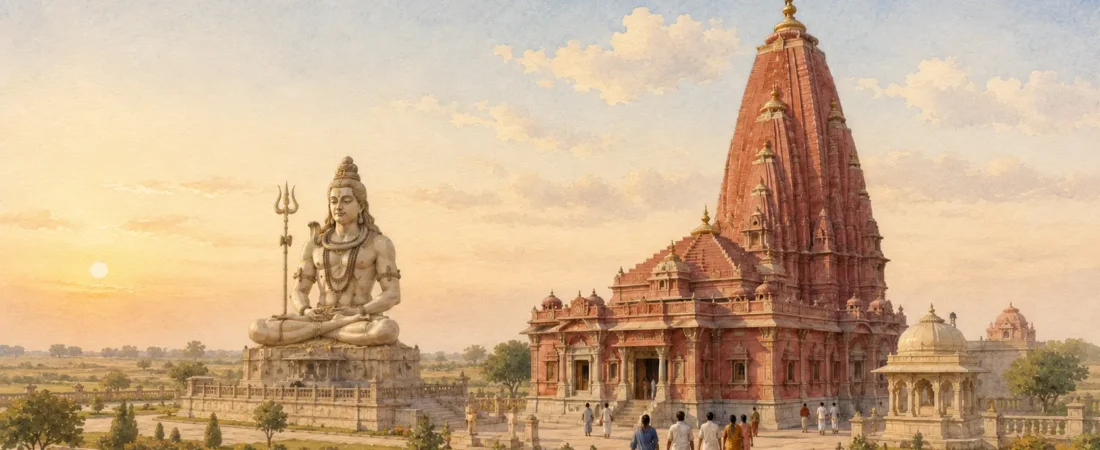
Set in the open coastal landscape of Gujarat’s Devbhumi Dwarka district, the shrine brings together the Jyotirlinga tradition, the sacred memory of Darukavana, Shiva’s serpent symbolism and the neighbouring world of Krishna’s Dwarka. It is therefore both a destination and a teaching: fear may surround a person, but it need not rule the inner life.
On this page
- Nageshwar Jyotirlinga at a glance
- Where Nageshwar is located
- The Sthala Purana of Supriya and Daruka
- Darukavana and the shrine’s living traditions
- Why Shiva is called Nageshwar
- Spiritual significance: from fear to fearlessness
- The temple, underground sanctum and Shiva statue
- Worship, darshan and festivals
- Vegetarian food and Gujarati culture
- Places to visit near Nageshwar
- How to reach the temple
- One-day and two-day pilgrimage plans
- Guidance for families and senior pilgrims
- Frequently asked questions
Nageshwar Jyotirlinga at a glance
| Detail | Pilgrim information |
|---|---|
| Sacred name | Shri Nageshwar Jyotirlinga / Nageshwar Mahadev |
| Presiding deity | Lord Shiva |
| Location | Devbhumi Dwarka district, Gujarat |
| Distance from Dwarka | Approximately 16–18 km by road, according to current government tourism pages |
| Sacred association | Darukavana and the devotee Supriya |
| Distinctive feature | Jyotirlinga in a lower or underground sanctum |
| Major landmark | Approximately 25-metre seated Shiva statue |
| Defining Indian Ethos value | Fearlessness rooted in devotion |
| Most sacred periods | Shravan and Maha Shivaratri |
| Comfortable travel season | November to February |
| Official visiting guidance | Gujarat Tourism currently lists dawn to dusk; festival and puja arrangements should be reconfirmed |
| Suggested stay | Dwarka |
| Convenient circuit | Dwarkadhish–Rukmini Devi–Nageshwar–Gopi Talav–Beyt Dwarka |
Where is Nageshwar Jyotirlinga?
Nageshwar Jyotirlinga stands on the route from Dwarka towards Okha and Beyt Dwarka, within Gujarat’s Devbhumi Dwarka district. The district administration places the shrine about 16 km from Dwarka, while Gujarat Tourism gives approximately 18 km. It is best to understand this as a short road journey of roughly 16–18 km rather than as an exact door-to-door distance.
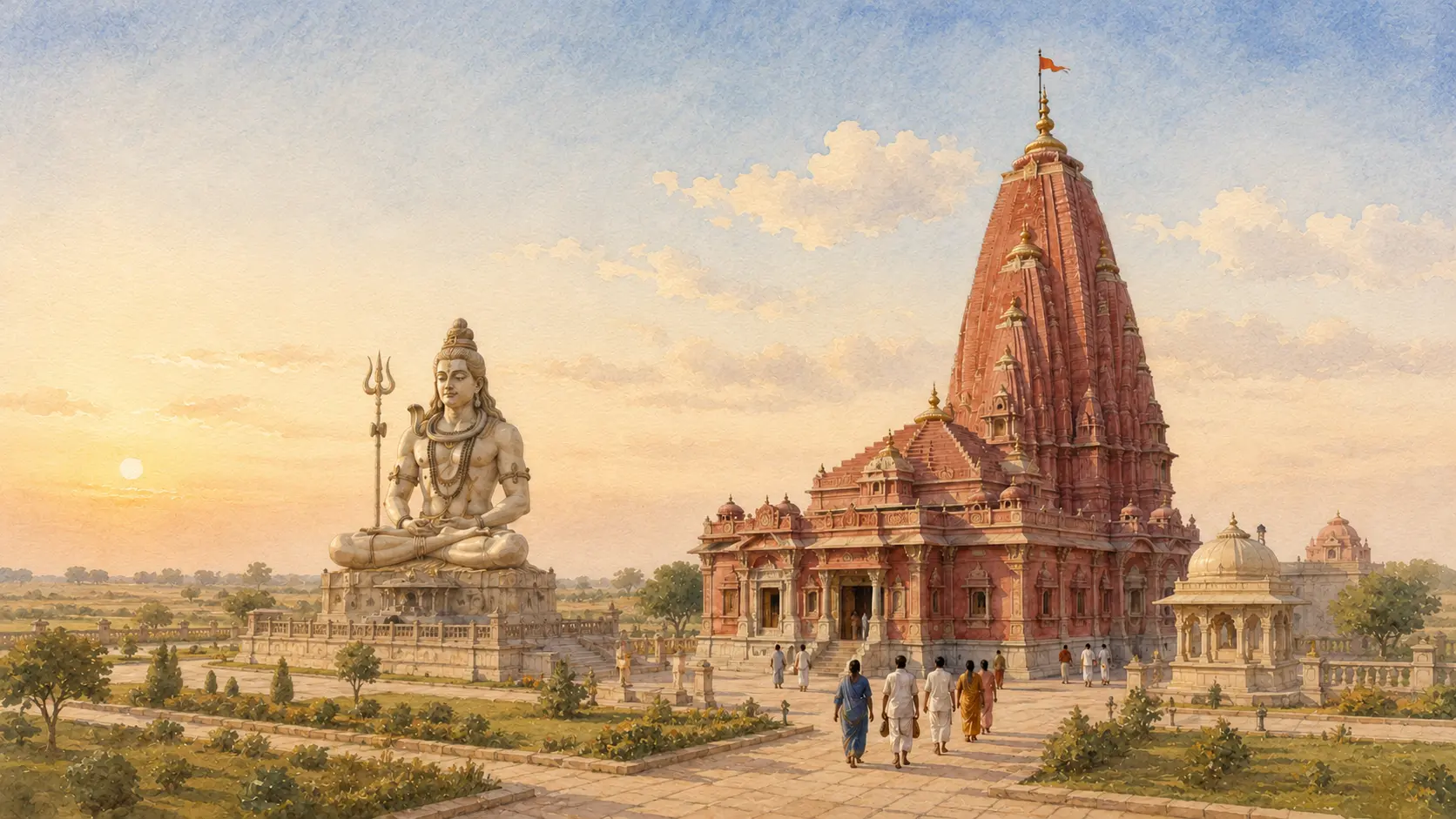
The surrounding land is open and coastal. Against that spacious setting rise the temple’s red form and the enormous seated image of Shiva. Unlike a crowded city shrine concealed within narrow lanes, Nageshwar announces itself through sky, distance and stillness.
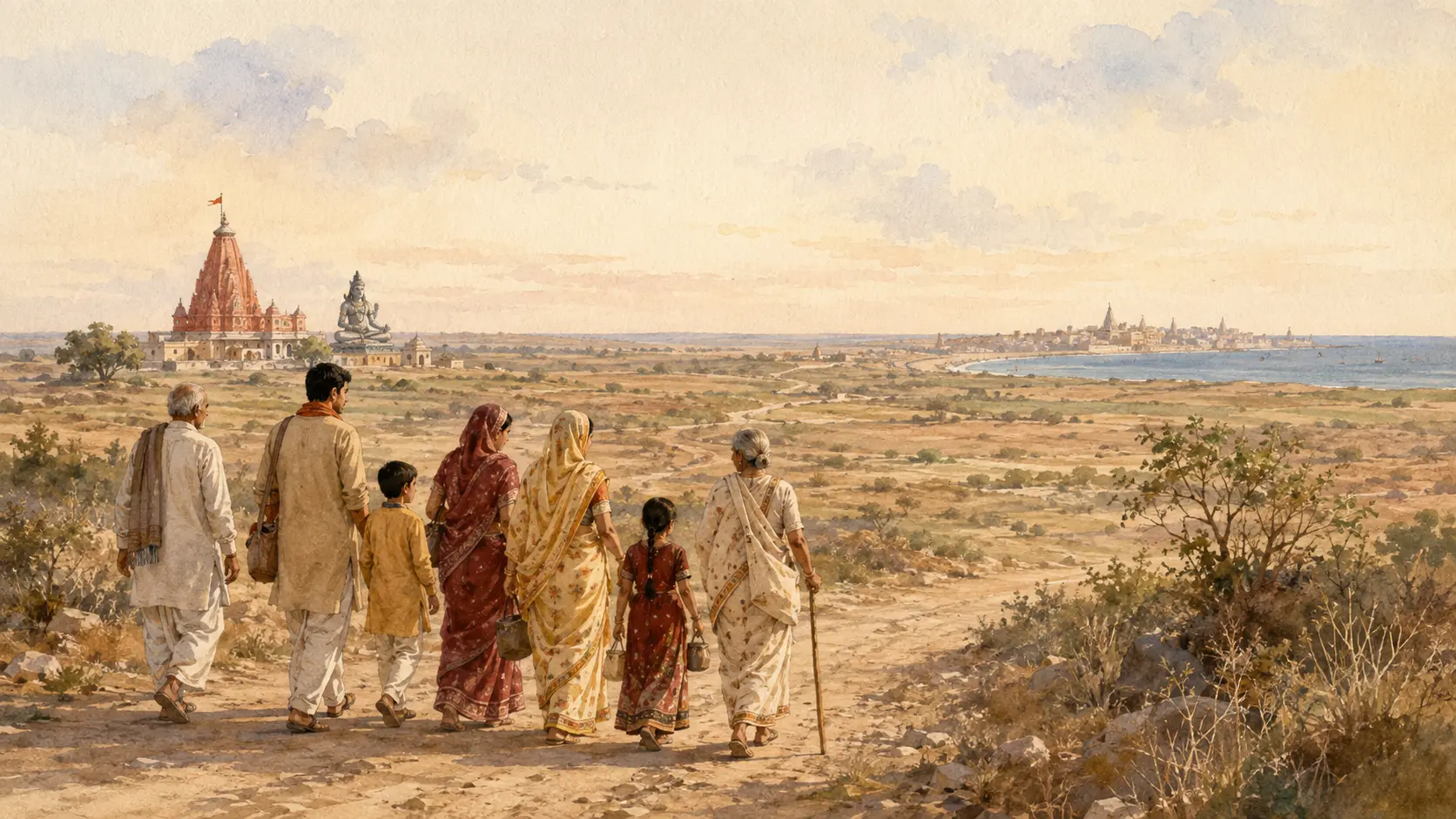
For most pilgrims, Dwarka is the practical base. Nageshwar can be visited independently, but its proximity to Dwarkadhish Temple, Rukmini Devi Temple, Gopi Talav and Beyt Dwarka makes it a natural part of a larger sacred circuit.
This joining of sites carries a deeper meaning. In one landscape, the pilgrim encounters Krishna as Dwarkadhish and Shiva as Nageshwar. Shaiva and Vaishnava devotion do not need to compete here. They meet as two sacred currents within the same civilizational geography.
Readers planning the wider journey may also explore our guide to Dwarka, the sacred abode of Lord Krishna and the overview of the Dwadasha Jyotirlingas.
The Sthala Purana: Supriya, Daruka and the power of remembrance
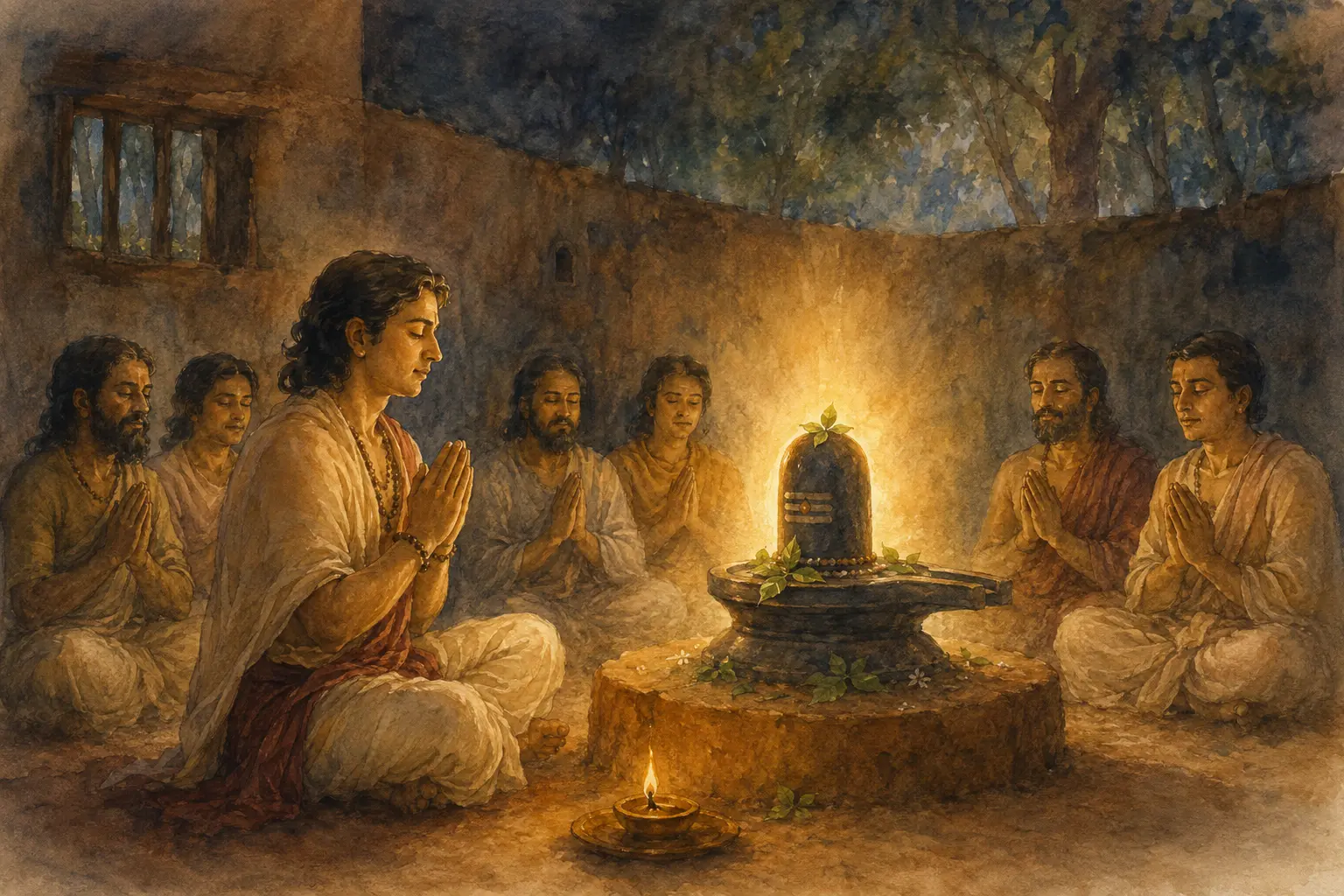
The best-known sacred account of Nageshwar concerns a Shiva devotee named Supriya and Daruka. Retellings contain variations in detail, but the spiritual centre remains consistent: a devotee is held captive, continues to remember Shiva and inspires fellow prisoners to do the same.
Gujarat Tourism’s account says that Daruka imprisoned Supriya. Even in captivity, Supriya chanted:
The mantra spread from one frightened person to another. What began as individual remembrance became shared courage. Moved by their devotion, Shiva manifested, vanquished the oppressive force and protected the devotees. A self-manifested linga appeared at the sacred place and continued to be worshipped as Nageshwar.
This is Sthala Purana–the sacred tradition through which devotees understand the spiritual personality of a place. It should be presented with reverence, while remaining distinct from documentary history.
The story’s deepest power lies not merely in the miraculous conclusion but in Supriya’s conduct before relief arrives. He does not know when the prison will open. He does not make devotion conditional upon immediate rescue. He remembers Shiva while the difficulty is still present.
That is a demanding form of faith. It does not deny fear; it prevents fear from becoming the sole ruler of consciousness.
For a family, the story can be shared gently with children: courage does not always mean that we feel no fear. Sometimes courage means choosing the right thought, word or action even while fear is present. Supriya’s mantra becomes a steady lamp in an uncertain place.
Darukavana: sacred forest, memory and regional traditions
Nageshwar’s legend is associated with Darukavana, the sacred forest named in the Nagesha tradition. The Sanskrit expression is remembered in the Dwadasha Jyotirlinga tradition, and different regions have preserved their own identifications and devotional claims around Nagesha or Nagnath.
Devotees in Gujarat revere Nageshwar near Dwarka as the Jyotirlinga of Darukavana, and both Gujarat Tourism and the Devbhumi Dwarka district administration present it as one of the twelve Jyotirlingas. Aundha Nagnath in Maharashtra is also honoured by its regional tradition and is similarly identified by Maharashtra Tourism. These are living traditions of faith, not matters that Indian Ethos should reduce to a contest.
This article focuses on Nageshwar in Devbhumi Dwarka, the shrine chosen for this stage of our Jyotirlinga journey, while respecting worshippers attached to other sacred identifications.
The idea of a vana, or forest, has its own significance in Indian spirituality. Forests, mountains, riverbanks and caves repeatedly become places where noise recedes and essential questions return. A forest can be both protective and unsettling. It hides familiar directions, requiring the seeker to cultivate attention.
Seen in this way, Darukavana is more than a geographical label. It becomes the landscape of the inner struggle: confusion surrounds the devotee, yet remembrance creates a path.
What does “Nageshwar” mean?
The name is commonly understood through two Sanskrit elements:
- Naga – serpent
- Ishwara – Lord
Nageshwar may therefore be understood as Lord of the Serpents.
The serpent is among Shiva’s most recognisable symbols. What most people instinctively fear rests calmly around his neck. In devotional reflection, this can suggest mastery over fear, mortality and instinct. The serpent’s shedding of its skin also makes it a natural symbol of renewal and transformation.
Yogic traditions use serpent imagery when speaking of latent spiritual energy. Yet these layers should not be collapsed into a single literal explanation. Symbolism grows through traditions of worship, philosophy and meditation; it is not a scientific formula or a promise of supernatural power.
For Indian Ethos, the most helpful reflection is this:
At Nageshwar, the serpent becomes an emblem of transformed relationship. Fear is no longer the master. Consciousness has taken its rightful place.
Spiritual significance of Nageshwar Jyotirlinga
Every Jyotirlinga reveals Shiva through a distinctive sacred landscape and story. Nageshwar’s defining value is fearlessness.
Fearlessness in the Indian spiritual sense is not recklessness. It is not the denial of danger, health needs or practical responsibility. It is clarity in the presence of uncertainty. It allows a person to take wise precautions without allowing anxiety to consume the mind.
Supriya’s story expresses this through four movements.
The prison: human limitation
Every life encounters limits. Some are physical; others arise from grief, doubt, attachment, social pressure or circumstances beyond our control. The prison in the Sthala Purana can be read as the condition in which the outer world seems to have become stronger than personal choice.
The mantra: inner freedom
Supriya continues to chant Om Namah Shivaya. The mantra does not initially remove the walls. It changes the centre from which he meets them. This is inner freedom: the refusal to let adversity decide the entire meaning of one’s life.
Daruka: power without dharma
Daruka represents force used to dominate rather than protect. The story reminds us that power without dharma eventually becomes destructive both to others and to the person who wields it.
Shiva: protective consciousness
Shiva manifests when devotion becomes stronger than fear. In spiritual reflection, Shiva is not merely an external rescuer; he is also the awakened steadiness that enables a person to stand upright within difficulty.
Thus Nageshwar’s enduring message can be expressed in one line:
This message belongs naturally beside the values already unfolded in our series: Somnath’s resilience, Srisailam’s Shiva–Shakti harmony, Mahakaleshwar’s transcendence of time, Omkareshwar’s oneness, Baidyanath’s healing, Bhimashankar’s strength guided by dharma and Rameswaram’s humility.
What is a Jyotirlinga?
Jyoti means light or radiance. Linga points to Shiva beyond the limits of ordinary form. The twelve Jyotirlingas are revered as radiant manifestations of Shiva and form one of India’s most important pilgrimage networks.
Government tourism sources describe the Nageshwar linga as Swayambhu, or self-manifested. Devotees approach it not simply as an object but as a living centre of Shiva’s presence.
At Nageshwar, three symbols come together:
- Jyoti – awareness that illumines
- Naga – fear, mortality and transformative energy
- Shiva – the consciousness that masters without being mastered
The teaching is not that a pilgrim will never again experience fear. It is that awareness can become greater than fear.
The temple and its distinctive sacred spaces
The antiquity of Nageshwar belongs principally to sacred tradition and Puranic memory. The age of the present temple complex should not be confused with the timelessness that devotees attribute to the Jyotirlinga. Government pages describe the living shrine and mention local archaeological claims, but they do not provide sufficient evidence for assigning a precise ancient date to the existing structure.
The most accurate formulation is therefore simple: Nageshwar preserves an ancient sacred tradition within a temple complex that has taken its present form over time.
The lower or underground sanctum
The Devbhumi Dwarka district administration describes the Jyotirlinga as enshrined in an underground sanctum. The physical descent gives the pilgrimage a memorable inward quality.
Symbolically, the pilgrim does not rise to a high chamber but moves lower, towards silence and the centre. Spiritual growth is not always a visible ascent. At times it requires us to descend beneath habit, appearance and noise, and to meet the fears we would rather avoid.
This is an editorial reflection, not a claim about the historical intention of the temple’s builders. Yet it gives pilgrims a meaningful way to prepare inwardly before darshan.
The great seated Shiva statue
One of Nageshwar’s most striking landmarks is the approximately 25-metre-high seated statue of Shiva. The still figure can be seen from a distance and gives the open complex a powerful visual centre.
Thousands may move around the temple, vehicles may arrive and queues may form, yet Shiva remains absorbed in stillness. The image quietly teaches that stillness need not depend upon an empty world. It can be cultivated in the midst of movement.
The temple hall, garden and pond
Gujarat Tourism describes the red temple building, its large hall and the main sanctum at the far end. The district page also notes the garden and pond near the great Shiva statue. These open areas help families pause before or after darshan, although crowd controls may change during major festivals.
Photography rules can vary within sacred spaces. Never assume that photographs are permitted inside the sanctum. Follow the signs and the instructions of temple staff without argument.
Darshan, worship and pilgrim etiquette
The heart of a Nageshwar visit is darshan. Devotees commonly associate Shiva worship with water offerings, bilva leaves, flowers, mantra japa, aarti and forms of abhisheka. However, direct offering procedures, sparsha darshan, clothing requirements, queues and paid puja arrangements can change.
As verified in August 2026, Gujarat Tourism lists general visiting hours as dawn to dusk. It does not provide a minute-by-minute official ritual schedule on the page consulted. Pilgrims should therefore confirm current timings and puja procedures with the temple or authorised local office shortly before travelling, particularly during Shravan, Mondays and Maha Shivaratri.
A respectful preparation may include:
- bathing and wearing clean, modest clothing;
- entering without rushing or pushing;
- keeping phones silent;
- using only authorised counters for offerings or rituals;
- not carrying prohibited items;
- following separate queue or sanctum instructions;
- avoiding photography where restricted;
- keeping the temple and surrounding land free of plastic and litter;
- allowing senior citizens, children and persons with disabilities sufficient space.
The most characteristic mantra of the Sthala Purana is:
One may chant softly and respectfully where permitted. The purpose is not performance. It is remembrance.
Bilva leaves in Shiva worship
The three-leafed bilva is traditionally dear to Shiva. Devotional interpretations connect its three leaflets with Shiva’s three eyes, the three gunas or the three dimensions of time. The offering symbolically gathers the whole person–body, mind and inner tendencies–and places them before Shiva.
Use only offerings permitted by the temple. Do not pluck leaves from protected plants or leave packaging around the complex.
Shravan, Maha Shivaratri and the best time to visit
Three different questions are often mixed together, so it is useful to separate them.
Most sacred month for Shiva worship: Shravan
Shravan, also called Sawan, is deeply associated with Shiva worship. Shravan Mondays can bring large devotional gatherings, special observances and longer queues. Pilgrims who value the sacred atmosphere may find the experience deeply moving, but families should plan for heat, crowding and waiting.
Most important festival: Maha Shivaratri
Gujarat Tourism specifically identifies Shivaratri as a period of great fervour at Nageshwar. The night celebrates wakefulness, discipline and the movement from darkness towards awareness–themes that closely echo Supriya’s story.
Most comfortable general travel season: November to February
Official tourism guidance recommends November to February for more comfortable weather. This is generally the easier season for families, senior pilgrims and those combining several places in the Dwarka region.
Coastal weather can change. Check current forecasts, transport conditions and local instructions before departure, especially when planning Beyt Dwarka or beach visits.
Gujarati and Saurashtrian culture around Nageshwar
Nageshwar is Shaiva in worship, Gujarati in cultural setting and pan-Indian in pilgrimage significance.
The wider Dwarka region is shaped by temple bells, bhajans, pilgrim markets, coastal settlements, Gujarati speech and dress, and the movement of families travelling together. Dwarka’s Krishna bhakti and Nageshwar’s Shiva bhakti exist side by side, giving the region a rare devotional breadth.
This coexistence is not accidental to Indian civilization. Homes and pilgrimage routes have long honoured several divine forms without needing to erase their distinctions. Krishna represents dharma, wisdom and divine action; Shiva represents stillness, transformation and transcendence. The pilgrim is not asked to choose between them.
The more beautiful lesson is:
Pure vegetarian food for pilgrims in Dwarka
Gujarat has one of India’s most celebrated vegetarian culinary traditions. For a pilgrimage, simple food is usually the wisest: nourishing enough for travel, but not so heavy that darshan becomes tiring.
Good vegetarian choices include:
- Gujarati thali with rotli, shaak, dal, rice or khichdi;
- khichdi with kadhi;
- bajra rotla with seasonal vegetable preparations;
- thepla with curd or a suitable accompaniment;
- handvo;
- dhokla or khaman;
- dal dhokli;
- ringan no olo when available;
- chaas;
- shrikhand or a small traditional sweet.
A traditional thali may contain farsan, vegetable preparations, pulses, yogurt dishes, dal, rice or khichdi, breads, chutneys, pickles and sweets. Portions can be generous, so ask for less if travelling immediately afterwards.
Pilgrims following strict satvik practice should politely confirm whether onion and garlic are used. Those avoiding excessive spice, sugar or fried food can request plain roti, rice, dal, khichdi, curd and simple vegetables. Carry drinking water and eat at clean, established vegetarian places.
Do not assume that every packaged snack is suitable for every dietary rule. Check the ingredient label when necessary.
Sacred and meaningful places near Nageshwar
Dwarkadhish Temple
Dwarkadhish Temple, also called Jagat Mandir, is the devotional centre of Dwarka and one of the four Char Dham destinations. Its sacred identity is associated with Krishna as the Lord of Dwarka. A Nageshwar–Dwarkadhish journey expresses the harmony of Shaiva and Vaishnava devotion within one pilgrimage.
Rukmini Devi Temple
The Rukmini Devi Temple lies outside the main city and is renowned for its sculptural and architectural character. The separation between Krishna’s city and Rukmini’s shrine is explained through local sacred tradition. Visit with reverence and avoid reducing the story to a casual tourist anecdote.
Gopi Talav Tirth
Gujarat Tourism identifies Gopi Talav as an important sacred place close to Nageshwar. Local Krishna tradition connects the lake and its distinctive soil with the gopis’ devotion. It fits naturally between Nageshwar and Beyt Dwarka on a day circuit.
Beyt Dwarka
Beyt Dwarka, also called Shankhodhar, is associated with Krishna’s residence and the story of Krishna and Sudama. Road access to the island region has changed with modern infrastructure, but local access rules and temple timings should still be checked on the day of travel.
Gomti Ghat
Beside Dwarkadhish Temple, Gomti Ghat brings together river, sea and a cluster of shrines. Pilgrims traditionally approach it as a sacred bathing and prayer space. Enter the water only where permitted and when conditions are safe.
Bhadkeshwar Mahadev
Bhadkeshwar Mahadev stands on a coastal projection at Dwarka. Tides can surround the approach, giving the shrine a dramatic relationship with the Arabian Sea. Check the tide and local access; never enter rough water for a photograph.
Shivrajpur Beach
Shivrajpur Beach, about 12 km from Dwarka according to Gujarat Tourism, can offer a calm coastal pause. It is not a substitute for the pilgrimage, but families with sufficient time may enjoy the shoreline and sunset. Follow current entry hours, weather guidance and safety restrictions.
How to reach Nageshwar Jyotirlinga
From Dwarka by road
Nageshwar is approximately 16–18 km from Dwarka. Taxis, hired vehicles and local pilgrimage transport commonly serve the Dwarka–Nageshwar–Gopi Talav–Beyt Dwarka route. Agree upon the itinerary and waiting time before departure.
By train
Dwarka railway station is the most convenient rail base. The Devbhumi Dwarka district administration states that Dwarka is connected by regular train services. Check the current Indian Railways schedule before booking because routes and operating days can change.
By air
Dwarka has no airport. Government sources identify Porbandar and Jamnagar as the nearest airport options, followed by road or rail travel. Distances vary between government pages depending on the measurement point, so use the figure shown by your current map and allow a generous transfer margin. Confirm the live flight schedule before finalising the pilgrimage.
By bus and private vehicle
Dwarka is connected by state and private bus services and can be reached by road via the regional highway network. For a first visit, staying in Dwarka and hiring a local vehicle for Nageshwar is usually the least tiring arrangement.
A practical one-day Dwarka–Nageshwar pilgrimage
Begin early at Dwarkadhish Temple and Gomti Ghat. After darshan, visit Rukmini Devi Temple and continue to Nageshwar. Keep sufficient time for the queue, quiet prayer and the lower sanctum; do not treat it as a photo stop.
After Nageshwar, pause at Gopi Talav and proceed towards Beyt Dwarka if current access, temple timings and the health of all travellers permit. Return to Dwarka for evening aarti or visit Bhadkeshwar Mahadev when tides and access are safe.
This is a full day. During Shravan, weekends and festivals, it may be too ambitious for senior pilgrims or young children.
A calmer two-day pilgrimage
Day 1: Dwarka
Centre the first day on Dwarkadhish Temple, Gomti Ghat and the old city. Rest during the hottest hours. Visit Rukmini Devi Temple and Bhadkeshwar Mahadev later, subject to timing and tide conditions.
Day 2: Nageshwar and the eastern circuit
Leave early for Nageshwar Jyotirlinga. Continue to Gopi Talav and Beyt Dwarka only after confirming live access. A family may add Shivrajpur Beach in the evening, but it is equally valid to return and rest.
The purpose of a pilgrimage is not to complete the maximum number of locations. One attentive darshan can carry greater meaning than a hurried checklist.
Guidance for families and senior pilgrims
- Choose November to February when comfort is the priority.
- Start early and include a midday rest.
- Carry prescribed medicine, drinking water and a light vegetarian snack.
- Wear modest clothing and comfortable footwear that is easy to remove.
- Expect steps or a descent to the sanctum; ask locally about current accessibility support.
- Do not promise a fixed completion time on Shravan Mondays or festival days.
- Use authorised counters and trusted transport.
- Keep identity documents and valuables secure.
- Avoid crowd pressure; allow others to pass rather than rushing.
- Check current weather and tide conditions before coastal stops.
- Let children know beforehand that silence and patience are part of temple etiquette.
- If health does not permit a ritual or a long queue, do not treat that limitation as a spiritual failure.
Frequently asked questions about Nageshwar Jyotirlinga
Is Nageshwar near Dwarka one of the twelve Jyotirlingas?
Yes. Gujarat Tourism and the Devbhumi Dwarka district administration identify Nageshwar near Dwarka as one of Shiva’s twelve Jyotirlingas and associate it with Darukavana and Supriya’s devotion.
How far is Nageshwar Jyotirlinga from Dwarka?
Current government pages give approximately 16–18 km. The exact journey depends on your starting point in Dwarka and traffic conditions.
What is the Sthala Purana of Nageshwar?
The widely told tradition remembers the Shiva devotee Supriya being held captive by Daruka. Supriya continued chanting Om Namah Shivaya, encouraged fellow prisoners and invoked Shiva’s protection. A self-manifested linga came to be worshipped at the site.
Why is Shiva called Nageshwar?
The name is commonly interpreted as “Lord of the Serpents.” Shiva’s serpent symbolism is associated devotionally with mastery over fear, mortality, instinct and transformative energy.
What is the special Indian Ethos message of Nageshwar?
Nageshwar represents fearlessness. Supriya’s circumstances restrict his body, but devotion protects his inner freedom. The story teaches that fear may be present without being allowed to govern the mind.
Is the Nageshwar Jyotirlinga in an underground sanctum?
The Devbhumi Dwarka district administration describes the Jyotirlinga as enshrined in an underground sanctum. Pilgrims should be prepared for a descent and ask about current assistance when travelling with seniors or persons with limited mobility.
What are the current Nageshwar Temple timings?
As verified in August 2026, Gujarat Tourism lists visiting hours broadly as dawn to dusk. Because puja, festival and queue arrangements can change, confirm the current schedule shortly before your visit rather than relying on unofficial fixed timings.
Can devotees perform abhisheka at Nageshwar?
Abhisheka is closely associated with Shiva worship, but the exact rules for personal participation, offerings, clothing, booking and sanctum access can change. Use only authorised temple guidance and counters.
Which month is most significant for Nageshwar?
Shravan is the most sacred month for concentrated Shiva worship, while Maha Shivaratri is the shrine’s major festival. For comfortable family travel, November to February is generally preferable.
Is Nageshwar the same as Aundha Nagnath?
They are different temples in different states. Nageshwar near Dwarka is revered in Gujarat’s Darukavana tradition, while Aundha Nagnath in Maharashtra has its own living Jyotirlinga identification. Indian Ethos respects both traditions and focuses here on the Gujarat shrine.
Can Nageshwar, Dwarkadhish and Beyt Dwarka be visited in one day?
Yes, many travellers combine them, usually adding Rukmini Devi Temple and Gopi Talav. It is a long day, however. Families with seniors, children or festival crowds should divide the journey across two days.
What pure vegetarian food should pilgrims try in Dwarka?
Gujarati thali, rotli-shaak, dal-rice, khichdi-kadhi, thepla, handvo, dhokla, khaman, bajra rotla, chaas and traditional sweets are good vegetarian choices. Confirm onion and garlic use when following a strict satvik diet.
Does worship at Nageshwar replace medical or professional help for fear or illness?
No. Prayer may provide spiritual strength and emotional steadiness, but it should accompany–not replace–appropriate medical, psychological, legal or practical support when needed.
Carry this with you
Nageshwar is remembered as a place where captivity does not defeat devotion.
Supriya cannot control the prison, but he can choose what his mind returns to. His mantra becomes courage. Courage becomes shared strength. Shared strength becomes an invocation, and Shiva appears as the protector of dharma.
The serpent around Shiva’s neck completes the teaching. That which produces instinctive fear is no longer in command. It has been brought into the field of awareness and transformed.
The temple’s proximity to Dwarka adds one more gentle lesson. Krishna and Shiva stand within the same sacred journey, reminding us that India’s unity has never required spiritual sameness.
May a visit to Nageshwar not merely add one more shrine to a pilgrim’s list. May it strengthen the quiet inner conviction that fear can be met with awareness, difficulty with dharma and uncertainty with remembrance.
Om Namah Shivaya. Har Har Mahadev. Jai Shri Nageshwar Mahadev.
Editorial source note
The location, Supriya–Daruka tradition, general visiting guidance, travel season and distance from Dwarka were checked against Gujarat Tourism’s Nageshwar Jyotirlinga page. The underground sanctum, 25-metre Shiva statue and local access information were checked against the Devbhumi Dwarka district administration. Rail, road and airport guidance was checked against the district’s How to Reach Dwarka page. Gujarati vegetarian food details were checked against Gujarat Tourism’s cuisine guide. The respectful note about Aundha Nagnath reflects the living identification presented by Maharashtra Tourism. Sacred tradition, historical evidence and Indian Ethos reflection are deliberately identified as different forms of knowledge.