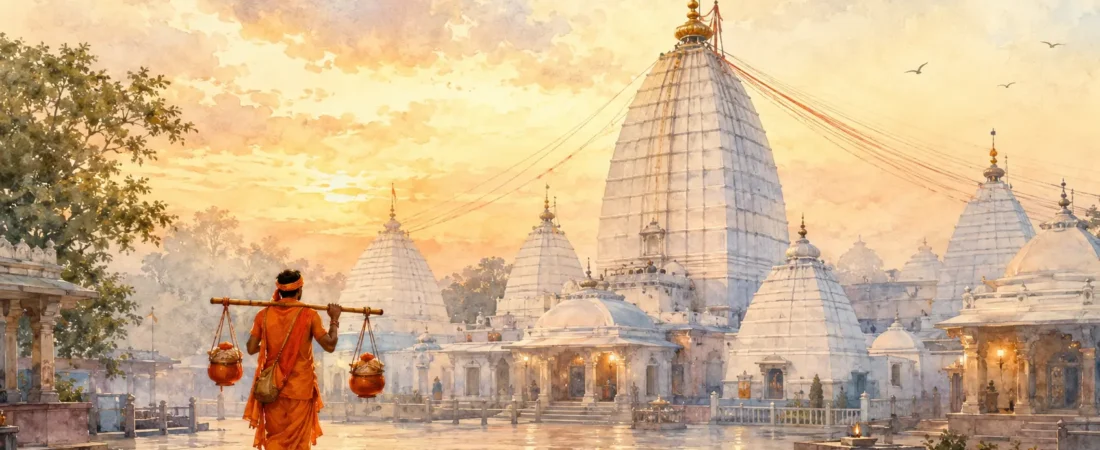
Among the twelve Jyotirlingas of Lord Shiva, Baba Baidyanath Dham in Deoghar carries a name of unusual tenderness: Vaidyanatha, the Divine Healer.
The shrine is not only a place where devotees seek relief from suffering. Its deeper message is that healing can mean the restoration of harmony – within the body, the mind, our relationships and our spiritual life. This does not replace medical care; rather, it gives the pilgrim a sacred language for courage, balance and inner renewal.
Deoghar itself means “the abode of the gods.” Here, the compact temple complex resounds with bells and the chant of Bol Bam. During Shravan, saffron-clad Kanwariyas walk from Sultanganj carrying Ganga water for Shiva. The Sthala Purana remembers Ravana’s fierce tapas, but also warns that spiritual power must be accompanied by humility and dharma. The adjoining Shiva–Shakti tradition reminds us that consciousness and divine energy are inseparable.
If Omkareshwar evokes the primordial sound Om, Baidyanath invites us to contemplate a compassionate truth:
Healing begins when what is scattered within us is gently brought back into harmony.
In this guide
- Baidyanath Jyotirlinga at a glance
- Where is Baidyanath Jyotirlinga?
- Why is Shiva called Vaidyanath?
- Sthala Purana: Ravana’s devotion and the linga that would not move
- What Ravana’s story teaches
- Baidyanath as both Shiva Kshetra and Shakti Kshetra
- Spiritual significance: Shiva as healer of the inner life
- The Baidyanath temple complex and architecture
- Darshan, puja and temple timings
- Shravan and the Sultanganj–Deoghar Kanwar Yatra
- Major festivals at Baba Dham
- Best vegetarian food to try in Deoghar
- Places to visit near Baidyanath Dham
- A thoughtful two-day Deoghar itinerary
- How to reach Baidyanath Dham
- Best time to visit Baidyanath Jyotirlinga
- Frequently asked questions
- Baidyanath: where devotion becomes healing
Baidyanath Jyotirlinga at a glance
| Pilgrimage detail | Practical information |
|---|---|
| Sacred name | Baba Baidyanath, Vaidyanath or Baijnath |
| Location | Deoghar, Jharkhand |
| Deity | Lord Shiva as Vaidyanatha, the Divine Healer |
| Sacred associations | One of the twelve Jyotirlingas; also revered in the local Shakti Peetha tradition |
| Temple complex | Main Jyotirlinga shrine with 21 associated temples |
| Official daily hours | 4:00 a.m. to 9:00 p.m.; timings and access can change on festivals |
| Most characteristic pilgrimage | Shravan Kanwar Yatra from Sultanganj to Deoghar |
| Walking distance traditionally cited | About 105–109 km, depending on the route and source |
| Best time for quieter travel | October to February |
| Nearest major rail gateway | Jasidih Junction, about 7 km from central Deoghar |
| Nearest airport | Deoghar Airport, about 12 km from the city |
| Ideal stay | One day for darshan; two days for the fuller Deoghar pilgrimage circuit |
Travel information was checked against the temple, Deoghar district and Government of India tourism pages on 17 August 2026. Pilgrims should recheck festival arrangements immediately before travel.
Where is Baidyanath Jyotirlinga?
Baba Baidyanath Dham stands in Deoghar in Jharkhand’s Santhal Parganas region. The temple is the spiritual centre around which the city’s identity has grown; Deoghar is also affectionately called Baba Dham or Baidyanath Dham.
The sacred complex is not an isolated monument. It is a living precinct of 22 shrines – the principal Baidyanath temple and 21 associated temples – where Shiva, Parvati and other deities are worshipped. Its lanes, flower stalls, prasada shops and continuous stream of pilgrims make it feel like a sacred city within the city.
Different regional traditions identify the Vaidyanath named in the Jyotirlinga verses with different holy places. Deoghar is one of the most widely revered identifications and is recognised as Baidyanath Jyotirlinga by the Deoghar district administration, Jharkhand Tourism and Incredible India. This guide follows the Deoghar tradition while respecting the other regional traditions associated with the sacred name Vaidyanath.
Why is Shiva called Vaidyanath?
The Sanskrit word vaidya means physician or healer, while natha means lord. Vaidyanatha therefore means Lord of Physicians or the Divine Healer.
In the temple’s sacred legend, Shiva heals Ravana after his severe tapas. Yet the name also opens a wider spiritual interpretation. A physician treats a visible illness; Shiva as Vaidyanatha addresses the inner conditions that keep human beings in distress – fear, ego, restlessness, attachment and ignorance.
The symbolism can be read in three movements:
- Jyoti is the light of awareness.
- Vaidya is the intelligence that restores balance.
- Shiva is the transforming presence through which the old gives way to the whole.
This makes Baidyanath one of the most personally resonant Jyotirlingas. Devotees may arrive carrying grief, anxiety, illness in the family or simply the fatigue of a demanding life. The shrine does not promise that faith will remove every difficulty. It offers something more enduring: a sacred centre from which difficulty can be faced with courage and clarity.
Sthala Purana: Ravana’s devotion and the linga that would not move
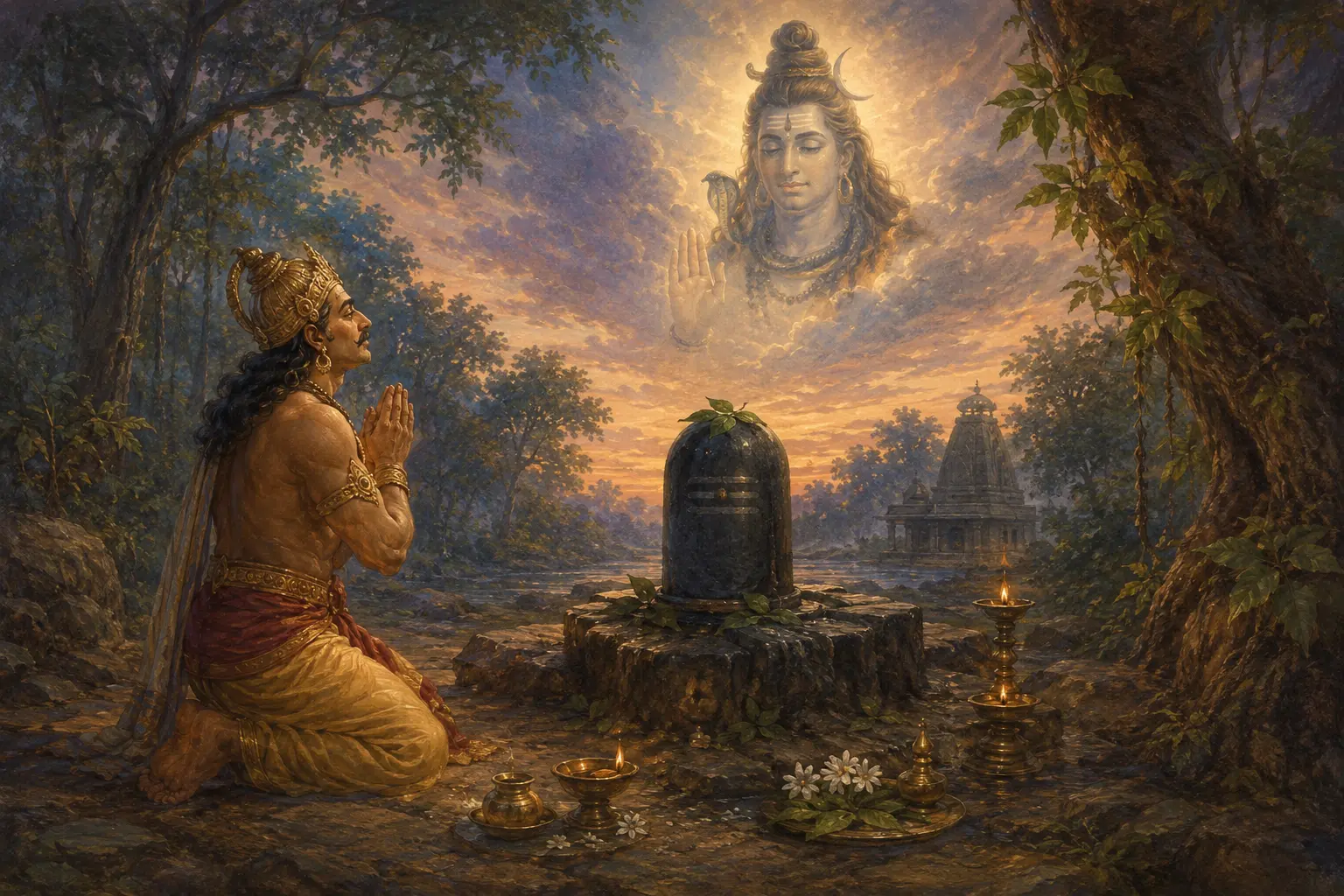
The best-known Sthala Purana of Baidyanath Dham is associated with Ravana, the learned and powerful king of Lanka.
Tradition says that Ravana wished to take Shiva’s presence to Lanka. He undertook severe tapas and worshipped with extraordinary determination. In one beloved version, he offered his heads one by one during his austerity. Pleased by this devotion, Shiva restored and healed him; from this act of divine healing comes the name Vaidyanatha.
Shiva then granted Ravana a sacred linga to carry to Lanka, but with a condition: once the linga touched the ground, it would remain there.
The gods feared the consequences of such spiritual power being established in Ravana’s kingdom. On the journey, circumstances compelled him to pause and entrust the linga to another person – described in different tellings as a cowherd or a young Brahmin. Unable to bear its weight indefinitely, the temporary bearer placed it on the earth. When Ravana returned, the linga had become firmly rooted.
He pulled with all his strength, but it would not move. Some local traditions remember the mark of his force upon the linga. The divine presence therefore remained at the sacred place later revered as Baidyanath Dham.
As with many ancient Sthala Puranas, details vary across oral and textual retellings. Their shared spiritual structure is more important than insisting on one modern, literal sequence: tapas brings grace, divine power cannot be possessed, and the sacred ultimately establishes itself where it chooses.
What Ravana’s story teaches
Ravana is one of the most complex figures in the Indian epics. He is remembered as a profound scholar and ardent Shiva devotee, yet he is also destroyed by arrogance, possessiveness and adharma.
That complexity gives the Baidyanath legend unusual moral depth. It tells us that spiritual accomplishment is not the same as spiritual maturity. Mantras, learning and tapas can create power, but only humility and dharma make that power auspicious.
Devotion may open the door to grace, but humility is what allows grace to transform us.
The rooted linga becomes a symbol of this truth. Ravana wants to carry divinity according to his own plan. Instead, he discovers that the Divine is not an object to be owned or controlled. Shiva chooses where to remain.
This is not a rejection of Ravana’s devotion. The tradition honours his intensity while refusing to romanticise his ego. It asks every devotee a quiet question: Has my worship made me gentler, steadier and more truthful?
Baidyanath as both Shiva Kshetra and Shakti Kshetra
Deoghar’s sacred identity is deepened by its association with the Shakti Peetha tradition. Local belief connects the region with the heart of Sati, and the Parvati shrine stands beside the principal Baidyanath temple. Sacred red threads traditionally link the two shrines, visually expressing the inseparability of Shiva and Shakti.
In Hindu philosophy, Shiva without Shakti is pure consciousness without movement; Shakti is the power through which consciousness creates, sustains and transforms. Their union is not merely a divine marriage. It is a vision of wholeness.
At Baidyanath, this becomes part of the healing symbolism:
- Shiva is stillness, awareness and the space in which healing can begin.
- Shakti is vitality, compassion and the energy through which healing unfolds.
- Their harmony reminds us that a complete life needs both inner silence and active care.
The Deoghar district history page notes that, along with Srisailam Mallikarjuna, Deoghar is revered as a place where Jyotirlinga and Shakti Peetha traditions meet.
Spiritual significance: Shiva as healer of the inner life
At Somnath, we encounter renewal after destruction. At Mahakaleshwar, we contemplate time and mortality. At Baidyanath, the central movement is from fragmentation to integration.
The body needs responsible care. The mind needs rest and clarity. Relationships need compassion. The conscience needs alignment with dharma. The spirit needs meaning.
Pilgrimage can support this inner work by interrupting ordinary routines. The early rising, the queue, the mantra, the offering of water and the humility of standing among thousands of other seekers all soften the illusion that we are self-sufficient.
Yet spiritual practice should never be presented as a substitute for qualified medical or mental-health care. The temple’s message is complementary: care for the body wisely, and also attend to the fear, isolation or loss of meaning that may accompany suffering.
Awareness itself can be healing. When we see clearly, we can begin to respond rather than merely react.
The Baidyanath temple complex and architecture
The origin of the sacred site is remembered as ancient, while the visible temple reflects centuries of patronage, repair and renewal. Deoghar district records that the original builder is not known. It notes that portions of the temple’s front are traditionally associated with Puran Mal, an ancestor of the Maharaja of Gidhaur, around 1596.
The principal shrine faces east and is a plain, powerful stone structure crowned by a pyramidal tower approximately 72 feet high. At the summit are three ascending gold vessels associated with the Maharaja of Gidhaur, along with a distinctive panchshula. The inner upper portion is traditionally described as containing the Chandrakanta Mani, an eight-petalled lotus jewel.
Around the main sanctum stand shrines associated with Parvati, Kali, Gayatri, Kal Bhairava, Lakshminarayana and other deities. This compact arrangement creates an intense devotional atmosphere. Unlike a monumental complex experienced from a great distance, Baidyanath is intimate, crowded with sacred presences and constantly alive with worship.
The most responsible historical description is therefore simple: Baidyanath’s sacred identity is rooted in Puranic tradition, while the temple seen today carries the material history of many generations.
Darshan, puja and temple timings
The official temple website lists daily opening hours from 4:00 a.m. to 9:00 p.m. The day includes morning worship, darshan, offerings, a period for the deity’s ritual rest or preparation, evening worship and shringara. Exact intervals and access rules can change, especially on Mondays, during Shravan, Maha Shivaratri and other crowded festivals.
Common forms of worship include:
- Jalabhisheka, especially with Ganga water
- Rudrabhisheka and Maha Abhisheka
- Bilva leaf and flower offerings
- Mantra japa
- Aarti and darshan
The simplest mantra is also the most enduring:
ॐ नमः शिवाय। Om Namah Shivaya.
During Shravan, arrangements may include long managed queues, holding areas and special restrictions. Do not depend on a timetable copied months earlier. Check the official Baba Baidyanath Dham temple website and the Deoghar district Shrawani Mela page shortly before departure.
Gentle pilgrim etiquette
- Dress modestly and choose clothes suitable for heat, rain and long queues.
- Carry only essentials; follow current rules for phones, bags and photography.
- Buy ritual items without blocking the narrow approaches to the temple.
- Do not push for proximity to the linga; darshan is an act of attention, not possession.
- Elderly pilgrims and families should avoid the heaviest festival rush unless prepared for long waits.
- Follow the temple administration and district authorities during crowd-control changes.
Shravan and the Sultanganj–Deoghar Kanwar Yatra
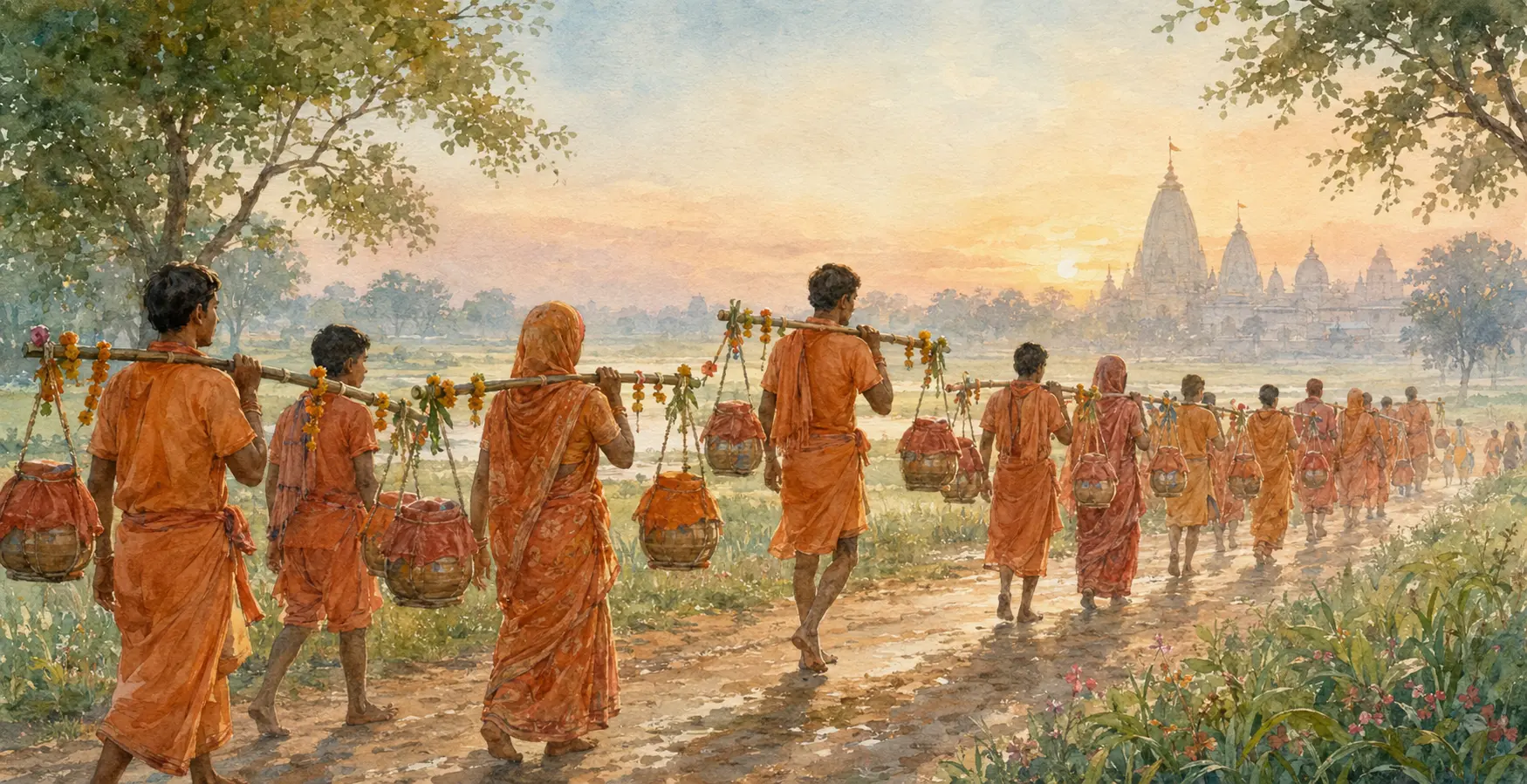
The Kanwar Yatra is the most distinctive living tradition of Baidyanath Dham. Pilgrims collect Ganga water at Sultanganj in Bihar, where the river is traditionally celebrated for flowing northward, and carry it on foot toward Deoghar.
Official sources cite a journey of roughly 105 to 109 kilometres, depending on the reference point and route. The pilgrims – Kanwariyas – carry the water in balanced vessels suspended from a decorated bamboo frame. The containers are treated with reverence because the water is meant for Shiva’s Jalabhisheka.
The long saffron line is not simply a festival crowd. It is a moving discipline.
- Walking becomes tapas.
- Carrying the water becomes seva.
- Repeating “Bol Bam” becomes mantra.
- Protecting the offering becomes mindfulness.
- Pouring the water over the Jyotirlinga becomes surrender.
The pilgrim knows the destination from the beginning, but cannot skip the path. That is why the Kanwariya is such a powerful image for spiritual life. Realisation may be the destination; repeated discipline carries us there.
What I carried so carefully, I finally offer to the Divine.
Shravan offers extraordinary devotional intensity, but it also brings immense crowds, humidity, rain and traffic changes. Pilgrims seeking a quieter temple experience should consider October to February instead.
Major festivals at Baba Dham
Shravan or Shrawani Mela
Held during July–August according to the lunar calendar, the month-long mela draws lakhs of pilgrims. The entire route and city reorganise around worship, transport, food, medical aid and crowd management.
Maha Shivaratri
The sacred night of Shiva is marked by special pujas, extended devotion and large gatherings. Advance accommodation planning is wise.
Basant Panchami Tilkotsav
The official temple tradition describes a ceremonial tilak connected with the divine wedding of Shiva and Parvati. Devotees, particularly from the Mithila region, arrive with decorated Kanwars.
Bhadra Purnima and other occasions
The Deoghar administration also records substantial pilgrim activity around Bhadra Purnima and other seasonal fairs. Mondays remain especially important for Shiva worship throughout the year.
Best vegetarian food to try in Deoghar
Indian Ethos recommends a simple, vegetarian and pilgrimage-friendly approach to food in Deoghar. During peak periods, choose clean, busy establishments serving freshly prepared food, drink sealed or safely filtered water and be cautious with milk sweets that have been stored in heat.
Deoghar peda
The city’s most famous edible souvenir is its milk-based peda, closely associated with Baba Dham and often taken home as prasada. Buy modest quantities from a clean, reputable seller and check freshness before travelling with it.
Chuda with curd or jaggery
Flattened rice is light, familiar and suited to a pilgrim’s day. Chuda with curd, milk or jaggery makes a gentle breakfast when freshness and hygiene are assured.
Dhuska with aloo–kala chana
Jharkhand Tourism highlights dhuska, a fried preparation made from a rice-and-lentil batter. Its classic vegetarian accompaniment is potato and black-chickpea curry. It is hearty, regional and best enjoyed freshly cooked.
Litti–chokha
Widely available across the Bihar–Jharkhand cultural belt, litti filled with roasted gram flour and served with vegetable chokha can be a satisfying vegetarian meal. Confirm whether ghee is added if you have dietary preferences.
Simple satvik meals
Rice, dal, roti, seasonal sabzi, khichdi, curd and poori–sabzi are readily found around the pilgrimage area. During an intense darshan day, simple food is often kinder to the body than a large restaurant meal.
Places to visit near Baidyanath Dham
Shivaganga
Close to the temple, Shivaganga is woven into the pilgrimage tradition. Kanwariyas traditionally bathe or purify themselves before offering Ganga water. Treat the area as a sacred water body rather than merely a sightseeing stop.
Naulakha Mandir
About 1.5 km from Baba Baidyanath Temple according to the district page, Naulakha Mandir is dedicated to Radha and Krishna. Its tall form recalls Belur’s Ramakrishna temple tradition. The temple is associated with Rani Charushila, who turned personal grief toward sacred patronage.
Nandan Pahar
This small hill on the edge of Deoghar contains a Nandi temple, shrines of Shiva’s family and broad views of the city. It works well as a gentle evening outing, especially for families.
Tapovan Hills and caves
Tapovan combines caves, shrines and the atmosphere of a natural retreat. The name itself evokes the ancient Indian idea of a forest of tapas – a landscape in which silence and discipline become spiritual teachers.
Trikut Pahar
Approximately 15–16 km from Deoghar, Trikut’s three peaks offer forest scenery, pilgrimage associations and trekking. The district tourism page mentions a ropeway, but its operating status has changed since the serious 2022 accident; travellers should not assume it is running and must verify current official safety information locally. Visit for the landscape and temple traditions rather than planning around the cable car.
Satsang Ashram and Ramakrishna Mission Vidyapith
These institutions reveal another dimension of Deoghar’s spiritual culture – modern movements of education, service, satsang and disciplined community life.
Basukinath
Pilgrims with an additional day often extend the journey to Basukinath, another important Shiva centre in the wider sacred circuit. Road time and festival traffic should be checked locally.
A thoughtful two-day Deoghar itinerary
Day one: Baba Baidyanath and the old sacred city
Begin before sunrise and enter the temple precinct with enough time for a patient queue. After darshan, visit the associated shrines without rushing. Pause at Shivaganga, eat a light vegetarian breakfast and rest during the hottest part of the day. In the afternoon, visit Naulakha Mandir. End with a quiet view from Nandan Pahar if weather and energy permit.
Day two: nature, reflection and Deoghar’s wider spiritual life
Choose either Tapovan or Trikut Pahar for the morning rather than attempting every site. Return to the city for lunch, then visit Satsang Ashram or Ramakrishna Mission Vidyapith where access is permitted. Families may keep Nandan Pahar for this evening. Travellers continuing to Basukinath should dedicate sufficient time rather than treating it as a hurried detour.
This rhythm preserves what pilgrimage easily loses when it becomes a checklist: silence, rest and receptivity.
How to reach Baidyanath Dham
By air
Deoghar Airport – also called Baba Baidyanath Airport – is approximately 12 km from the city. Flight routes and frequency change, so check the airline’s live schedule before booking. Hired cars are available from the airport.
By train
Jasidih Junction is the principal rail gateway, approximately 7 km from Deoghar. The district administration also lists Baidyanath Dham Junction and Deoghar station. Confirm the exact arrival station on your ticket because transfer distances differ.
By road
Deoghar is connected with cities and towns in Jharkhand, Bihar and West Bengal. The district page places Ranchi at roughly 278 km and Dhanbad at about 132 km by road. Monsoon conditions, festival diversions and Shravan traffic can lengthen travel significantly.
Best time to visit Baidyanath Jyotirlinga
Choose according to the experience you seek:
| Season | What it offers | What to consider |
|---|---|---|
| Shravan, usually July–August | The most powerful Kanwar Yatra atmosphere | Very heavy crowds, rain, long queues and traffic controls |
| October–February | Pleasant weather and easier local sightseeing | Festival dates may still create busy periods |
| Maha Shivaratri | Intense Shiva worship and special celebrations | Book early and expect crowd-management measures |
| Summer | Often lighter than major festivals | Heat can make queues and sightseeing tiring |
For a first visit with elderly family members, the cooler non-festival months are usually gentler. For a devotee specifically seeking the living tradition of the Kanwar Yatra, Shravan is incomparable – but it requires physical and logistical preparation.
Frequently asked questions
Is Baidyanath Dham one of the twelve Jyotirlingas?
Yes. Deoghar is widely revered as one of the twelve Jyotirlinga sites and is identified as such by the district administration, Jharkhand Tourism and Incredible India. Other regional traditions also associate the name Vaidyanath with other sacred places; this article follows the Deoghar tradition.
Why is Shiva called Baidyanath or Vaidyanath here?
Vaidya means physician or healer. In the Sthala Purana, Shiva heals Ravana after his severe tapas. Spiritually, Vaidyanatha represents the restoration of harmony in body, mind and inner life.
What is the main legend of Baidyanath Jyotirlinga?
Ravana performs intense tapas, receives a sacred linga from Shiva and is instructed not to place it on the ground. During the journey it is set down and becomes permanently rooted at the sacred site.
Is Baidyanath also a Shakti Peetha?
Deoghar’s local sacred tradition venerates the site as a Shakti Peetha associated with Sati’s heart. The proximity and symbolic linking of the Baidyanath and Parvati shrines express the union of Shiva and Shakti.
What are the official Baidyanath Dham temple timings?
The official temple website lists the temple as open daily from 4:00 a.m. to 9:00 p.m. Ritual intervals, queue access and festival schedules can change, so verify shortly before visiting.
How far is the Kanwar Yatra from Sultanganj to Deoghar?
Official sources cite roughly 105–109 km depending on the reference point and route. Kanwariyas carry Ganga water from Sultanganj to offer as Jalabhisheka at Baba Dham.
Which month is best for Baidyanath Dham?
Shravan offers the most intense devotional atmosphere. October to February is generally better for comfortable weather, quieter darshan and nearby sightseeing.
How many days are enough for Deoghar?
One day can cover darshan outside peak periods. Two days allows time for the temple complex, Naulakha Mandir, Nandan Pahar and one nature or spiritual site without rushing.
What vegetarian food is Deoghar known for?
Try fresh Deoghar peda, chuda with curd or jaggery, Jharkhand-style dhuska with potato and black-chickpea curry, litti–chokha and simple satvik thali meals.
Which station is best for Baidyanath Dham?
Jasidih Junction is the principal gateway and is about 7 km from Deoghar. Baidyanath Dham Junction and Deoghar station may be convenient for some routes.
Can elderly pilgrims visit during Shravan?
They can, but Shravan brings very heavy crowds, rain, long waits and changing access arrangements. A cooler non-festival period is usually more comfortable unless special assistance and careful planning are available.
Is the Trikut Pahar ropeway operating?
Do not assume that it is. Operating and safety status has changed since the 2022 accident. Check current information from the district or tourism authorities locally before planning any ropeway visit.
Baidyanath: where devotion becomes healing
Baba Baidyanath Dham is more than another sacred point on the map of India’s twelve Jyotirlingas. It is a living pilgrimage built around an extraordinary idea – Shiva as Vaidyanatha, the Divine Healer.
The Sthala Purana remembers Ravana’s fierce devotion and the limits of pride. The temple brings Shiva and Shakti into intimate proximity. During Shravan, countless pilgrims lift Kanwars filled with Ganga water and walk kilometre after kilometre chanting Shiva’s name. At the end of the journey, the water is poured over the Jyotirlinga, and effort, fatigue, longing and ego are symbolically placed at Shiva’s feet.
Perhaps this is Baidyanath’s enduring message:
Healing is not always the disappearance of pain. Sometimes it is the return of courage, balance, meaning and trust in the midst of pain.
The Divine Physician invites us to care for the body responsibly, quieten the mind, repair what can be repaired, surrender what cannot be controlled and allow awareness to illumine the path ahead.
ॐ नमः शिवाय। बोल बम। हर हर महादेव। जय बाबा बैद्यनाथ।
Sources and further reading
- Official Baba Baidyanath Dham Temple
- Baba Baidyanath Dham Temple – District Deoghar
- History of Deoghar – District Administration
- Shrawani Mela 2026 – District Deoghar
- How to Reach Deoghar – District Administration
- Deoghar: The Abode of God – Incredible India
- Naulakha Temple – District Deoghar
- Nandan Pahar – District Deoghar
- Trikut Pahar – District Deoghar
- Cuisine of Jharkhand – Jharkhand Tourism