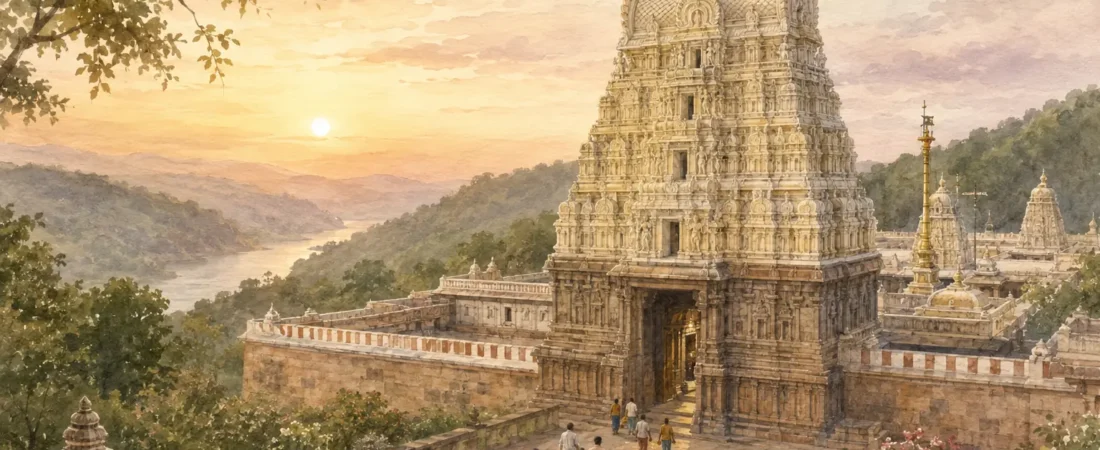
High in the Nallamala Hills of Andhra Pradesh, where forested ridges descend towards the Krishna River, stands one of Bharat’s most profound sacred landscapes: Srisailam Mallikarjuna Jyotirlinga. Here, Lord Shiva is worshipped as Sri Mallikarjuna Swamy and Devi as Sri Bhramaramba. The kshetra is revered in two great pilgrimage traditions at once: as one of the twelve Jyotirlingas of Shiva and as one of the eighteen Maha Shakti Peethas honoured in South Indian tradition.
This union gives Srisailam its distinctive spiritual character. It is not a shrine of Shiva alone or Shakti alone, but a living reminder that stillness and energy, consciousness and creation, compassion and courage are inseparable. The official Devasthanam describes the temple as a place where Mallikarjuna and Bhramaramba are worshipped together within one sacred complex, set amid the demanding terrain and natural beauty of the Nallamala Hills.
The pilgrimage is equally remarkable for its layered heritage. Puranic narratives, local Sthala Purana, dynastic patronage, Shaiva and Shakta worship, the memory of saints, the living traditions of the Chenchu community and the sacred ecology of the Krishna valley all meet here. To approach Srisailam thoughtfully is therefore to enter a temple, a forest, a river landscape and a civilizational memory at the same time.
ॐ मल्लिकार्जुनाय नमः।
Om Mallikārjunāya Namaḥ: Salutations to Lord Mallikarjuna.
Contents
- Srisailam at a glance
- Why Srisailam is spiritually unique
- Sthala Purana and sacred legends
- Bhramaramba Devi and the Shakti Peetha
- Sacred geography and Patalaganga
- Chenchu Mallanna and living local tradition
- History and architecture
- Darshan, pujas and festivals
- Places to visit near Srisailam
- Vegetarian food and local culture
- How to reach Srisailam
- Best time to visit, stay and practical guidance
- A suggested two-day itinerary
- Indian Ethos reflections
- Frequently asked questions
Srisailam Mallikarjuna Jyotirlinga at a Glance
| Detail | Information |
|---|---|
| Sacred name | Sri Bhramaramba Mallikarjuna Swamy Varla Devasthanam |
| Location | Srisailam, Nandyal district, Andhra Pradesh |
| Presiding deities | Sri Mallikarjuna Swamy and Sri Bhramaramba Devi |
| Sacred status | One of the twelve Jyotirlingas and one of the eighteen Maha Shakti Peethas |
| Landscape | Nallamala Hills and the Krishna River valley |
| Sacred river name | Patalaganga |
| Principal festivals | Maha Shivaratri Brahmotsavam, Ugadi, Karthika Masam and Navaratri/Dasara observances |
| Nearest major airport | Rajiv Gandhi International Airport, Hyderabad, according to the Devasthanam |
| Nearest railhead named by the temple | Markapur Road, followed by a road journey |
| Best general season | October to February for more comfortable weather |
| Ideal visit length | Two days for the temple and principal nearby sites |
| Official information and booking | Srisaila Devasthanam |
Why Is Srisailam Spiritually Unique?
The spiritual importance of Srisailam begins with its identity as a Jyotirlinga kshetra. The Jyotirlinga is traditionally understood not merely as a stone emblem but as a manifestation of Shiva’s limitless light. It points beyond measurable form towards the beginningless and endless reality symbolised by the pillar of radiance in the famous Jyotirlinga narrative.
At Srisailam, this Shaiva sanctity is joined by the presence of Sri Bhramaramba Devi, worshipped as a powerful form of the Divine Mother. The temple therefore embodies Shiva and Shakti together. The official temple description interprets this presence as the equal and indivisible coexistence of masculine and feminine principles.
This is not simply an abstract philosophy. In everyday life, awareness without the energy to act can remain incomplete, while action without awareness can become restless. Mallikarjuna and Bhramaramba together invite the pilgrim to cultivate both: the clarity to see and the strength to serve; inner stillness and responsible participation in the world.
Srisailam is also called Srigiri, Sirigiri, Sriparvata and Srinaga in different traditions. The Devasthanam reverentially describes Srisaila Mahakshetram as “Kailasa on Earth.” Such language belongs to sacred tradition rather than geographical measurement, but it communicates how generations of devotees have experienced the hill: as a place set apart for tapas, darshan and spiritual renewal.
Sthala Purana of Srisailam
Srisailam’s sacred identity is held within several complementary narratives. These stories belong to Puranic and local devotional tradition; they should be received for the spiritual truths they carry rather than treated as modern historical records.
The Story of Kumara and the Compassion of the Divine Parents
One of the best-known traditions connects Srisailam with Lord Kartikeya, also called Kumara. When Shiva and Parvati wished to decide which of their sons should marry first, Ganesha and Kartikeya were asked to circle the world. Kartikeya set out on his peacock, while Ganesha circumambulated his parents, recognising them as the universe itself. Ganesha’s wisdom was honoured, and his marriage was celebrated first.
On returning, Kartikeya felt hurt and withdrew to Mount Krauncha. Shiva and Parvati followed, not to punish him but to console him. Tradition holds that they remained near their son in the form of Mallikarjuna. The story gives the kshetra a tender dimension: divinity does not abandon one who turns away in pain. Like compassionate parents, Shiva and Parvati cross distance to restore relationship.
For families, the story offers a quiet lesson. Wisdom and speed do not always move in the same way; each child experiences the world differently. Love listens beneath anger, gives space without withdrawing affection and seeks reconciliation without humiliation.
Chandravati, the Cow and the Jasmine Garland
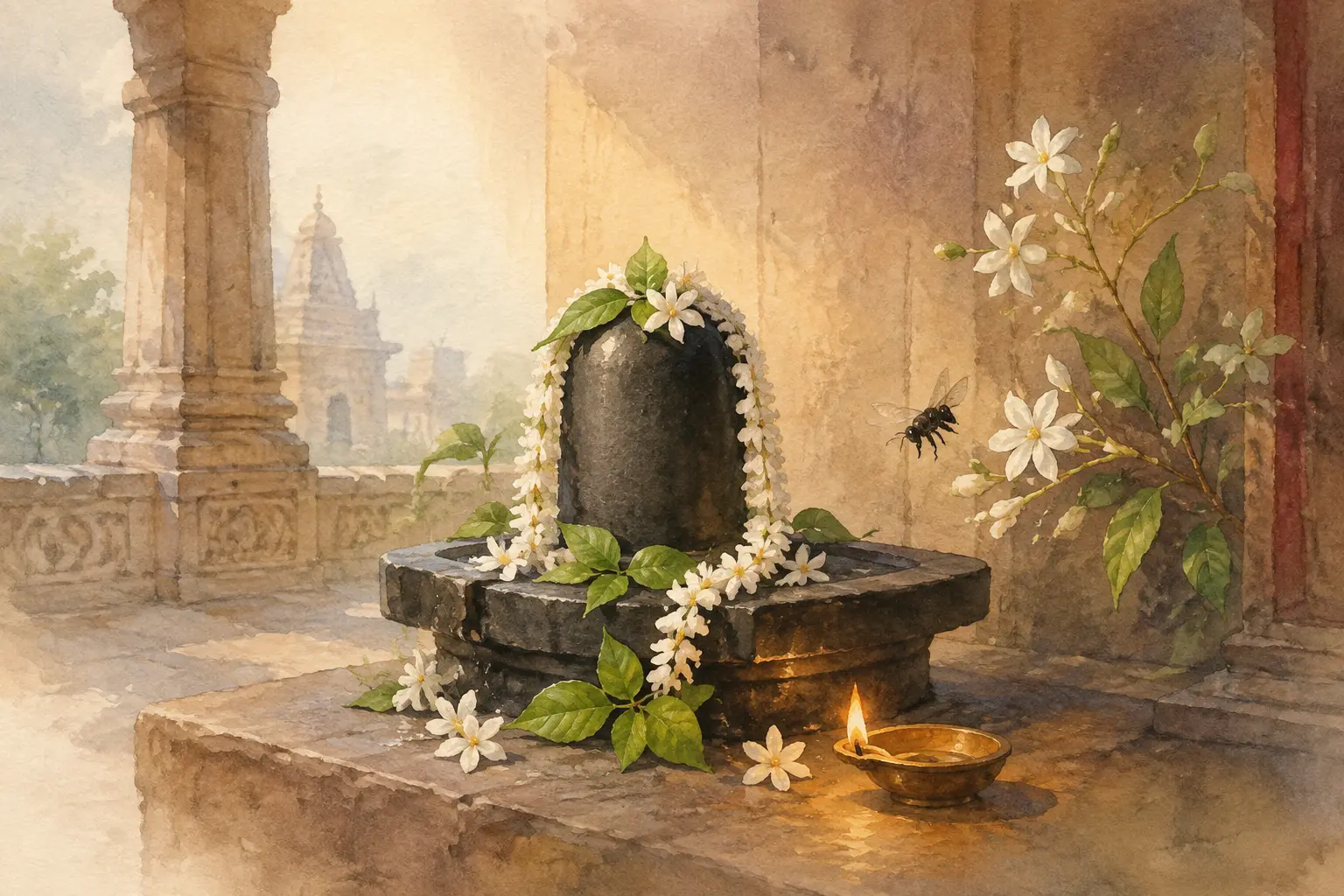
Another local tradition remembers a devoted woman named Chandravati, often described as a princess who withdrew into the forest and lived a life of worship. She noticed that one of her cows was releasing its milk over a particular place. There she discovered a linga and began offering worship with jasmine flowers.
The Devasthanam’s account of Mallikarjuna Swamy associates Chandravati’s seva and the offering of the mallika, or jasmine, with the name Mallikarjuna. Traditional explanations also connect Mallika with Parvati and Arjuna with Shiva. The white jasmine becomes more than a flower: it suggests simplicity, purity and devotion that asks for no display.
Why the Name Mallikarjuna Matters
Sacred names often hold several layers at once. “Mallikarjuna” remembers the fragrance of jasmine, the loving presence of Shiva and Shakti and the devotion through which an apparently ordinary forest place is recognised as sacred. The Sthala Purana therefore shifts attention from grandeur to perception. Chandravati sees what others might overlook. Her worship teaches that a sacred encounter begins when attention becomes reverence.
Sri Bhramaramba Devi and the Shakti Peetha
Sri Bhramaramba Devi is the presiding Goddess of Srisailam. Her name is connected with bhramara, the bee. The official temple page places her story within the Srisaila Khanda and the tradition of Bhramari Devi.
In a well-known sacred narrative, the asura Arunasura obtained protection that made him invulnerable to beings of two or four legs. When his power became destructive, the Divine Mother manifested through countless bees and overcame him. This is a traditional theological story, not a historical claim. Its symbolism is striking: power may imagine itself secure by accounting for obvious dangers, yet dharma can arise through a form that pride has failed to consider.
The bee also suggests concentration. Moving directly towards fragrance and nectar, it becomes an image of focused devotion. Bhramaramba therefore represents protective strength joined with alert intelligence. Her presence prevents the pilgrimage from being understood only as withdrawal into stillness; she also embodies the courage required to confront disorder.
Srisailam is honoured among the eighteen Maha Shakti Peethas in widely followed South Indian tradition. Lists of Shakti Peethas and the body-part associations attached to them vary across texts and regions. A culturally responsible account should acknowledge this variation rather than forcing every tradition into one universal list.
The Sacred Geography of Srisailam
The geography of Srisailam is essential to its meaning. The temple rises amid the Nallamala range, and the Krishna River flows through the deep valley below. Forest, hill, water, stone and pilgrimage route are not background scenery; together they form the kshetra.
The Devasthanam’s account describes Srisailam as an embodiment of Sri Chakra. This is a sacred interpretation of landscape: the hill is experienced as a field of divine energy, with gateways, subsidiary shrines, water sources and paths forming a larger ritual geography.
Patalaganga: The Krishna River Below the Hill
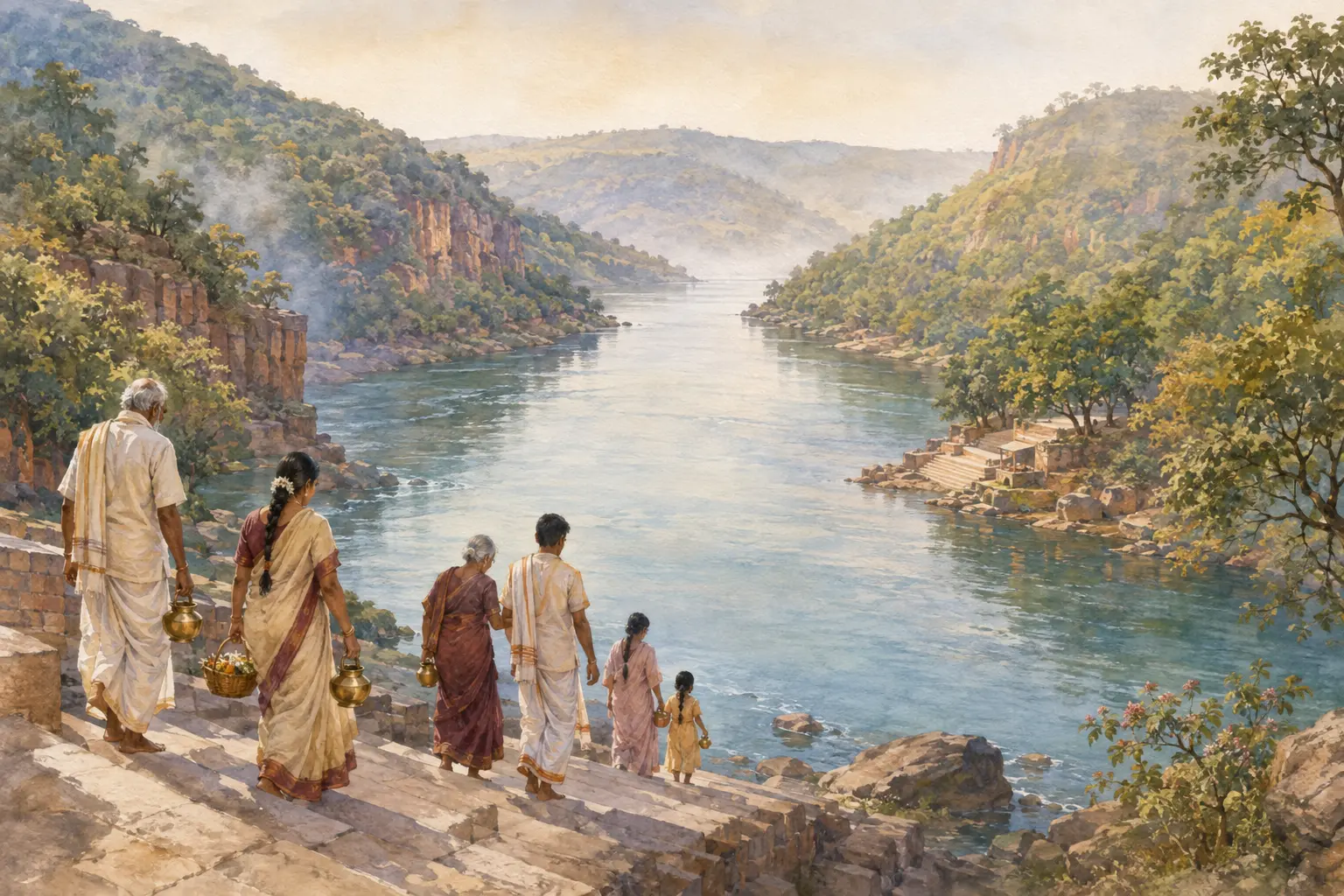
At Srisailam, the Krishna River is reverentially called Patalaganga. Pilgrims traditionally descend towards the river for a sacred bath or to collect water before worship. Today, access conditions, water levels, steps, ropeway operations and boating arrangements can vary, so travellers should verify them locally, especially if elders or children are accompanying them.
Water in a tirtha is not treated as a commodity. It receives prayer, carries memory and reminds the pilgrim of dependence on nature. The most meaningful offering at Patalaganga is therefore responsible conduct: avoid soap and plastic, do not leave ritual materials or food waste in the river, and follow all local safety instructions.
The Nallamala Forest
Srisailam lies within the wider landscape of the Nagarjunasagar-Srisailam Tiger Reserve. The reserve’s official ecotourism portal describes its forests, wildlife, birdlife and regulated safari activities. The forest is not simply an attraction added to a temple trip. It is a living ecological system and a reminder that many of India’s sacred sites survived because communities learned to approach forests with restraint.
The temple’s current connectivity guidance states that forest check-post gates on the approaches are closed daily from 9:00 PM to 6:00 AM. Pilgrims should plan the ghat-road journey within permitted hours and drive cautiously.
Chenchu Mallanna: A Living Relationship With the Forest Community
The Chenchus are an Indigenous forest community with a long relationship to the Nallamala region. Local tradition affectionately regards Mallikarjuna as Chenchu Mallanna and as a son-in-law of the Chenchu people. This relationship brings the divine into kinship: Shiva is not distant royalty but a member of the family, welcomed into community life.
The tradition should be presented with respect, not reduced to colourful folklore for tourists. Visitors should avoid intrusive photography, seek consent before photographing people, purchase crafts fairly where available and never treat a living community as a spectacle. The deeper teaching of Chenchu Mallanna is belonging: the sacred landscape includes the people who have known and cared for it across generations.
Srisailam Through History
The origin of Srisailam cannot be fixed to a single date. The temple’s own account distinguishes its immeasurable antiquity in sacred tradition from the historical evidence preserved through inscriptions, architecture and records of patronage.
Srisailam is mentioned in a long stream of religious memory and South Indian cultural history. The Devasthanam’s historical overview associates the region with the Satavahanas and later dynasties. Across the centuries, rulers and patrons connected with the Ikshvakus, Pallavas, Chalukyas, Kakatiyas, Reddis and the Vijayanagara Empire supported the sacred complex or routes leading to it. The temple walls, gateways, mandapas, sculptures and inscriptions preserve this cumulative history rather than the work of one period alone.
The Reddi rulers are especially remembered for their patronage of Srisailam and for improving access to the hill and Patalaganga. Vijayanagara patronage contributed major architectural elements and reinforced the temple’s importance within the wider southern sacred world. Temple tradition also remembers the devotion of Chhatrapati Shivaji Maharaj and associates him with the northern gateway.
Srisailam is further connected in religious memory with Adi Shankaracharya, whose visit is affirmed by the Devasthanam’s overview, and with the Virashaiva saint Akka Mahadevi. Local tradition associates the serene streams of Phaladhara Panchadhara with Adi Shankaracharya’s meditation. Such associations should be described as received tradition unless supported by precise contemporary evidence.
History here is best understood as continuity. Different dynasties, languages and devotional movements did not erase the kshetra’s earlier layers; they added to them. Srisailam became a meeting place for Shaiva, Shakta, Agamic, folk, philosophical and royal traditions.
Temple Architecture and Sacred Art
The Srisailam temple complex has a powerful, fortified presence. High enclosure walls, monumental gateways, pillared halls and richly carved stone surfaces create a transition from the outer pilgrimage town to the concentrated atmosphere of the sanctum.
The main shrines of Mallikarjuna Swamy and Bhramaramba Devi are surrounded by subsidiary shrines, sacred trees, springs and ritual spaces. The official main-temple inventory records shrines connected with Nandi, Ganapati, Veerabhadra, Kumara Swamy, Uma Maheswara, the Pandava lingas and other forms within the complex.
The sculptural programme reflects several periods and traditions. Pilgrims should notice the stonework patiently rather than rushing only towards the queue. Mandapa pillars, narrative reliefs, guardian figures, gopurams and inscriptions reveal how art served worship, memory and teaching. Photography rules can change and restrictions may apply within the precinct; always follow the temple’s current instructions.
Darshan, Pujas and Worship at Srisailam
The temple’s darshan page currently states that darshan begins from 6:00 AM onwards. Closing intervals, ticket categories, Sparsha Darshan arrangements and festival schedules may change. Check the official website immediately before travel rather than relying on an old timetable or an unofficial agent.
Important forms of worship offered through the Devasthanam may include:
- Darshan of Sri Mallikarjuna Swamy and Sri Bhramaramba Devi
- Abhishekam and Rudrabhishekam to Lord Mallikarjuna
- Kumkumarchana to Sri Bhramaramba Devi
- Kalyanotsavam, celebrating the divine wedding
- Rudra Homam and Mrityunjaya Homam
- Chandi Homam and other Devi-related worship
- Gow Puja, Ganapati worship and selected samskara sevas
- Paroksha Sevas for devotees who cannot be physically present
Availability, eligibility, dress code, reporting time and the number of participants vary by seva. The temple says traditional Hindu dress is required for devotees participating in sevas. Book only through the official Srisaila Devasthanam portal or authorised counters.
A Simple Personal Practice
Even without a special ticket, a pilgrim may approach the shrine with a simple discipline: bathe, wear clean and modest clothing, quieten the phone, carry only permitted offerings, chant “Om Namah Shivaya” and remember both Mallikarjuna and Bhramaramba. The purpose is not to accumulate rituals but to become more attentive, humble and inwardly steady.
Major Festivals and the Most Significant Times to Visit
Maha Shivaratri Brahmotsavam
Maha Shivaratri is among Srisailam’s grandest observances. Brahmotsavam rituals, special pujas, vahana sevas and large gatherings of Shiva Deeksha devotees create an intense devotional atmosphere. It is spiritually powerful but also extremely crowded. Accommodation and official darshan arrangements should be booked early.
Ugadi
Ugadi has a special place in the Srisailam pilgrimage calendar and draws many devotees from Andhra Pradesh, Telangana and Karnataka. The long-standing padayatra traditions from parts of Karnataka are an important expression of regional devotion. Weather can already be hot, so walking pilgrims and families should plan hydration, rest and daytime travel carefully.
Karthika Masam
Karthika Masam is deeply associated with Shiva worship, lamps, vrata and temple visits. The hill takes on a particularly luminous devotional atmosphere, but weekends and auspicious dates may bring heavy crowds and changes to Sparsha Darshan.
Navaratri and Dasara
For devotees of Sri Bhramaramba Devi, Navaratri and Dasara are especially meaningful. Alankaras and Devi worship emphasise the Shakti dimension of the kshetra.
For most travellers, October to February offers the most comfortable combination of weather and sightseeing. Those seeking festival intensity may choose Maha Shivaratri, Ugadi or Karthika Masam, accepting larger crowds and more limited accommodation.
Important Places to Visit Near Srisailam
1. Sakshi Ganapathi
Pilgrims traditionally visit Sakshi Ganapathi on the approach to Srisailam. Sakshi means witness. The Devasthanam’s account explains the form through the idea of time as witness. Devotional belief holds that Ganapati bears witness to the pilgrim’s visit to the kshetra.
2. Patalaganga
The Krishna River below the hill is approached for sacred bathing, quiet prayer and views of the valley. Confirm the condition of steps, ropeway and water access. Elders and visitors with mobility limitations should not assume every route will be easy.
3. Sikhareswaram
Located at a high point in the Srisailam region, Sikhareswaram is associated with the sacred summit and broad views of the Nallamala landscape. Traditional belief gives great importance to darshan of the Srisaila shikhara. Visit during daylight and follow forest and traffic directions.
4. Hatakeswaram
The official temple page places Hatakeswaram about five kilometres west of the Srisailam hills. It is a quieter Shaiva site, traditionally linked with spiritual practice.
5. Phaladhara Panchadhara
This serene place of natural streams is traditionally associated with Adi Shankaracharya’s meditation. The steps can be demanding, and water flow varies by season. Its value lies in silence and contemplation, not merely in taking photographs.
6. Akka Mahadevi Caves
The caves are connected with the memory of Akka Mahadevi and may involve a boat journey followed by walking. Boat services, water levels, weather and forest permissions vary. Confirm the entire route through current authorised operators before including it in the day’s plan.
7. Srisailam Dam and Viewpoints
The dam and Krishna valley offer impressive views, especially after the monsoon when conditions are safe. Stop only at authorised viewpoints. Do not park on blind curves or walk into restricted zones.
8. Nagarjunasagar-Srisailam Tiger Reserve Activities
Visitors interested in ecology can explore regulated activities listed on the NSTR official portal. Safari routes, ticket systems and seasonal closures change. For example, the reserve’s current page for the Ishtakameswari route notes restrictions during the rainy months. Treat any wildlife sighting as a privilege, keep noise low and never feed animals.
Vegetarian Food and Cuisine in Srisailam
Pilgrimage food is at its best when it is simple, fresh and suitable for the journey. Srisailam offers temple annaprasadam and vegetarian meals through many pilgrim facilities and local eateries. Distribution times and locations may change, so enquire at the Devasthanam information centre.
The vegetarian flavours of Andhra Pradesh worth seeking include:
- Pulihora, tangy tamarind or lemon rice closely associated with temples and festivals
- Pesarattu, a green-gram dosa, often served with ginger chutney
- Idli, dosa, upma and garelu for breakfast
- Andhra vegetarian meals with rice, pappu, sambar, charu, vegetable kooralu, pachadi, appadam and curd
- Gongura pappu or other seasonal leafy dals
- Gutti vankaya, stuffed brinjal curry, when available in a vegetarian kitchen
- Ragi sangati with a suitable vegetarian dal or vegetable accompaniment
- Curd rice and buttermilk, particularly helpful in warmer weather
- Traditional sweets such as pootharekulu, sunnundalu or boorelu, depending on availability
Andhra cooking can be spicy. Families with elders or children may request less chilli. Devotees following a satvik diet should ask whether onion and garlic are used, because preparation differs from one kitchen to another. Drink sealed or safely filtered water and choose busy, clean establishments where food is freshly prepared.
Food in a pilgrimage town is more than refreshment. Annaprasadam expresses equality: people of different backgrounds sit together and receive nourishment as grace. Accept only what you can finish, avoid waste and support the cleanliness of the dining area.
How to Reach Srisailam
Srisailam is in Nandyal district, Andhra Pradesh. The final road journey passes through forest and ghat sections, so arrival time matters.
By Road
The Devasthanam’s current connectivity page lists Srisailam at approximately 220 km from Hyderabad, 180 km from Kurnool, 272 km from Vijayawada and 530 km from Bengaluru. Andhra Pradesh, Telangana and Karnataka road transport services operate buses on relevant routes, while private taxis are also used.
The forest gates on the principal approaches are closed from 9:00 PM to 6:00 AM. Do not plan a late-night ghat-road arrival. Fuel up before the forest stretch, avoid speeding, do not stop to photograph wildlife and follow instructions at every check post.
By Train
The temple identifies Markapur Road as the nearest railway station serving Srisailam, about 91 km away, followed by a bus or taxi journey. Train schedules and onward connections change, so verify both before booking. Depending on the traveller’s starting point, Kurnool, Nandyal or other railheads may offer alternatives but involve a longer road journey.
By Air
The official temple guidance identifies Rajiv Gandhi International Airport, Hyderabad as the nearest major airport, approximately 230 km from Srisailam. It generally offers the widest flight connectivity, followed by a road journey. Always allow enough time to cross the forest gates before night closure.
From Bengaluru
For travellers from Bengaluru, an overnight or daytime bus may be available depending on the season, or the journey can be made by private vehicle via the appropriate Andhra Pradesh route. Because the official distance is approximately 530 km and forest gates close at night, a rushed one-day return is not advisable. A two-night plan is more comfortable for families and senior citizens.
Where to Stay
The Srisaila Devasthanam operates rooms, cottages and guest facilities, and Andhra Pradesh Tourism lists Haritha accommodation in Srisailam. Satrams and other pilgrim lodgings are also available. Standards, check-in rules and availability vary greatly, particularly during festivals.
Use the official temple accommodation portal or Andhra Pradesh Tourism for current information. Do not transfer money to an unverified personal number or unofficial social-media account claiming guaranteed rooms or special darshan.
For elders, confirm the distance from the room to the temple, lift availability, hot water, vehicle access and meal arrangements before payment. “Near Srisailam” can still mean a location requiring transport.
Suggested Two-Day Srisailam Pilgrimage Itinerary
Day One: Main Darshan and Sacred Hill
- Arrive during daylight and check in.
- Visit Sakshi Ganapathi if approaching by road and timing permits.
- Complete darshan of Sri Mallikarjuna Swamy and Sri Bhramaramba Devi.
- Spend time with the temple’s subsidiary shrines and architecture without obstructing queues.
- Attend an evening worship period if the current schedule allows.
- Eat a simple vegetarian dinner and rest early.
Day Two: River, Tirthas and Landscape
- Begin with an early temple visit or pre-booked seva.
- Visit Patalaganga, considering the mobility of all family members.
- Continue to Hatakeswaram and Phaladhara Panchadhara.
- Visit Sikhareswaram during daylight.
- Include the dam viewpoint or a regulated NSTR activity only if time, weather and permissions allow.
- Depart well before the forest-gate closure.
Akka Mahadevi Caves usually require additional time and current transport confirmation. Treat them as a separate half-day or full-day excursion rather than crowding them into an already full schedule.
Practical Pilgrimage Guidance
- Reconfirm darshan, seva, accommodation and forest-gate information shortly before departure.
- Book only through official portals or authorised counters.
- Wear modest clothing; devotees participating in sevas should follow the prescribed traditional dress code.
- Carry valid photo identification, necessary medicines and a reusable water bottle where permitted.
- Travel light, especially during Maha Shivaratri, Ugadi and Karthika Masam.
- Ask before taking photographs, and obey all restrictions inside the temple.
- Assist elders on steps and slopes; do not assume the ropeway or every facility will be operating.
- Keep plastic, food waste and ritual residue out of the forest and river.
- Do not feed monkeys or wildlife.
- Mobile connectivity may be inconsistent in forest stretches; share the route and expected arrival time with family in advance.
Four Indian Ethos Reflections From Srisailam
Shiva and Shakti: Balance Is Sacred
Mallikarjuna and Bhramaramba together teach that life is sustained through complementary powers. Wisdom must guide action; courage must be tempered by compassion; discipline must make room for nurture.
The Kumara Story: Love Crosses Distance
The Sthala Purana of the divine parents following their hurt son turns theology into an intimate family value. Reconciliation begins when love is willing to move first.
Jasmine: Great Devotion Can Be Simple
Chandravati’s jasmine offering reminds us that sincerity gives value to an offering. Sacredness is not measured by expense but by attention, cleanliness and humility.
The Forest and River: Pilgrimage Includes Responsibility
Srisailam’s holiness cannot be separated from the Nallamala forest and Krishna River. To protect water, wildlife and the dignity of local communities is not an optional environmental gesture; it is part of honouring the kshetra.
Carry This With You
Srisailam is often described as Kailasa on Earth, yet its deepest message may be very close to ordinary life. A parent moves towards a wounded child. A devotee recognises the sacred in a quiet forest place. A jasmine flower becomes worship. The bee becomes the power of concentrated purpose. Shiva and Shakti abide together, showing that inner silence and courageous action belong to one complete life.
When the pilgrim leaves the hill, the journey need not end. Srisailam can be carried home as a discipline: listen before reacting, reconcile with tenderness, act with awareness, honour the feminine and masculine as equal, and protect the natural world that sustains every sacred tradition.
हर हर महादेव। जय मल्लिकार्जुन। जय भ्रामराम्बा।
Frequently Asked Questions
Where is Srisailam Mallikarjuna Jyotirlinga located?
It is in Srisailam, Nandyal district, Andhra Pradesh, amid the Nallamala Hills and above the Krishna River valley.
Why is Srisailam temple so important?
Srisailam is revered both as one of Shiva’s twelve Jyotirlingas and as a Maha Shakti Peetha of Sri Bhramaramba Devi. The presence of Shiva and Shakti in the same temple complex gives the kshetra exceptional significance.
What is the Sthala Purana of Mallikarjuna Jyotirlinga?
One principal tradition says Shiva and Parvati came near Mount Krauncha to console their son Kartikeya and remained as Mallikarjuna. Another local tradition remembers Chandravati discovering and worshipping a linga with jasmine flowers.
What does Mallikarjuna mean?
The name is associated with mallika, the jasmine offered in local tradition, and with Shiva as Arjuna. It is also interpreted as expressing the united presence of Parvati and Shiva.
Is Bhramaramba Devi a Shakti Peetha?
Yes. Sri Bhramaramba at Srisailam is widely honoured among the eighteen Maha Shakti Peethas in South Indian tradition. Details and enumeration vary across regional textual lists.
What are the current Srisailam temple timings?
As checked on 17 August 2026, the official darshan page states that darshan begins at 6:00 AM onwards. Daily intervals and closing times can change, especially during festivals, so verify on the official website before travel.
Which is the best time to visit Srisailam?
October to February is generally most comfortable. Maha Shivaratri, Ugadi and Karthika Masam are spiritually significant but much more crowded.
How many days are sufficient for Srisailam?
Two days are recommended for unhurried darshan and the principal nearby sites. Add another half or full day if planning Akka Mahadevi Caves or a regulated forest activity.
How can I reach Srisailam from Bengaluru?
The official temple page places Bengaluru about 530 km away by road. Bus and private-vehicle options vary. Plan the journey so the forest approach is completed between 6:00 AM and 9:00 PM, and avoid a rushed same-day return.
What vegetarian food should I try in Srisailam?
Temple annaprasadam, pulihora, pesarattu, idli, dosa, garelu, Andhra vegetarian meals, pappu, seasonal vegetable curries, gongura pappu, curd rice and regional sweets are good choices. Ask about onion and garlic if following a satvik diet.
What places should I visit near Srisailam temple?
Sakshi Ganapathi, Patalaganga, Sikhareswaram, Hatakeswaram, Phaladhara Panchadhara, the Srisailam Dam viewpoints and, when current conditions permit, Akka Mahadevi Caves and regulated NSTR activities are important options.
Is night travel allowed through the Srisailam forest?
The Devasthanam currently states that forest gates on the approaches are closed from 9:00 PM to 6:00 AM. Plan the ghat-road journey accordingly and reconfirm before departure.
Read next: The Dwadasha Jyotirlingas | Somnath Jyotirlinga | Temples of India
Sources and Editorial Note
- Srisaila Devasthanam: official website
- About Srisailam
- Main Temple
- Mallikarjuna Swamy
- Bhramaramba Devi
- Temple History
- Darshan and Sevas
- Connectivity and forest-gate guidance
- Nagarjunasagar-Srisailam Tiger Reserve: official ecotourism portal
- Incredible India: Srisailam Temple
- Andhra Pradesh Tourism: Srisailam accommodation
Visitor and travel information was checked on 17 August 2026. Timings, access, ticket categories, forest permissions, accommodation and transport can change. Sacred narratives are identified as Puranic or local tradition; symbolic readings are presented as Indian Ethos reflections rather than archaeological fact. All three proposed illustrations are original AI-generated conceptual watercolours, not documentary photographs.