Temples of India · Somnath
Standing beside the Arabian Sea at Prabhas Patan, Somnath is revered as the first of Shiva’s twelve Jyotirlingas. Discover its Puranic legend, spiritual symbolism, remarkable history of renewal, worship traditions, festivals and the sacred places that make Prabhas Kshetra a profound pilgrimage landscape.
By the Indian Ethos Editorial Team · Visitor information checked 17 August 2026
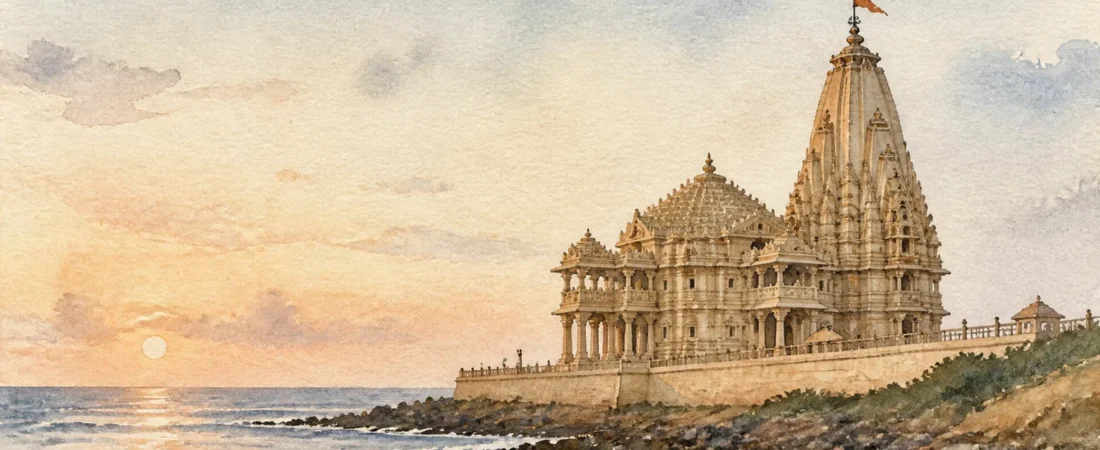
At Prabhas Patan in Gujarat, Somnath’s sandstone shikhara rises beside the Arabian Sea. Temple bells carry across the precinct while waves meet the western shore, placing a living shrine against an unusually open horizon.
Yet Somnath is far more than a celebrated temple or a destination on a pilgrim’s map. It is a remarkable meeting point of Shiva bhakti, sacred geography, Puranic memory, architecture, history and civilizational resilience. Its name means “Lord of Soma”—Lord of the Moon—and its deepest message is one of renewal: the mind may waver, human creations may fall and centuries may pass, but the divine Jyoti remains eternal.
The present temple was reconstructed after Indian Independence. Its Prana Pratishtha was performed on 11 May 1951 by India’s first President, Dr Rajendra Prasad, a date confirmed by the Shree Somnath Trust. Today, Somnath remains a living centre of Shiva worship and pilgrimage.
Indian Ethos reflection: Somnath teaches that what is deeply rooted in faith and values can endure, renew itself and rise again.
Contents
- Somnath Jyotirlinga at a glance
- Spiritual importance and the legend of Soma
- Prabhas Kshetra and its sacred geography
- History, reconstruction and architecture
- Shiva worship, darshan and sacred occasions
- Nearby pilgrimage places
- Food, culture and complete travel guidance
- Four reflections to carry into the pilgrimage
- Frequently asked questions
Somnath Jyotirlinga at a Glance
| Detail | Information |
|---|---|
| Sacred name | Shree Somnath Mahadev |
| Deity | Lord Shiva |
| Significance | Traditionally revered as the first of the twelve Jyotirlingas |
| Location | Prabhas Patan, Gir Somnath district, Gujarat |
| Sacred region | Prabhas Kshetra |
| Name meaning | “Lord of Soma” or “Lord of the Moon” |
| Present temple consecration | 11 May 1951 |
| Nearest railheads | Somnath and Veraval |
| Best weather | Generally October to February |
| Major observances | Maha Shivaratri, Shravan Maas, Shravan Somvar, Masik Shivaratri and Kartik Purnima |
Why Is Somnath Spiritually Important?
A Jyotirlinga is understood in Hindu tradition not merely as a stone emblem but as a manifestation of Shiva as Jyoti—limitless, self-luminous divine consciousness. The twelve Jyotirlingas are among the most sacred centres of Shaiva worship, and Somnath is traditionally placed first in their enumeration. Our Dwadasha Jyotirlingas introduction gives the complete traditional sequence.
The spiritual importance of Somnath therefore extends beyond the physical sanctum. The shrine invites the devotee to move from form towards essence: from the visible Linga to the invisible light it represents, from the restless mind to still awareness, and from the changing world to the unchanging presence of Shiva.
This gives Somnath a particularly powerful symbolism. Temples may be damaged and rebuilt, architecture may change, and generations may come and go—but the sacred light to which the temple points is beyond destruction.
The Sacred Legend of Soma and Lord Shiva
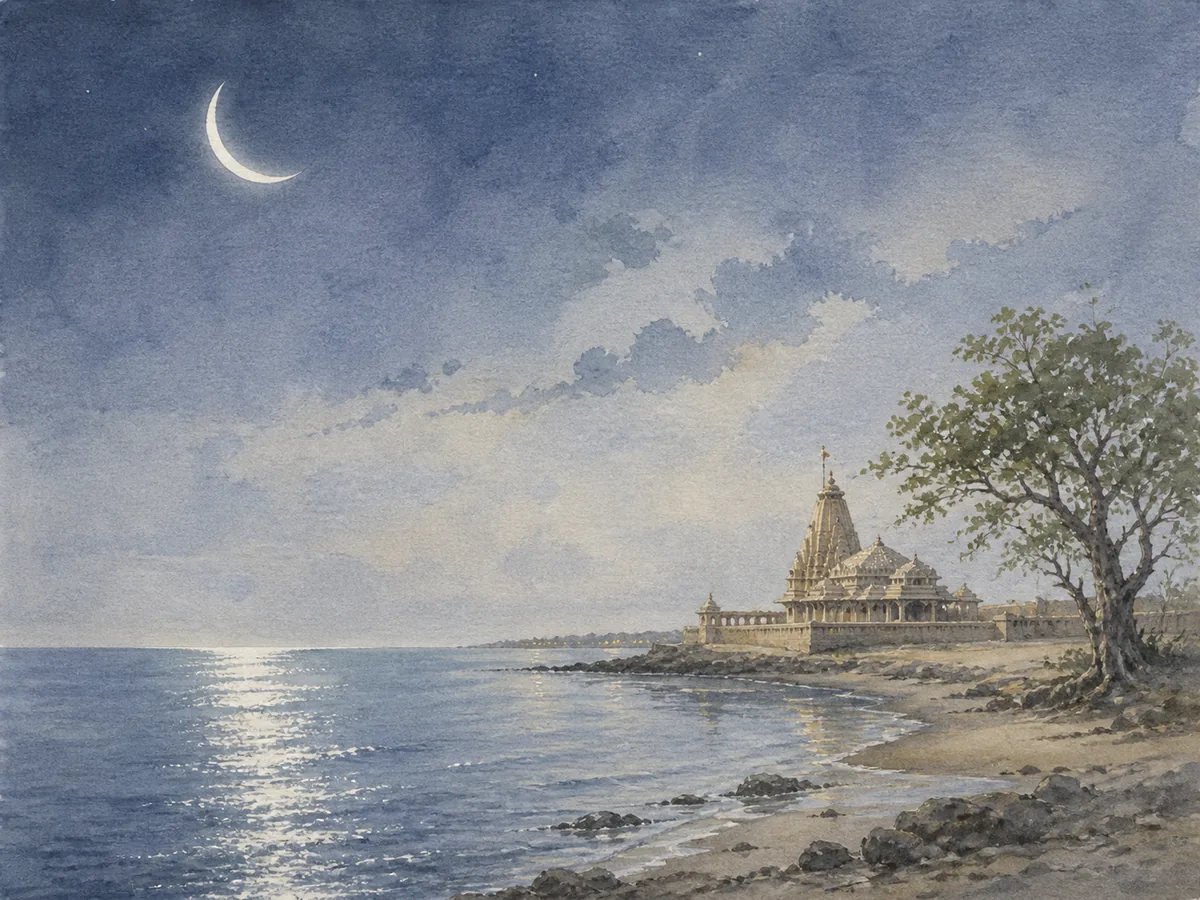
According to the Puranic tradition summarised by the Shree Somnath Trust, Chandra—the Moon deity—married the twenty-seven daughters of Daksha Prajapati. These daughters are traditionally associated with the twenty-seven Nakshatras of Indian astronomy. Chandra, however, showed special affection towards Rohini and neglected his other wives.
Distressed by this unequal treatment, the other daughters approached Daksha. Angered by Chandra’s conduct, Daksha cursed him, causing his radiance and vitality to diminish. As the Moon began to wane, Chandra sought divine refuge and performed intense worship of Lord Shiva at Prabhas.
Pleased by his penance, Shiva granted him relief. The Moon would not disappear forever; instead, he would pass through a continuous cycle of waning and waxing. Lord Shiva thus came to be worshipped here as Somnath, the Lord and protector of Soma.
This is a sacred narrative preserved within Hindu tradition; it should be understood as Puranic memory rather than documented political history.
The Inner Meaning of the Soma Legend
In Indian thought, the Moon is closely associated with manas, the mind. Like the Moon, the human mind waxes and wanes: it moves between enthusiasm and weariness, certainty and doubt, happiness and sorrow.
Shiva represents the still consciousness beneath these fluctuations. Chandra’s surrender to Shiva can therefore be read as the journey of the unsteady mind towards inner balance. Somnath reminds the pilgrim that peace does not necessarily come from stopping every change; it comes from discovering the unchanging centre within oneself.
Prabhas Kshetra: A Sacred Landscape
Somnath belongs to the ancient pilgrimage region known as Prabhas Kshetra. The word Prabhas conveys radiance or splendour—an especially fitting name for the abode of a Jyotirlinga.
Near Somnath lies the Triveni Sangam, traditionally associated with the confluence of the Hiran, Kapila and Saraswati rivers. Gujarat Tourism describes this confluence as an ancient sacred site. Pilgrims traditionally visit it for prayer, remembrance and ritual bathing, subject to local conditions and safety guidance.
Prabhas Kshetra also carries a profound Vaishnava connection. Nearby Bhalka Tirth commemorates the traditional account of the hunter Jara’s arrow striking Lord Krishna. The associated pilgrimage continues towards Dehotsarg or Golok Dham, linked in tradition with Krishna’s departure from his earthly form. Gujarat Tourism’s account of Bhalka Tirth identifies the shrine with this sacred narrative.
Within one compact landscape, the pilgrim encounters:
- Somnath—the Jyotirlinga of Lord Shiva;
- Triveni Sangam—the sacred confluence;
- Bhalka Tirth—the final-earthly-journey tradition of Lord Krishna; and
- Dehotsarg or Golok Dham—the sacred memory of Krishna’s departure.
Prabhas is therefore not merely the setting of a temple. It is a sacred geography in which Shaiva and Vaishnava traditions meet with striking harmony.
Somnath Through History: Destruction, Renewal and Continuity
Somnath’s early history is layered with sacred tradition, literary memory and later historical evidence. Devotional accounts speak of successive temples made of gold, silver, wood and stone. These belong to the temple’s traditional sacred narrative and should not be treated as an archaeological chronology.
The Shree Somnath Trust’s historical account records that the shrine faced repeated attacks and rebuilding during the medieval period. Rather than reducing this complex history to a dramatic count, it is more meaningful to recognise the recurring pattern: communities repeatedly restored worship at Somnath.
In the eighteenth century, Maharani Ahilyabai Holkar of Indore established a temple at Somnath, preserving active worship close to the older sacred site. This shrine, commonly known as the Old Somnath Temple or Ahilyabai Temple, remains part of the pilgrimage circuit listed by the Shree Somnath Trust.
Reconstruction After Independence
The modern reconstruction of Somnath became deeply significant in the years following Indian Independence. Sardar Vallabhbhai Patel played a decisive role in initiating the project, while K. M. Munshi worked persistently towards its realization. The design was prepared by temple architect Prabhashankar Sompura. Jam Saheb Digvijaysinhji laid the foundation stone on 8 May 1950, and Dr Rajendra Prasad performed the Prana Pratishtha on 11 May 1951, according to the Shree Somnath Trust’s historical note.
Somnath’s modern rebuilding came to represent more than architectural restoration. For many Indians, it expressed cultural continuity and the freedom to renew a sacred institution through collective devotion after Independence.
Its historical message is not that stone is invulnerable. It is that a living tradition can outlast the forces that damage its outward forms.
Somnath represents punarutthana—renewal. Forms may fall, but faith, memory and values can endure.
Architecture of the Present Somnath Temple
The present temple follows a western Indian temple style and was designed by Prabhashankar Sompura. The Trust’s reconstruction account identifies its principal elements as the garbhagriha or sanctum, sabha mandapa, nritya mandapa and a commanding shikhara crowned by a kalasha and dhwaja.
The honey-coloured stone, sculpted surfaces and vertical movement of the shikhara give the temple dignity without diminishing the solemnity of worship. Its location beside the Arabian Sea adds a dimension that no enclosed architectural description can fully capture. The shrine stands at the edge of the land, facing a horizon that appears without end.
The composition lends itself to a beautiful spiritual interpretation:
| Sacred element | Reflective meaning |
|---|---|
| Temple | The embodied human being seeking the Divine |
| Shikhara | The ascent from the earthly towards higher awareness |
| Jyotirlinga | Eternal, self-luminous consciousness |
| Ocean | Infinity and the immeasurable Divine |
| Dhwaja | Living faith and sacred continuity |
This is an interpretive reflection, not a claim that every architectural feature was historically designed with only this one meaning.
Shiva Worship and Puja at Somnath
Worship at Somnath centres on darshan, abhisheka, mantra, bilva offering, aarti and Vedic puja. The temple’s official booking system may list pujas such as Rudrabhisheka, Gangajal Abhisheka, Bilva Puja, Someshwar Mahapuja, Mahamrityunjaya Japa, Laghurudra and other ritual services. Availability, participation rules and booking arrangements can change, so devotees should use only the official Shree Somnath Trust website for current information.
Significance of Bilva Patra
The three-leaved Bilva Patra is one of the most beloved offerings in Shiva worship. Its three leaflets are traditionally associated with sacred triads such as Shiva’s three eyes and the three gunas.
A well-known verse from the Bilvashtakam is used during Bilva worship:
त्रिदलं त्रिगुणाकारं त्रिनेत्रं च त्रियायुधम् ।
त्रिजन्मपापसंहारम् एकबिल्वं शिवार्पणम् ॥
Meaning: “This single Bilva leaf, threefold in form and associated with Shiva’s sacred triads, I offer to Lord Shiva with devotion.”
The essential spirit of the offering is not grandeur but sincerity. A simple leaf, offered with a focused mind and pure intention, becomes an act of surrender.
Somnath Darshan and Aarti Timings
As listed by the Shree Somnath Trust’s official FAQ and verified on 17 August 2026:
| Temple observance | Current listed time |
|---|---|
| Darshan | 6:00 AM to 10:00 PM |
| Morning Aarti | 7:00 AM |
| Midday Aarti | 12:00 noon |
| Evening Aarti | 7:00 PM |
| “Jay Somnath” sound-and-light programme | Evening; timing and operation should be reconfirmed before visiting |
Timings can change on festivals, special occasions or due to weather and administrative requirements. The sound-and-light programme may not operate during the monsoon or unsuitable weather. Always check the official website shortly before travel.
A Meaningful Darshan Plan
For a quieter pilgrimage experience, arrive before the morning aarti and allow unhurried time for darshan. Visit the associated tirthas during the day, then return to the precinct around sunset to experience the evening atmosphere and aarti.
Do not plan Somnath as a hurried one-hour stop. One full day allows a meaningful visit; two days provide a gentler pilgrimage that includes the sacred sites of Prabhas Kshetra.
Most Sacred Times to Visit Somnath
Maha Shivaratri
Maha Shivaratri is among the grandest observances at Somnath. Devotees gather for worship, mantra, aarti and special rituals. The atmosphere is intensely devotional, but the temple and surrounding area are also very crowded.
Shravan Maas and Shravan Somvar
The sacred month of Shravan is especially important for Shiva worship. Mondays during the month—Shravan Somvar—draw many devotees for abhisheka and Bilva offerings. Those seeking the devotional intensity of a major pilgrimage period may choose Shravan, while those who need easier movement or a quieter visit may prefer another season.
Masik Shivaratri
The monthly Shivaratri is observed by Shiva devotees through prayer, fasting, mantra and worship. It offers a spiritually meaningful alternative for pilgrims unable to visit during Maha Shivaratri.
Kartik Purnima
Kartik Purnima is also celebrated with enthusiasm in the Somnath region and has a long association with pilgrimage at Prabhas.
Somnath Sthapana Divas—11 May
The anniversary of the reconstructed temple’s consecration is observed on 11 May.
Places to Visit Near Somnath Temple
1. Triveni Sangam
The sacred confluence traditionally associated with the Hiran, Kapila and Saraswati rivers is an important place for prayer and remembrance. Visitors should respect local customs and follow safety guidance near the water.
2. Bhalka Tirth
This shrine preserves the traditional memory of the moment when the hunter Jara’s arrow struck Lord Krishna. Its unusual reclining image of Krishna gives the temple a deeply contemplative atmosphere.
3. Dehotsarg or Golok Dham
Associated with Lord Krishna’s final earthly journey, this site forms a natural continuation of the Bhalka Tirth pilgrimage.
4. Ahilyabai Temple—Old Somnath Temple
The temple established by Maharani Ahilyabai Holkar is historically significant for preserving worship at Somnath during a difficult period. Its more intimate scale offers a different devotional experience from the present grand temple.
5. Prabhas Patan Museum
Located near the temple, the museum preserves sculptural and architectural fragments connected with earlier temple structures. Gujarat Tourism notes a reconstructed twelfth-century shrine among its important displays. Check opening days and timings locally before visiting.
6. Gita Mandir and Lakshminarayan Temple
These nearby shrines deepen the region’s connection with Lord Krishna and the wider Vaishnava tradition.
Vegetarian Food and the Culture of Saurashtra
A pilgrimage through India is also an encounter with regional culture. Saurashtra offers a rich vegetarian food tradition built around grains, pulses, vegetables, curd and buttermilk, balanced with distinctive Gujarati flavours.
Pilgrims may encounter dishes such as bajra rotla, khichdi-kadhi, dal, seasonal shaak, thepla, handvo, dhokla, khaman, farsan, chaas and Gujarati or Saurashtrian thali. Those observing a satvik diet should enquire about onion, garlic and preparation methods before ordering, because practices vary between kitchens.
The wider culture of Saurashtra is expressed through Gujarati hospitality, bhajans, temple festivals, garba and folk traditions, colourful textiles, embroidery, handicrafts and strong devotional lineages. Somnath is particularly fascinating because Shaiva worship flourishes within a region that also carries an intimate sacred connection with Lord Krishna.
How to Reach Somnath
Somnath is located at Prabhas Patan in Gir Somnath district, Gujarat.
By Train
Somnath railway station is close to the pilgrimage area. Veraval, approximately 7 km away according to the Trust’s current FAQ, is another important railhead. Train routes and schedules change, so check the official railway timetable before booking.
By Road
Somnath is well connected by road to Veraval and major cities and pilgrimage destinations in Gujarat. State transport buses, private buses and taxis serve the region. Journey times vary by route and traffic.
By Air
Regional flight operations can change. The Trust’s current FAQ lists Diu as the nearest airport, while Rajkot and other Gujarat airports may offer more connections depending on the season. Confirm current flights and the onward road journey before finalising plans.
Best Time to Visit
October to February generally brings more pleasant weather for darshan and local sightseeing. Shravan and Maha Shivaratri offer a powerful devotional atmosphere but also larger crowds. Summer afternoons can be hot, while the monsoon may affect outdoor plans and the sound-and-light programme.
Where to Stay
The Shree Somnath Trust operates pilgrim accommodation, including guest houses and economical dormitory facilities. Room categories, prices, availability and check-in conditions can change; consult the official pilgrim facilities page before travel.
The Trust warns devotees about fraudulent booking requests made through private phone numbers, WhatsApp messages, unofficial accounts and UPI requests. Use only somnath.org or an official Trust booking counter for accommodation, puja and donations.
Practical Pilgrimage Guidance
- Wear modest, comfortable clothing suitable for a place of worship.
- Carry a valid photo identity document for accommodation and travel requirements.
- Use only official counters or the Trust website for puja, rooms and donations.
- The official Trust FAQ says mobiles, cameras, smartwatches and other electronic gadgets are prohibited inside; free lockers are available at the cloakroom. Photography is prohibited.
- Travel light, especially during crowded festivals.
- The Trust currently lists wheelchairs, golf carts at the main gate and a lift inside the precinct; senior citizens and visitors with mobility needs should reconfirm assistance before arrival.
- Keep the seashore and sacred sites clean; avoid leaving plastic, food waste or ritual materials behind.
- Reconfirm darshan, aarti, festival and programme timings before the journey.
Four Reflections to Carry Into the Pilgrimage
Somnath offers four profound ideas for reflection.
Soma—The Changing Mind
Like the Moon, the mind passes through phases. It expands and contracts, brightens and dims. Spiritual maturity does not demand that we deny these changes; it asks us to understand them without losing our inner centre.
Shiva—Inner Stillness
Shiva represents the awareness that remains present beneath every fluctuation. When the mind turns towards this stillness, it begins to recover balance.
Jyoti—The Light of Knowledge
The Jyotirlinga is the light that dispels inner darkness. It represents the movement from avidya to awareness, from confusion to clarity and from limitation towards the infinite.
Reconstruction—Civilizational Resilience
Somnath’s repeated renewal is a powerful metaphor for cultural continuity. Buildings may be damaged, but a civilization survives when its knowledge, worship, memory and values continue to live among its people.
These four dimensions transform Somnath from a destination into a teaching: steady the mind, seek the inner light, preserve what is sacred and rebuild with courage.
Carry This With You
Somnath is not merely a monument beside the Arabian Sea. It is a living testimony to devotion, continuity and renewal. The Moon that sought refuge in Shiva reminds us of the restless human mind seeking balance. The Jyotirlinga reminds us of the eternal light within. The temple’s journey through history reminds us that civilizations endure when their deepest values remain alive.
As the waves return to the shore at Prabhas, Somnath leaves the pilgrim with a quieter thought: what matters may need to be remembered, tended and sometimes rebuilt.
हर हर महादेव। जय सोमनाथ।
Frequently Asked Questions
Is Somnath the first Jyotirlinga?
Yes. Hindu tradition reveres Somnath as the first among the twelve Jyotirlingas of Lord Shiva.
Where is Somnath Jyotirlinga located?
It is at Prabhas Patan in Gir Somnath district on the Saurashtra coast of Gujarat, beside the Arabian Sea.
What does the name Somnath mean?
Somnath means “Lord of Soma” or “Lord of the Moon.” The name refers to the Puranic tradition in which Chandra worshipped Shiva at Prabhas.
What are the current darshan and aarti timings?
As verified on 17 August 2026, the Trust lists darshan from 6:00 AM to 10:00 PM and aarti at 7:00 AM, 12:00 noon and 7:00 PM. Always reconfirm before travel.
Which is the best month to visit Somnath?
October to February is generally most comfortable for travel. Shravan and the period around Maha Shivaratri are spiritually significant but much more crowded.
How many days are sufficient for Somnath?
One full day covers the main temple and key nearby tirthas. Two days are preferable for an unhurried pilgrimage through Prabhas Kshetra.
What are the most important places near Somnath?
Triveni Sangam, Bhalka Tirth, Dehotsarg or Golok Dham, Ahilyabai Temple, Prabhas Patan Museum, Gita Mandir and Lakshminarayan Temple are among the principal sites.
Is photography allowed inside Somnath Temple?
The Shree Somnath Trust states that photography and electronic gadgets—including mobiles, cameras and smartwatches—are prohibited inside. Free lockers are available at the cloakroom; follow all current security instructions.
How should rooms and pujas be booked?
Use only the official Shree Somnath Trust website, somnath.org, or official Trust counters. Do not transfer money to private numbers or unofficial accounts.
Read next: The Dwadasha Jyotirlingas · Temples of India · Dwarka: The Sacred Abode of Lord Krishna
Sources and Editorial Note
- Shree Somnath Trust—official website
- Shree Somnath Trust—visitor FAQ
- Shree Somnath Trust—pilgrim facilities
- Shree Somnath Trust—reconstruction and traditional history
- Gujarat Tourism—Somnath Temple
- Gujarat Tourism—Triveni Sangam
- Gujarat Tourism—Bhalka Tirth
- Gujarat Tourism—Prabhas Patan Museum
- Bilvashtakam text, Sanskrit Documents
Visitor information was checked on 17 August 2026. Sacred narratives and symbolic readings are identified as tradition or Indian Ethos interpretation rather than archaeological fact. The illustrations are original AI-generated conceptual watercolours, not documentary photography. Illustration: Indian Ethos / OpenAI.