TEMPLES OF INDIA · DWARKA
On Gujarat’s western shore, Dwarka brings together Krishna’s royal and civic life, a living Char Dham, a many-layered temple and an ancient maritime landscape—without asking faith and archaeology to make the same kind of claim.
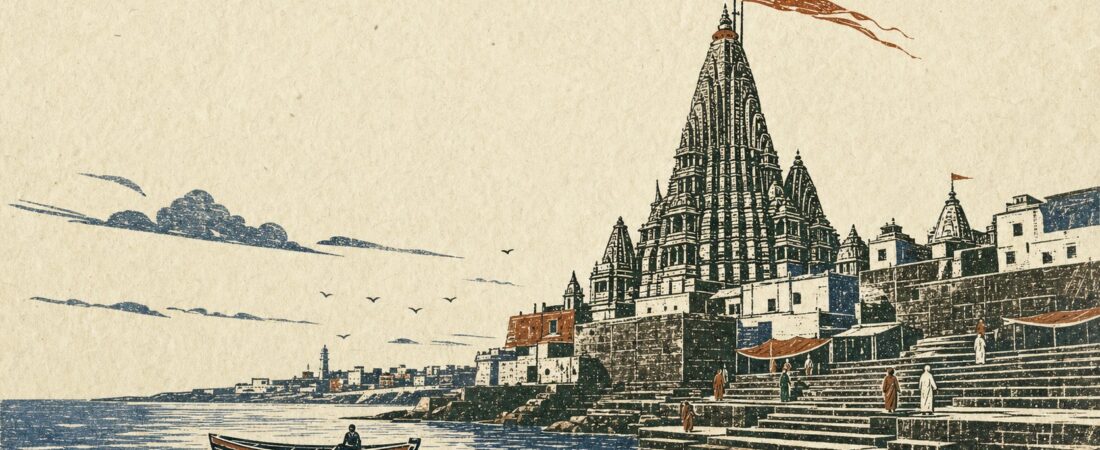
At the edge of Dwarka, stone steps descend towards the tidal Gomti creek. Boats move across the water, the Arabian Sea opens beyond them, and the flag above the Dwarkadhish Temple remains visible over the town. The setting explains something essential about this sacred place: Dwarka has always looked both inward and outward—towards worship, and towards the wider world.
For devotees, this is the city of Krishna as Dwarkadhish, the Lord of Dwarka. Here he is remembered not only as the beloved child of Gokul or the charioteer who speaks the Bhagavad Gita, but also as the protector of a people, the centre of a household and court, and a guide who acts within the difficult responsibilities of society.
That is Dwarka’s enduring gift. It does not place spiritual life far from worldly duty. It asks whether clarity, courage and devotion can be carried into the decisions we make for others.
The heart of Dwarka
Modern Dwarka stands on the western coast of Gujarat, beside the Gomti creek and the Arabian Sea. Its principal shrine is the Dwarkadhish Temple, also called Jagat Mandir. Dwarka is also the western destination in the pan-Indian Char Dham pilgrimage, alongside Badrinath, Puri and Rameswaram. The Devbhumi Dwarka district administration and the Ministry of Tourism describe the temple’s central place in this living pilgrimage tradition.
The Sanskrit name Dvārakā is commonly connected with dvāra, a door or gateway. “Gateway to liberation” is therefore best understood as a devotional interpretation, not a literal historical definition. Yet the image is fitting. Dwarka is a threshold between river and sea, memory and material evidence, household responsibility and spiritual aspiration.
Dwarka in brief
- Who is worshipped here? Krishna as Dwarkadhish—the Lord or King of Dwarka.
- Why is Dwarka sacred? It is associated with Krishna’s later life and is one of the four Char Dham pilgrimage destinations.
- What do sacred texts say? Puranic and epic traditions describe a fortified coastal city established for the Yadavas and later reclaimed by the sea.
- What does archaeology show? Dwarka and Bet Dwarka have a long maritime past, with stone anchors, structures and settlement evidence from different periods.
- Has archaeology proved that the offshore remains are Krishna’s city? No. The finds establish the region’s archaeological importance, but their dates and interpretation do not provide a simple identification with the city described in sacred literature.
Why Krishna’s people came to Dwarka
The story begins with danger around Mathura. In the Mahabharata, Krishna recalls that the Yadavas left Mathura under pressure from Jarasandha and went to Dwaravati. The Sabha Parva account presents relocation as a response to a threat the community could not safely absorb forever.
Puranic traditions develop the story in richer architectural detail. The Bhagavata Purana describes a fortified city built within the sea when further attacks threatened Mathura. The tenth book, chapter 50 depicts a spacious, well-planned city; the Harivamsa tradition names Vishvakarma as its divine architect and tells of the ocean making room for it.
These are sacred narratives, not modern construction records. Their purpose is larger than dating walls. They remember leadership as the protection of life: Krishna does not cling to a vulnerable capital merely to preserve prestige. He changes course for the welfare of his people.
There is quiet strength in that choice. We sometimes mistake steadiness for remaining exactly where we are. Dwarka suggests another possibility: a wise change of place or plan can also be an act of dharma.
Krishna as Dwarkadhish: devotion in a life of responsibility
Krishna’s Vrindavan stories are filled with intimacy, play and longing. Dwarka reveals another dimension. Here, tradition places him amid diplomacy, family relationships, public decisions and the consequences of power.
To call him Dwarkadhish is to remember a form of spiritual maturity that does not withdraw from the world. Work must still be done. People must be protected. Conflicts must be judged. Affection, loyalty and duty must somehow share the same house.
This is an Indian Ethos interpretation rather than a historical claim: Dwarka can be read as a reminder that an inward life and an active life need not be rivals. The question is not whether we have responsibilities, but what quality of attention we bring to them.
Dwarkadhish Temple: an ancient faith in a rebuilt monument
The Dwarkadhish Temple rises close to the Gomti creek, its carved shikhara and great flag shaping the city’s skyline. Krishna is worshipped here as a sovereign presence, and the temple remains an active centre of darshan, ritual and pilgrimage—not a monument emptied of worship.
Temple tradition attributes an early shrine to Vajranabha, Krishna’s great-grandson. That belief should not be confused with the age of every stone visible today. The site has passed through destruction, rebuilding, repair and architectural change over many centuries. Archaeological work around the complex has also identified earlier phases beneath or near the present sacred site.
The most honest description is therefore also the most meaningful: Dwarkadhish Temple is both old and continuously renewed. Its sanctity rests not on pretending that the standing structure has remained untouched since Krishna’s age, but on the devotion that has repeatedly restored worship in the same sacred landscape.
Did the ancient city of Dwarka sink beneath the sea?
The careful answer begins by separating three things: sacred text, archaeological evidence and later interpretation.
In the Mausala Parva of the Mahabharata, Arjuna leads the surviving women, children and elders away after the destruction of the Yadava clan. As they depart, the sea floods Dvaraka. The Kisari Mohan Ganguli translation of Book 16, Section 7 presents this as part of the ending of an age—a scene of impermanence as well as loss.
Marine archaeology has indeed found important material off modern Dwarka. Explorations by researchers from India’s National Institute of Oceanography documented scattered dressed stone blocks, semicircular structures and more than a hundred stone anchors. These finds support Dwarka’s long history as a port.
But the same research also places a firm boundary around what can be claimed. A 2004 study in Current Science argued that many offshore structures are more likely the remains of a jetty than a habitation site; it noted the absence of pottery that would normally be expected from a submerged settlement and found evidence ranging across historical and medieval periods. The authors concluded that the structures were difficult to date precisely. Read the National Institute of Oceanography study.
In 2025, the Archaeological Survey of India renewed underwater exploration near Dwarka and Bet Dwarka to document remains and assess their antiquity through scientific analysis. The Ministry of Culture’s statement describes an investigation in progress, not a final identification of a legendary city.
So, is there an ancient maritime landscape beneath and around Dwarka? Yes. Do texts preserve a powerful tradition of a city claimed by the sea? Yes. Has archaeology conclusively shown that the offshore remains are the splendid city described in the epics and Puranas? Not at present.
Faith does not need careless evidence, and archaeology does not honour a sacred tradition by making a claim its data cannot yet carry.

The sacred places of Dwarka beyond the main temple
A Dwarka pilgrimage is best understood as a connected sacred geography rather than a list of attractions.
Gomti Ghat
Below the Dwarkadhish Temple, steps lead to the Gomti creek near its meeting with the sea. Pilgrims traditionally bathe or pause here before darshan. The Ministry of Tourism’s Gomti Ghat guide also places the ghat within a wider circuit that includes the main temple, Bet Dwarka, Rukmini Devi Temple and Nageshwar.
The water’s edge makes Dwarka’s central image visible: every gateway is also a meeting place.
Bet Dwarka
Bet Dwarka, also written Beyt Dwarka and traditionally called Shankhodhar, is an island pilgrimage site associated with Krishna’s residence. Devotional tradition also connects it with Sudama, Krishna’s childhood friend, whose modest gift of rice becomes a story about affection that does not measure worth by wealth. The Government of India’s Bet Dwarka guide distinguishes the island’s pilgrimage importance from its history as a coastal port.
Rukmini Devi Temple
Rukmini’s temple stands apart from the main Dwarkadhish shrine. A well-known local tradition explains this separation through a story involving the sage Durvasa and a moment when thirst, hospitality and anger meet. It is a sacred legend rather than a documented account of why the buildings occupy their present locations.
The story nevertheless keeps Rukmini visible in Dwarka’s landscape—not as a decorative presence beside Krishna, but as a deity with a shrine, worship and narrative world of her own.
Nageshwar Jyotirlinga
The wider pilgrimage circuit also includes Nageshwar, revered in tradition as one of the twelve Jyotirlingas of Shiva. Its presence reminds visitors that sacred geographies in India often overlap: a journey centred on Krishna may also carry a pilgrim towards a major Shaiva shrine. Gujarat Tourism provides the official visitor overview.
How to visit Dwarka with attention
You do not need to hurry through every site for the pilgrimage to feel complete.
- Begin at the water. A quiet pause at Gomti Ghat gives the temple and town their coastal context.
- Let darshan set the pace. Follow current temple instructions, dress respectfully and treat queues as part of a shared sacred space.
- Keep tradition and history distinct. Receive a legend as a carrier of meaning without turning it into an archaeological claim.
- Make room for the wider landscape. Bet Dwarka, Rukmini Devi Temple and Nageshwar each add a different relationship to the pilgrimage.
- Check official information before travelling. Temple timings, access arrangements, festival crowds and local transport can change.
Frequently asked questions about Dwarka
Why is Dwarka called the sacred abode of Lord Krishna?
Hindu epic and Puranic traditions associate Dwarka with Krishna’s later life and the Yadava community. In the living temple tradition, Krishna is worshipped here as Dwarkadhish, the Lord of Dwarka.
Why is Dwarka important in the Char Dham pilgrimage?
Dwarka is the western sacred destination in the fourfold Char Dham circuit. The other three are Badrinath in the north, Puri in the east and Rameswaram in the south.
Who built the Dwarkadhish Temple?
Devotional tradition credits an early shrine to Vajranabha, Krishna’s great-grandson. The standing temple, however, reflects centuries of rebuilding and restoration; it should not be described as one untouched structure from Krishna’s time.
Is the underwater city of Dwarka archaeologically proven?
Archaeologists have found offshore structures and many stone anchors that demonstrate Dwarka’s long maritime importance. Published research has not conclusively identified those remains as the city described in Krishna tradition, and scientific investigation continues.
What is the difference between Dwarka and Bet Dwarka?
Dwarka is the mainland pilgrimage town centred on the Dwarkadhish Temple and Gomti Ghat. Bet Dwarka is an island pilgrimage site associated in tradition with Krishna’s residence and his meeting with Sudama.
Carry this with you
Dwarka’s splendour is not only in a remembered city, a temple tower or the possibility of ruins beneath the sea. Its deeper beauty lies in the form of Krishna it keeps before us: loving, discerning and fully engaged with responsibility.
The sea in Dwarka’s sacred story eventually reclaims palaces, roads and walls. What remains is the question those stories leave in our hands. Can we protect without possessing, act without losing our centre, and allow devotion to shape the quality of our everyday decisions?
Perhaps that is the gateway Dwarka still opens.
Jai Shri Dwarkadhish.
Read next: Temples of India – The Soul of a Timeless Civilization · Jagannath Temple in Puri: Where the Lord Lives Among His People
Editorial source note
This article is based on source material supplied to Indian Ethos by email on 20 July 2026 and independently checked against sacred-text translations, government visitor information, National Institute of Oceanography research and the Ministry of Culture. Traditional narratives are labelled as tradition or legend; archaeological findings are not presented as proof of Krishna’s city. Both accompanying images are original AI-generated editorial illustrations, not documentary photographs.