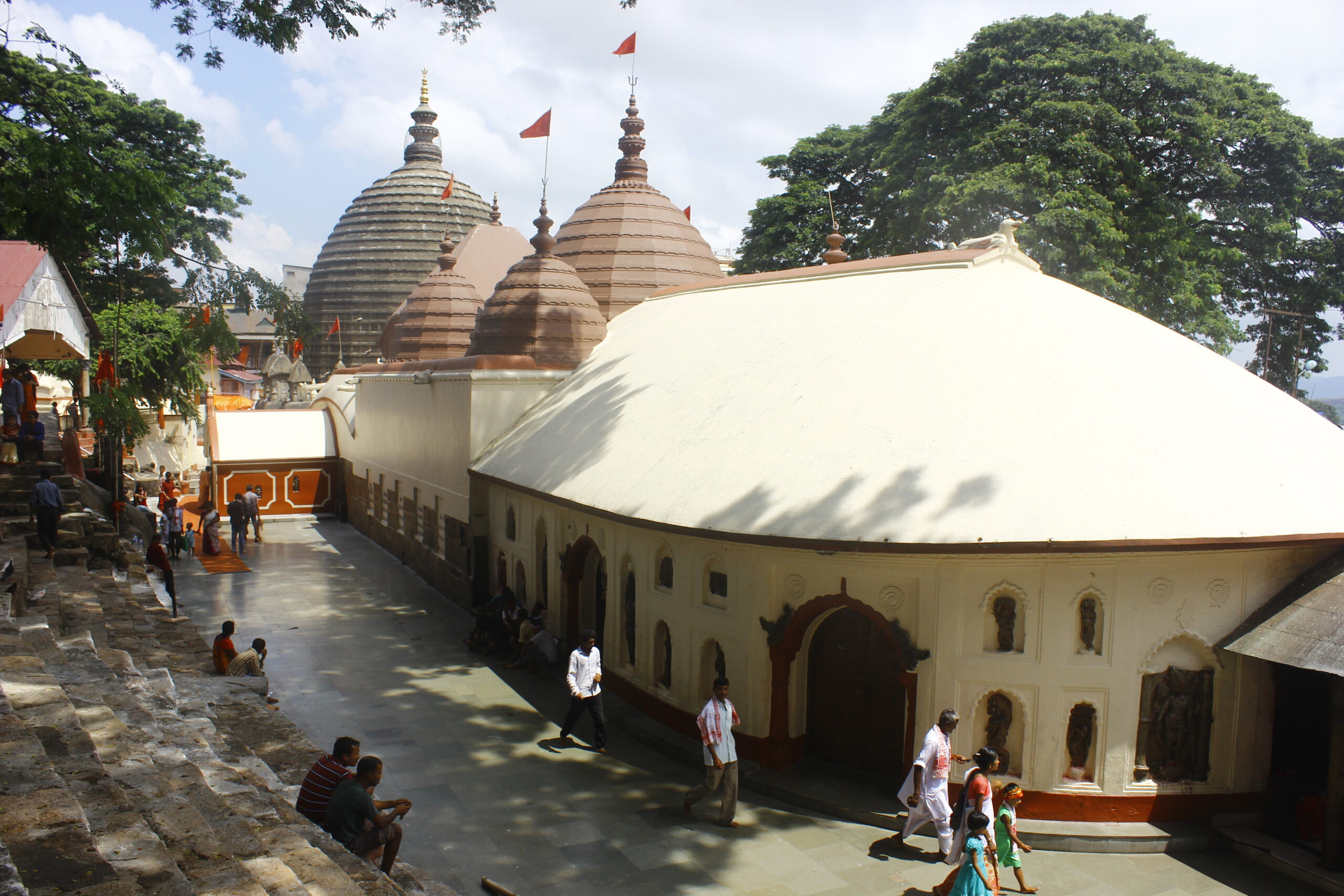
On the blue-green slopes of Nilachal Hill, above the Brahmaputra valley, the Divine Mother is worshipped not through a conventional image but through a sacred cleft in living rock. This is Kamakhya, one of the most revered centres of Shakta worship in India, associated in many traditions with Kamarupa and the sacred geography sometimes described as Harikshetre Kamarupe.
Harikshetre Kamarupe Shakti Peetha is commonly connected in pilgrimage discussions with Sri Kamakhya Temple at Nilachal Hill, Guwahati, Assam. Names and identifications can vary between regional lists and textual traditions; this guide therefore distinguishes the widely shared Kamakhya tradition from the variation in the wording of Peetha lists.
Quick facts: Deity: Maa Kamakhya; location: Nilachal Hill, Guwahati, Assam; sacred tradition: Shakti Peetha and Tantric Shaktism; major festival: Ambubachi Mela; setting: a hilltop temple complex overlooking the Brahmaputra valley.
Who Is Maa Kamakhya?
Maa Kamakhya is revered as a powerful manifestation of Adi Shakti, the primordial Divine Feminine. Her worship honours desire, creative power, fertility, the cycles of nature and the mystery through which life continually renews itself. In the Kamakhya sanctum, the Goddess is not represented by a freestanding anthropomorphic idol. Devotees worship a yoni-shaped cleft in the rock, kept moist by a natural spring. The sacred form is understood as a symbol of the source of creation and the living presence of Shakti.
Sthala Puranam: The Sacred Story of Nilachal Hill
According to the widely recounted Shakta legend, Goddess Sati, daughter of Daksha Prajapati and consort of Lord Shiva, attended her father’s yajna despite not being invited. When Daksha insulted Shiva, Sati, overcome by anguish, gave up her body in the sacrificial fire. Shiva, stricken with grief, carried her body and moved through the worlds in a terrible cosmic dance. To restore balance, Lord Vishnu used his Sudarshana Chakra to divide the body, and the places where its parts fell became sacred Shakti Peethas.
Kamakhya tradition holds that Sati’s yoni—the generative source of life—fell on Nilachal Hill. The site consequently became a profound emblem of the creative power of the Goddess. The story is a sacred narrative of devotion and cosmic restoration, not merely a tale of loss: it affirms that the feminine principle is inseparable from the continuity of life itself.
Another regional legend explains the name Kamarupa through Kamadeva, the god of love. After being reduced to ashes by Shiva’s fiery gaze, Kamadeva is said to have regained his form in this land through the grace of the Goddess. The region came to be associated with the restoration of rupa, or form. These stories belong to religious lore and should be read alongside, rather than confused with, the temple’s documented architectural history.
Why Is Kamakhya So Significant?
- A major Shakti Peetha: Kamakhya is one of the most important pilgrimage centres in Shakta tradition and is included in many lists of the sacred Peethas.
- The sacred source of life: The yoni-peetha honours the generative power of the Divine Mother and the cycles of nature.
- A living centre of Tantra: Kamakhya has a long-standing association with Tantric forms of worship and spiritual practice. Some rites are specialised and should be understood through authorised temple traditions rather than sensational accounts.
- A meeting of traditions: The temple’s history reflects layered indigenous, regional, Shakta and Tantric currents within Assam’s religious culture.
- The ten Mahavidyas: The wider Nilachal complex includes shrines associated with the ten wisdom goddesses—Kali, Tara, Tripura Sundari, Bhuvaneshwari, Bhairavi, Chhinnamasta, Dhumavati, Bagalamukhi, Matangi and Kamala.
Temple History and Architecture
The present Kamakhya temple reflects centuries of rebuilding and patronage. Assam’s official tourism and district sources describe the shrine as a historic complex on Nilachal Hill, with the present temple rebuilt in the sixteenth century under the Koch rulers after an earlier structure was destroyed. The temple’s distinctive profile combines a beehive-shaped shikhara with sculptural and architectural elements characteristic of the region.
The innermost sanctum is reached by descending into a cave-like chamber. Its sacred rock cleft and spring make the experience very different from darshan at a temple centred on a sculpted murti. The hill itself is part of the sacred landscape: subsidiary shrines, old paths and viewpoints form a larger pilgrimage circuit rather than a single isolated monument.
Rituals and Worship
Daily worship is conducted by the temple’s authorised priests according to established traditions. Visitors may offer prayers and seek darshan; specific pujas, offerings, access arrangements and timings can change, so confirm current details with the temple before travelling. Do not assume that every ritual described online is open to general visitors.
- Darshan and prayer: Devotees seek the Mother’s blessings for spiritual strength, family well-being and the fulfilment of sincere prayers.
- Offerings: Flowers, incense, lamps and other offerings may be governed by temple rules. Check which items are permitted before entering.
- Mantra and meditation: Devotees may chant a simple salutation such as “Om Kamakhyai Namah” with reverence. Formal Tantric practices are distinct traditions and should be learnt only from qualified teachers.
- Respectful conduct: Follow instructions from temple staff, observe photography restrictions, dress modestly and be prepared for queues and uneven steps.
Ambubachi Mela: Celebrating the Creative Power of the Goddess
Ambubachi Mela, generally held around the monsoon period in June, is Kamakhya’s best-known annual festival. In temple tradition, this time marks the Goddess’s annual menstruation and the regenerative power of the Earth. The main shrine closes for a prescribed period and reopens after ritual observances; devotees then gather for darshan and blessings. The festival draws pilgrims, ascetics and visitors from across India.
Ambubachi is a powerful cultural statement: menstruation and fertility are placed within a sacred understanding of nature’s rhythms. It is also an exceptionally busy period, with crowded roads, accommodation pressure and changes to access. Check the temple’s current official announcement for exact dates, closure periods and reopening arrangements each year.
Other important observances
Durga Puja is celebrated with great devotion, and the temple calendar also includes observances such as Manasa Puja and Vasanti Puja. Dates and arrangements vary by year; confirm the current calendar with the temple authorities.
Travel Guide: How to Reach Kamakhya Temple
- By air: Fly to Lokpriya Gopinath Bordoloi International Airport, Guwahati, then continue by road to Nilachal Hill. Allow extra time for traffic and festival crowds.
- By train: Guwahati Railway Station is a major railhead; Kamakhya Junction may be convenient depending on your train. Check your arrival station and onward transport before booking.
- By road: Taxis, app-based cabs where available and local transport connect central Guwahati with the hill. The final approach may involve queues and traffic restrictions on peak days.
- Best season: October to March is often more comfortable for sightseeing. June’s Ambubachi Mela is spiritually significant but crowded and monsoon conditions can affect travel.
- Planning advice: Keep footwear and belongings in designated areas, carry water for the approach, wear practical footwear until the required point, and follow all security and temple instructions. Verify current darshan hours directly before departure.
Nearby Spiritual and Cultural Attractions
- Maa Bhubaneswari Temple: Located higher on Nilachal Hill, it is known for its panoramic views over Guwahati and the Brahmaputra valley.
- Nilachal Hill’s Mahavidya shrines: If time and access allow, explore the wider sacred landscape respectfully, following local directions and opening arrangements.
- Umananda Temple: A Shiva shrine on Peacock Island in the Brahmaputra; boat services and river conditions should be checked locally.
- Navagraha Temple: A hilltop shrine associated with the nine celestial bodies and traditional Hindu astrology.
- Ugratara Temple: An important Devi shrine within Guwahati.
- Assam State Museum: A useful stop for learning about Assam’s archaeology, crafts, textiles and cultural history.
- Srimanta Sankardev Kalakshetra: A cultural complex presenting Assamese art, performance traditions and heritage.
- Brahmaputra riverfront: A peaceful way to appreciate the river landscape; choose authorised operators and follow local safety advice.
Strictly Vegetarian Food in Guwahati
Guwahati’s food culture includes both vegetarian and non-vegetarian dishes, so vegetarian pilgrims should ask clearly about ingredients, stock, cooking surfaces and shared utensils. The following are vegetarian dishes to look for—not a claim that every restaurant or kitchen is exclusively vegetarian.
- Assamese vegetarian thali: Rice with seasonal vegetable preparations, dal and greens; confirm that the dal and vegetables contain no fish, meat stock or animal-based ingredients.
- Khar with vegetables: A traditional Assamese preparation that may be made with vegetables; recipes vary, so ask about every ingredient.
- Aloo pitika: Mashed potato traditionally seasoned with mustard oil, onion, chilli and herbs; request a version without any non-vegetarian additions.
- Vegetable tenga: A tangy vegetable curry inspired by Assamese sour flavours; confirm it is not cooked with fish or fish stock.
- Rice, dal and seasonal greens: A simple option when the kitchen can confirm vegetarian preparation.
- Vegetarian snacks: Pitha, sweets, fruit and tea may be available, but recipes and fillings differ. Ask before ordering, especially during fasting or festival days.
Strict vegetarian safeguard: If you avoid eggs, fish, meat, fish sauce or shared cooking equipment, explain this explicitly. Prefer a clearly vegetarian establishment or a temple-associated meal service whose current practices have been confirmed directly. Do not rely on a dish name alone.
A Gentle One-Day Pilgrimage Plan
- Early morning: Travel to Nilachal Hill and allow time for security and darshan.
- Late morning: Explore accessible shrines in the Kamakhya complex, subject to temple rules and your walking comfort.
- Lunch: Choose a verified vegetarian meal in Guwahati and confirm ingredients before ordering.
- Afternoon: Visit the Assam State Museum or Srimanta Sankardev Kalakshetra, depending on opening hours and energy.
- Evening: Enjoy a safe, authorised Brahmaputra riverfront experience or return for rest. Avoid overpacking the day during festival periods.
Frequently Asked Questions
Is Harikshetre Kamarupe the same as Kamakhya Shakti Peetha?
Many pilgrimage discussions connect Kamarupa with Kamakhya at Nilachal Hill. The exact phrase “Harikshetre Kamarupe” may appear differently across lists and traditions, so it is best to state the association carefully rather than claim every source uses an identical name.
What is worshipped in the Kamakhya sanctum?
The central object of worship is a sacred yoni-shaped cleft in rock, associated with a natural spring, rather than a conventional standing idol of the Goddess.
What is the spiritual meaning of Ambubachi Mela?
It honours the Goddess’s annual menstruation and symbolises fertility, renewal and the creative rhythms of the Earth in Kamakhya’s religious tradition.
Can visitors practise Tantric rituals at Kamakhya?
Kamakhya is a major centre of Tantric Shaktism, but specialised rites are not the same as ordinary visitor worship. Follow temple rules and seek instruction only through legitimate, qualified traditions.
Can I find strictly vegetarian food nearby?
Vegetarian meals are available in Guwahati, but kitchens differ in their practices. Confirm ingredients, stock, utensils and cross-contact directly, especially if you require a strictly vegetarian kitchen.
Sources and Further Reading
- Awesome Assam — Assam Tourism: Kamakhya Temple
- Government of Assam — Kamakhya Temple visitor and history information
- Maa Kamakhya Devalaya — official notices and current temple guidance
- Utsav — Government of India tourism initiative: Ambubachi Mela
Image credit: Kamakhya Temple, Nilachal Hills, Guwahati, photograph by Deeporaj, Wikimedia Commons, licensed under Creative Commons Attribution-ShareAlike 4.0 (CC BY-SA 4.0). Original file: Wikimedia Commons. No edits made to the photograph.
Indian Ethos presents this guide for cultural and pilgrimage education. Temple practices and travel details may change; confirm arrangements with the temple and local authorities before your visit.